


• About
  • FAQ
  • Earn Bitcoin while Surfing the net
  • Buy & Sell Crypto on Paxful
Newsletter
Approx Foundation
  • Home
    • Home – Layout 1
  • Bitcoin
  • Ethereum
  • Regulation
  • Market
  • Blockchain
  • Business
  • Guide
  • Contact Us
No Result
View All Result
  • Home
    • Home – Layout 1
  • Bitcoin
  • Ethereum
  • Regulation
  • Market
  • Blockchain
  • Business
  • Guide
  • Contact Us
No Result
View All Result
Approx Foundation
No Result
View All Result
Home Bitcoin

Is Quantum Computing A Risk To Bitcoin? ARK Invest Weighs In

Moussa by Moussa
March 12, 2026
in Bitcoin
0
Is Quantum Computing A Risk To Bitcoin? ARK Invest Weighs In
189
SHARES
1.5k
VIEWS
Share on FacebookShare on Twitter


Trusted Editorial content, reviewed by leading industry experts and seasoned editors. Ad Disclosure

A new research paper from ARK Invest and Unchained examines one of the most persistent questions in Bitcoin: whether advances in quantum computing could eventually break it’s cryptography.


Related articles

XRP’s ‘Golden Ticket’ Might Not Be What You Think, Expert Says

XRP Negative Funding Continues, Crashes To Levels Not Seen Since 2022

March 12, 2026
Cosmos Health (COSM) Buys $600,000 In Bitcoin

Cosmos Health (COSM) Buys $600,000 In Bitcoin

March 12, 2026

The authors conclude that while the technology represents a legitimate long-term concern, it does not pose an immediate threat to the network. Published March 11 and authored by Dhruv Bansal, Tom Honzik and David Puell, the report argues that current quantum systems remain far from the capabilities required to compromise Bitcoin’s cryptographic foundations.

Bitcoin Quantum Threat Is Distant, Not Immediate

The paper’s central thesis is straightforward: quantum computing represents a real but gradual risk.

“Our two central arguments are as follows,” the authors write. “Quantum is a long-term risk but not an imminent threat. The community must continue to research and make plans for protecting the network as quantum computers improve.”


They add that even if breakthroughs occur, exploiting them against Bitcoin would be costly and slow. “If quantum computing were to affect Bitcoin’s cryptography, the process would be protracted and undertaken at meaningful cost to the attacker.”

In practical terms, the report notes that today’s machines fall well short of the scale needed to attack the elliptic-curve cryptography used by Bitcoin keys. Current devices operate in what researchers call the “NISQ era,” characterized by limited logical qubits and high error rates.

Breaking Bitcoin’s cryptography would require significantly more advanced systems. “To do so would require at least 2,330 logical qubits and tens of millions to billions of quantum gates,” the authors write, far beyond the roughly hundred-qubit systems typical today.

Rather than a sudden technological shock, the paper outlines a staged progression toward any meaningful threat. The authors describe a series of milestones in quantum development. Early stages involve experimental systems with limited commercial usefulness. Later phases would see applications in fields like chemistry or materials science long before cryptographic attacks become viable.

Only in more advanced stages would quantum computers become capable of breaking elliptic-curve cryptography — and even then the process could take longer than Bitcoin’s roughly 10-minute block interval.
The researchers emphasize that this gradual progression would create numerous warning signals. “In our view, quantum development will be a gradual technological progression—not a sudden ‘Q-day’ event—giving markets and the Bitcoin network time to adapt.”

The implication is that the broader internet security ecosystem would likely face disruption before Bitcoin specifically becomes vulnerable. “Meaningful breakthroughs would disrupt internet security first,” the paper states, “triggering coordinated responses well beyond Bitcoin.”

The report also estimates how much bitcoin could theoretically be vulnerable if large-scale quantum attacks became feasible. According to the analysis, roughly 1.7 million BTC stored in older P2PK address types are considered exposed but likely lost. Another 5.2 million BTC sit in address formats that could be migrated if necessary.

Combined, the authors estimate that roughly 35% of the total outstanding supply could theoretically face quantum exposure in its current form. However, because many of those coins are inactive or capable of being moved to safer address types, the researchers frame the issue as manageable rather than catastrophic.

Governance And Upgrades Remain Open Questions

While the technical threat may be distant, the report highlights governance challenges that could emerge if the ecosystem eventually needs to adopt post-quantum cryptography. Upgrading Bitcoin’s cryptographic primitives would require consensus changes, meaning coordination across developers, miners, node operators, and the broader community.

The authors also raise unresolved questions around coins whose public keys are already exposed on-chain. “There is no consensus about protecting coins that remain vulnerable to quantum,” the report notes, pointing to ongoing debates about whether such coins should be migrated, restricted, or treated as recoverable by quantum attackers.

The researchers ultimately frame the issue as a long-range engineering problem rather than a near-term existential risk. “Quantum risk will evolve over an extended period of time, with many intermediate warning signals and decision points,” the authors conclude. “An abrupt single point of failure is unlikely.”

At press time, Bitcoin traded at $69,496.
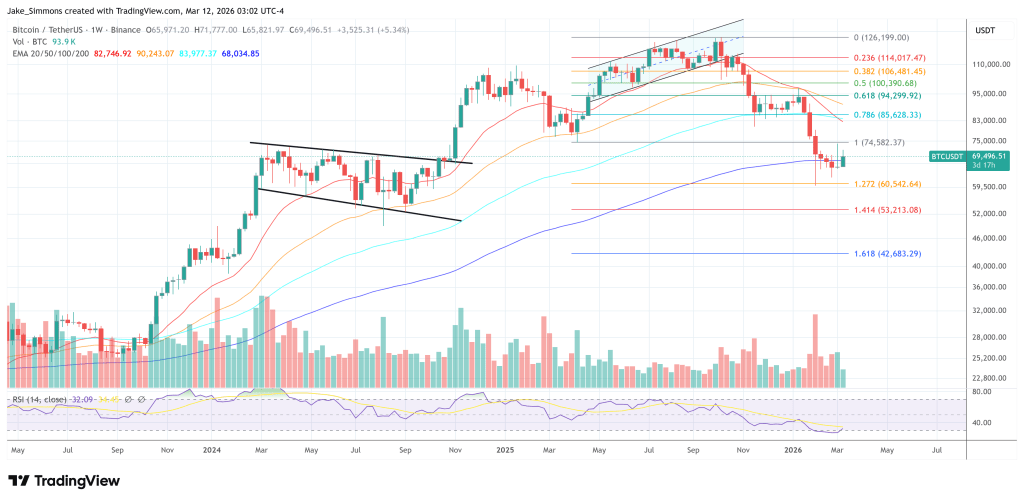
Bitcoin price chart
Bitcoin must break above the 1.0 Fib level, 1-week chart | Source: BTCUSDT on TradingView.com

Featured image created with DALL.E, chart from TradingView.com

Editorial Process for bitcoinist is centered on delivering thoroughly researched, accurate, and unbiased content. We uphold strict sourcing standards, and each page undergoes diligent review by our team of top technology experts and seasoned editors. This process ensures the integrity, relevance, and value of our content for our readers.



Source link

Share76Tweet47

Related Posts

XRP’s ‘Golden Ticket’ Might Not Be What You Think, Expert Says

XRP Negative Funding Continues, Crashes To Levels Not Seen Since 2022

by Moussa
March 12, 2026
0

The XRP funding rate has been on the decline after the price hit its 2025 peak above 2025, and this...

Cosmos Health (COSM) Buys $600,000 In Bitcoin

Cosmos Health (COSM) Buys $600,000 In Bitcoin

by Moussa
March 12, 2026
0

Cosmos Health Inc. announced it has purchased $600,000 worth of Bitcoin as part of its ongoing digital assets treasury strategy. ...

Hash2cash Bets on Tokenized Hashrate; Executive Rejects AI Pivot

Hash2cash Bets on Tokenized Hashrate; Executive Rejects AI Pivot

by Moussa
March 12, 2026
0

The bitcoin mining industry is facing a severe hashrate shakeout, leading many independent operators to cease operations. In response, Hash2cash...

How do Bitcoin mining pools typically handle payout frequency versus thresholds?

taproot – When — and why — did Bitcoin Script shift to a commit–reveal structure?

by Moussa
March 12, 2026
0

Re-reading the whitepaper, Section 2 describes ownership as transferring coins directly to the next owner's public key — which maps...

Pepe Price Analysis: Why April Could See a 200% ROI (And the Risks)

Pepe Price Analysis: Why April Could See a 200% ROI (And the Risks)

by Moussa
March 12, 2026
0

Pepe is currently sitting inside a technical pressure cooker. After a blistering run earlier in the cycle, the price has...

Load More

youssufi.com

sephina.com

[vc_row full_width="stretch_row" parallax="content-moving" vc_row_background="" background_repeat="no-repeat" background_position="center center" footer_scheme="dark" css=".vc_custom_1517813231908{padding-top: 60px !important;padding-bottom: 30px !important;background-color: #191818 !important;background-position: center;background-repeat: no-repeat !important;background-size: cover !important;}" footer_widget_title_color="#fcbf46" footer_button_bg="#fcb11e"][vc_column width="1/4"]

We bring you the latest in Crypto News

[/vc_column][vc_column width="1/4"][vc_wp_categories]
[/vc_column][vc_column width="1/4"][vc_wp_tagcloud taxonomy="post_tag"][/vc_column][vc_column width="1/4"]

Newsletter

[vc_raw_html]JTNDcCUzRSUzQ2RpdiUyMGNsYXNzJTNEJTIydG5wJTIwdG5wLXN1YnNjcmlwdGlvbiUyMiUzRSUwQSUzQ2Zvcm0lMjBtZXRob2QlM0QlMjJwb3N0JTIyJTIwYWN0aW9uJTNEJTIyaHR0cHMlM0ElMkYlMkZhcHByb3gub3JnJTJGJTNGbmElM0RzJTIyJTNFJTBBJTBBJTNDaW5wdXQlMjB0eXBlJTNEJTIyaGlkZGVuJTIyJTIwbmFtZSUzRCUyMm5sYW5nJTIyJTIwdmFsdWUlM0QlMjIlMjIlM0UlM0NkaXYlMjBjbGFzcyUzRCUyMnRucC1maWVsZCUyMHRucC1maWVsZC1maXJzdG5hbWUlMjIlM0UlM0NsYWJlbCUyMGZvciUzRCUyMnRucC0xJTIyJTNFRmlyc3QlMjBuYW1lJTIwb3IlMjBmdWxsJTIwbmFtZSUzQyUyRmxhYmVsJTNFJTBBJTNDaW5wdXQlMjBjbGFzcyUzRCUyMnRucC1uYW1lJTIyJTIwdHlwZSUzRCUyMnRleHQlMjIlMjBuYW1lJTNEJTIybm4lMjIlMjBpZCUzRCUyMnRucC0xJTIyJTIwdmFsdWUlM0QlMjIlMjIlM0UlM0MlMkZkaXYlM0UlMEElM0NkaXYlMjBjbGFzcyUzRCUyMnRucC1maWVsZCUyMHRucC1maWVsZC1lbWFpbCUyMiUzRSUzQ2xhYmVsJTIwZm9yJTNEJTIydG5wLTIlMjIlM0VFbWFpbCUzQyUyRmxhYmVsJTNFJTBBJTNDaW5wdXQlMjBjbGFzcyUzRCUyMnRucC1lbWFpbCUyMiUyMHR5cGUlM0QlMjJlbWFpbCUyMiUyMG5hbWUlM0QlMjJuZSUyMiUyMGlkJTNEJTIydG5wLTIlMjIlMjB2YWx1ZSUzRCUyMiUyMiUyMHJlcXVpcmVkJTNFJTNDJTJGZGl2JTNFJTBBJTNDZGl2JTIwY2xhc3MlM0QlMjJ0bnAtZmllbGQlMjB0bnAtcHJpdmFjeS1maWVsZCUyMiUzRSUzQ2xhYmVsJTNFJTNDaW5wdXQlMjB0eXBlJTNEJTIyY2hlY2tib3glMjIlMjBuYW1lJTNEJTIybnklMjIlMjByZXF1aXJlZCUyMGNsYXNzJTNEJTIydG5wLXByaXZhY3klMjIlM0UlQzIlQTBCeSUyMGNvbnRpbnVpbmclMkMlMjB5b3UlMjBhY2NlcHQlMjB0aGUlMjBwcml2YWN5JTIwcG9saWN5JTNDJTJGbGFiZWwlM0UlM0MlMkZkaXYlM0UlM0NkaXYlMjBjbGFzcyUzRCUyMnRucC1maWVsZCUyMHRucC1maWVsZC1idXR0b24lMjIlM0UlM0NpbnB1dCUyMGNsYXNzJTNEJTIydG5wLXN1Ym1pdCUyMiUyMHR5cGUlM0QlMjJzdWJtaXQlMjIlMjB2YWx1ZSUzRCUyMlN1YnNjcmliZSUyMiUyMCUzRSUwQSUzQyUyRmRpdiUzRSUwQSUzQyUyRmZvcm0lM0UlMEElM0MlMkZkaXYlM0UlM0NiciUyRiUzRSUzQyUyRnAlM0U=[/vc_raw_html][/vc_column][/vc_row]
No Result
View All Result
  • Contact Us
  • Homepages
  • Business
  • Guide

© 2024 APPROX FOUNDATION - The Crypto Currency News