



• About
  • FAQ
  • Earn Bitcoin while Surfing the net
  • Buy & Sell Crypto on Paxful
Newsletter
Approx Foundation
  • Home
    • Home – Layout 1
  • Bitcoin
  • Ethereum
  • Regulation
  • Market
  • Blockchain
  • Business
  • Guide
  • Contact Us
No Result
View All Result
  • Home
    • Home – Layout 1
  • Bitcoin
  • Ethereum
  • Regulation
  • Market
  • Blockchain
  • Business
  • Guide
  • Contact Us
No Result
View All Result
Approx Foundation
No Result
View All Result
Home Regulation

Vitalik Buterin suggests 10X increase in Ethereum gas limit to support L2 growth and censorship resistance

Moussa by Moussa
February 14, 2025
in Regulation
0
Vitalik Buterin suggests 10X increase in Ethereum gas limit to support L2 growth and censorship resistance
189
SHARES
1.5k
VIEWS
Share on FacebookShare on Twitter


Vitalik Buterin has argued that increasing Ethereum’s L1 gas capacity is necessary to support transaction inclusion and application development when most activity occurs on L2. In a new blog post, Buterin outlined calculations suggesting that a roughly 10× expansion in L1 capacity would preserve key network functions even as applications migrate to Layer 2 solutions.

The gas limit defines the maximum amount of computational work that can be performed in a single block, setting an upper bound on the transactions and operations processed. Increasing the gas limit expands the protocol’s capacity to process more computational work per block, allowing it to handle a higher volume of transactions and more complex operations while influencing fee dynamics.

Recent 20% increase in gas limit

Buterin’s analysis builds on the recent increase in the L1 gas limit from 30 million to 36 million, which raises capacity by 20%.

Buterin noted that further increases, enabled by efficiency improvements in Ethereum clients, reduced history storage from EIP-4444, and eventual adoption of stateless clients, could offer long-term benefits. His discussion frames the debate over scaling by comparing current gas needs with more ideal scenarios across several use cases.

As Buterin reported, censorship resistance remains a critical function. He demonstrated that bypass transactions—designed to overcome potential censorship on L2—could cost approximately $4.50 at current gas prices. By scaling L1 capacity by roughly 4.5×, these costs could be driven down, ensuring that valid transactions reach the blockchain promptly even under congestion. In a similar vein, cross-L2 asset movements, including transfers of high-volume assets and NFTs, currently incur costs near $14 per operation.

Buterin’s estimates suggest that with improved design and a scaling factor of about 5.5× to 6×, such transactions might be executed at a fraction of that cost, potentially as low as $0.28 in an ideal setup.

Mass exits from L2s

Buterin’s analysis extends to scenarios involving mass exits from L2. An exit refers to the operation by which users withdraw their assets from a Layer 2 solution back to Ethereum’s main chain (L1), typically to safeguard funds during network disruptions or other emergencies.

He calculated that under current parameters, an exit requiring 120,000 gas per user would allow between 7.56 million and 32.4 million users to exit over a one-week to 30-day period, depending on the roll-up design. With optimized protocols—reducing the cost per exit operation to approximately 7,500 gas—the number of users able to exit safely could increase substantially, supporting millions more and reducing the risk of liquidity or security issues during periods of network stress.

Addressing token issuance, Buterin observed that many new ERC20 tokens are launched on L2. However, tokens issued on L2 may be vulnerable if a hostile governance upgrade occurs, a risk mitigated by launching on L1. He cited examples such as the deployment of the Railgun token, where the cost was over 1.6 million gas.

Even if these costs were reduced to around 120,000 gas, the expense per issuance remains near $4.50, implying that a scaling factor up to 18× could be required for more widespread, cost-effective token launches that meet lower target fees.

The discussion also covered operations tied to keystore wallets. Buterin estimated that for widespread key updates—assuming 50,000 gas per operation—a 3.3× increase in gas capacity might be needed, though efficiency gains reducing the cost to around 7,500 gas per operation could lower this requirement to nearly 1.1×.

Similarly, frequent L2 proof submissions, necessary for maintaining up-to-date interoperability between chains, currently impose substantial costs that limit the number of viable L2s. With advanced aggregation protocols potentially lowering per-submission costs to about 10,000 gas, a scaling factor of roughly 10× would be needed to make regular L2-to-L1 updates economically viable.
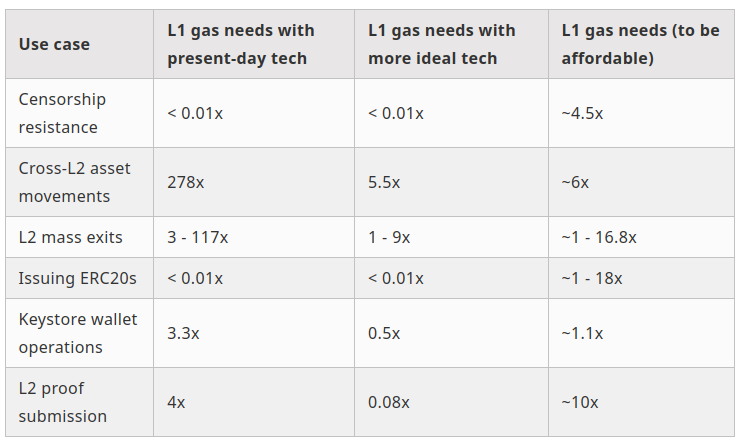
Vitalik Buterin L1 gas limit table (Source: Vitalik Buterin)

Buterin’s calculations highlight that despite most activity shifting to L2, maintaining robust L1 functionality is essential to preserve censorship resistance, enable efficient asset transfers, support mass exits, safeguard token issuance, and facilitate interoperability.

As Buterin concluded, increasing L1 gas capacity offers value by ensuring that fundamental blockchain operations remain secure and accessible even as network usage patterns evolve.

His analysis frames a clear argument for near-term scaling measures that could safeguard Ethereum’s core functions regardless of the long-term balance between L1 and L2 activity.

Mentioned in this article
BlocscaleBlocscale


Source link

Related articles

Ethereum loses 10% of its DeFi market share as rival chains close in

Ethereum loses 10% of its DeFi market share as rival chains close in

May 8, 2026
Ethereum’s biggest staker has just become a public company with over $10 billion locked up

Ethereum’s biggest staker has just become a public company with over $10 billion locked up

May 5, 2026
Share76Tweet47

Related Posts

Ethereum loses 10% of its DeFi market share as rival chains close in

Ethereum loses 10% of its DeFi market share as rival chains close in

by Moussa
May 8, 2026
0

Make CryptoSlate preferred on Ethereum's share of the total value locked (TVL) in DeFi compressed from 63.5% at the start...

Ethereum’s biggest staker has just become a public company with over $10 billion locked up

Ethereum’s biggest staker has just become a public company with over $10 billion locked up

by Moussa
May 5, 2026
0

Make CryptoSlate preferred on Bitmine has staked more than $10 billion in ETH, making it the largest corporate Ethereum treasury...

Aave says creditors are trying to seize stolen ETH before victims get their $71M back

Aave says creditors are trying to seize stolen ETH before victims get their $71M back

by Moussa
May 5, 2026
0

Make CryptoSlate preferred on Aave filed an emergency motion last week to free millions in frozen ETH from a restraining...

Soldøgn Interop Recap ☀️ | Ethereum Foundation Blog

Soldøgn Interop Recap ☀️ | Ethereum Foundation Blog

by Moussa
May 2, 2026
0

This past week, just over 100 Ethereum core contributors gathered above the Arctic Circle — in Longyearbyen, Svalbard — for...

Announcing Cohort 7 of the Ethereum Protocol Fellowship

Announcing Cohort 7 of the Ethereum Protocol Fellowship

by Moussa
April 30, 2026
0

TL;DR: We are excited to announce that applications are now open for the seventh cohort of the Ethereum Protocol Fellowship...

Load More

youssufi.com

sephina.com

[vc_row full_width="stretch_row" parallax="content-moving" vc_row_background="" background_repeat="no-repeat" background_position="center center" footer_scheme="dark" css=".vc_custom_1517813231908{padding-top: 60px !important;padding-bottom: 30px !important;background-color: #191818 !important;background-position: center;background-repeat: no-repeat !important;background-size: cover !important;}" footer_widget_title_color="#fcbf46" footer_button_bg="#fcb11e"][vc_column width="1/4"]

We bring you the latest in Crypto News

[/vc_column][vc_column width="1/4"][vc_wp_categories]
[/vc_column][vc_column width="1/4"][vc_wp_tagcloud taxonomy="post_tag"][/vc_column][vc_column width="1/4"]

Newsletter

[vc_raw_html]JTNDcCUzRSUzQ2RpdiUyMGNsYXNzJTNEJTIydG5wJTIwdG5wLXN1YnNjcmlwdGlvbiUyMiUzRSUwQSUzQ2Zvcm0lMjBtZXRob2QlM0QlMjJwb3N0JTIyJTIwYWN0aW9uJTNEJTIyaHR0cHMlM0ElMkYlMkZhcHByb3gub3JnJTJGJTNGbmElM0RzJTIyJTNFJTBBJTBBJTNDaW5wdXQlMjB0eXBlJTNEJTIyaGlkZGVuJTIyJTIwbmFtZSUzRCUyMm5sYW5nJTIyJTIwdmFsdWUlM0QlMjIlMjIlM0UlM0NkaXYlMjBjbGFzcyUzRCUyMnRucC1maWVsZCUyMHRucC1maWVsZC1maXJzdG5hbWUlMjIlM0UlM0NsYWJlbCUyMGZvciUzRCUyMnRucC0xJTIyJTNFRmlyc3QlMjBuYW1lJTIwb3IlMjBmdWxsJTIwbmFtZSUzQyUyRmxhYmVsJTNFJTBBJTNDaW5wdXQlMjBjbGFzcyUzRCUyMnRucC1uYW1lJTIyJTIwdHlwZSUzRCUyMnRleHQlMjIlMjBuYW1lJTNEJTIybm4lMjIlMjBpZCUzRCUyMnRucC0xJTIyJTIwdmFsdWUlM0QlMjIlMjIlM0UlM0MlMkZkaXYlM0UlMEElM0NkaXYlMjBjbGFzcyUzRCUyMnRucC1maWVsZCUyMHRucC1maWVsZC1lbWFpbCUyMiUzRSUzQ2xhYmVsJTIwZm9yJTNEJTIydG5wLTIlMjIlM0VFbWFpbCUzQyUyRmxhYmVsJTNFJTBBJTNDaW5wdXQlMjBjbGFzcyUzRCUyMnRucC1lbWFpbCUyMiUyMHR5cGUlM0QlMjJlbWFpbCUyMiUyMG5hbWUlM0QlMjJuZSUyMiUyMGlkJTNEJTIydG5wLTIlMjIlMjB2YWx1ZSUzRCUyMiUyMiUyMHJlcXVpcmVkJTNFJTNDJTJGZGl2JTNFJTBBJTNDZGl2JTIwY2xhc3MlM0QlMjJ0bnAtZmllbGQlMjB0bnAtcHJpdmFjeS1maWVsZCUyMiUzRSUzQ2xhYmVsJTNFJTNDaW5wdXQlMjB0eXBlJTNEJTIyY2hlY2tib3glMjIlMjBuYW1lJTNEJTIybnklMjIlMjByZXF1aXJlZCUyMGNsYXNzJTNEJTIydG5wLXByaXZhY3klMjIlM0UlQzIlQTBCeSUyMGNvbnRpbnVpbmclMkMlMjB5b3UlMjBhY2NlcHQlMjB0aGUlMjBwcml2YWN5JTIwcG9saWN5JTNDJTJGbGFiZWwlM0UlM0MlMkZkaXYlM0UlM0NkaXYlMjBjbGFzcyUzRCUyMnRucC1maWVsZCUyMHRucC1maWVsZC1idXR0b24lMjIlM0UlM0NpbnB1dCUyMGNsYXNzJTNEJTIydG5wLXN1Ym1pdCUyMiUyMHR5cGUlM0QlMjJzdWJtaXQlMjIlMjB2YWx1ZSUzRCUyMlN1YnNjcmliZSUyMiUyMCUzRSUwQSUzQyUyRmRpdiUzRSUwQSUzQyUyRmZvcm0lM0UlMEElM0MlMkZkaXYlM0UlM0NiciUyRiUzRSUzQyUyRnAlM0U=[/vc_raw_html][/vc_column][/vc_row]
No Result
View All Result
  • Contact Us
  • Homepages
  • Business
  • Guide

© 2024 APPROX FOUNDATION - The Crypto Currency News