



The Swarm Team is pleased to announce the immediate release of Swarm client v0.3, the third proof-of-concept release (POC3) of the Ethereum Swarm client. The POC3 code is now merged into the official go-ethereum repository’s master branch.
Swarm 0.3 has been deployed to the public Testnet, and the Ethereum Foundation is running a 50-node strong cluster of Swarm nodes together with a public web gateway on https://swarm-gateways.net. We welcome everyone to try it out or commit to operate stable nodes.
The past year
It has been a year and a half since the first release of the POC2 series was deployed and the Swarm project launched its public alpha network.
Two Swarm summits, two orange papers and forty thousand lines of code later, it is time to take stock.
In the past year the Swarm team has grown in size and is now on fire delivering the vision. We have been busy redesigning the network layer, rewriting the retrieval protocol using a stream abstraction, rewriting connectivity management and the overlay network code as well as developed a sophisticated network simulation framework to test algorithmic correctness, scalability and fault tolerance of various subsystems.
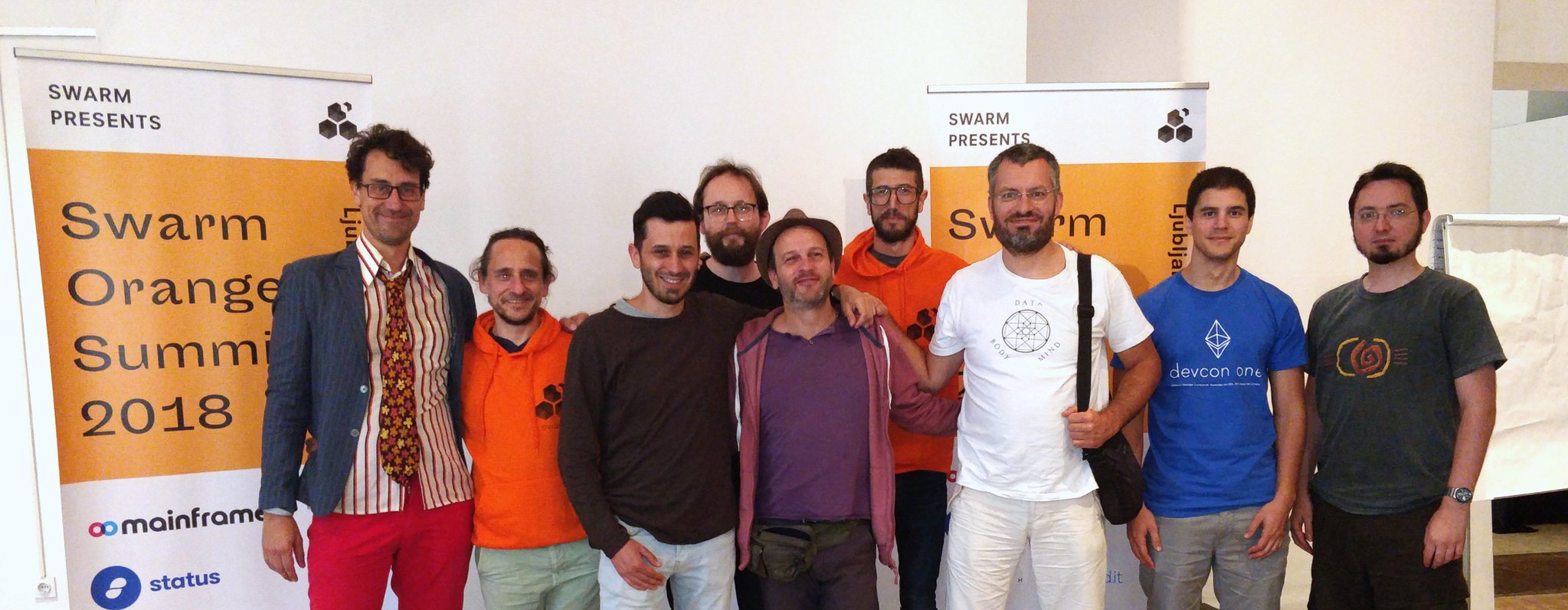
POC3 code was finalised just in time for the Swarm Orange Summit in Ljubljana, where we had 80 participants and a very inspiring and creative week (watch this two-minute video hosted on Swarm) of talks and coding. It is inspiring to see a growing number of contributors and companies that want to build on swarm.
Swarm 0.3
Swarm content storage is a lot more than just “bittorrent on steroids”. The technical details can be found in the chapter on architecture in the new and improved Swarm guide. You’ll find a more thorough academic presentation of Swarm’s components in the orange papers or learn more about Swarm through the recorded conference talks.
In an earlier blog post, we introduced the basics of Swarm storage and content distribution.
At its core, Swarm is a service that provides APIs to upload and download content to the cloud and through URL-based addressing offers virtual hosting of websites and decentralised applications (dapps) without webservers, using decentralised peer-to-peer distributed infrastructure. The vision is that of a new internet which is not only fault-tolerant, has zero downtime and offers censorship resistance but is also economically self-sustaining due to a built-in incentive system. By compensating nodes for contributing their bandwidth and disk space, these incentives aim to achieve reliable low-latency scalable retrieval of popular content on the one hand and guarantees persistence of important yet rarely accessed data like archives or backups on the other. For smooth delivery Swarm will use the SWAP protocol (planned for POC3.1) while for storage guarantees it will use a two-tiered insurance system (planned for POC4).
Beyond the basics of data storage and delivery, the POC 3 release includes some new and experimental features.
PSS
The same p2p connections that are used for data storage and delivery can also be used for node-to-node messaging. PSS combines Swarm routing (bzz) with the Whisper (shh) encrypted message format (bzz+shh=pss). In short, PSS is a messaging protocol with strong privacy features running on top of the Swarm network. This messaging infrastructure can be the foundation of a whole new system of internode communication services (the email, tweet, newsletter of the future), hence, can be referred to as Postal Service over Swarm.
PSS is fully featured yet experimental on the new POC3 network and dapps can interact with it using a JSON RPC API. We are collaborating closely with companies and projects that want to use pss to build second-layer infrastructure. Mainframe is building a slack-alternative collaborative group communications tool (Onyx) and their web3 SDK, and Status have expressed interest in building it into their mobile chat.
Mutability
Another experimental new feature in POC3 is the Swarm Mutable Resource.
Typical in p2p storage systems, content is addressed by its digital fingerprint (hash) and any changes to the content results in a change of this address. Users of the web, however, are accustomed to mutable resources: when visiting URLs we expect to see the most up-to-date version of the ‘site’. In order to make it easy to access changing content at permanent human-readable addresses, Swarm integrates with the Ethereum Name Service (ENS) on the Ethereum blockchain. This is what allows us to reference Swarm content by names like bzz://theswarm.eth.
Swarm POC3 adds another layer in the form of Mutable Resource Updates (MRU). These allow off-chain updates of content associated with an address at a potentially faster pace than ENS updates on the blockchain could support and without incurring the cost of on-chain transactions.
MRU is an experimental feature in current POC3 testnet and is still undergoing changes.
FUSE support
FUSE enables users to integrate Swarm data directly into their local file systems (only on Linux and Mac). Using this system, users can “mount a Swarm manifest” as if it were a regular directory. It supports file system read and write operations, in which all content is automatically synced with the Swarm.
In future, combining FUSE with Swarm Mutable Resources, it should be possible, for example, to sync your entire home folder between devices – the backend to a decentralised storage with a Dropbox-like functionality.
Encryption support
Swarm 0.3 comes with built-in encryption allowing for secure uploads of private data. The way encryption works users can upload a directory privately and still ‘share’ a subdirectory with specific peers.
Access Control Trees (Swarm 0.3.2) will offer an API for users to manage access to content independently of publishing it. Granted access will work across versions of resources.
The year ahead
The year ahead will be both exciting and challenging. As part of the POC3 series we are planning to switch on a revamped SWAP accounting system (Swarm 0.3.1) and enable ‘light’ Swarm nodes (Swarm 0.3.2).
Implementing erasure coding, proof of custody, insurance are also on the roadmap.
We are on target delivering Swarm POC4 (production beta prerelease) in 2019.
We keep on building a community with our allies who champion the values of web3 and actively collaborate through working groups, building the foundational infrastructure, the backbone of second-layer services such as databases (http://wolk.com), private data management (http://datafund.io), rights and creative works licensing (http://jaak.io), decentralised version control (ethergit, http://epiclabs.io), video transcoding and streaming service (http://livepeer.org), communication and collaboration (https://mainframe.com) and the list is growing.
Contact Us
We welcome your feedback and contribution. Come find us in our gitter channel or our github repository.