


Morgan Stanley’s decision to file for spot Bitcoin and Solana ETFs caught even seasoned ETF watchers off guard and in Jeff Park’s telling, it’s a stronger signal about crypto’s next leg of adoption than another round of flows into the existing market leaders.
The surprise wasn’t merely that a major wirehouse wants in. It was the branding and the timing. Bloomberg Intelligence ETF analyst James Seyffart said he “didn’t see this coming,” amplifying Eric Balchunas’ “SHOCKER” reaction to the filings. Seyffart then pointed to Matt Hougan’s framing of what made it unusual: “Morgan Stanley manages 20 ETFs, but mostly under the Calvert/Parametric/Eaton Vance brands. These will be the 3rd and 4th ETFs to bear the ‘Morgan Stanley’ brand. Pretty remarkable.”
Park, the head of alpha strategies at Bitwise and ProCap CIO, argues the late-cycle entry is precisely why the filing matters. “It is unheard of for a vanilla ETF product to launch two years after the first to market has already secured the liquidity throne,” he wrote. “IAU famously tried a year later, and never caught up.” Park’s point was that Morgan Stanley wouldn’t make that bet unless internal channels were flashing something the broader market still underestimates.
Why This Is ‘The Most Bullish Thing’ For Bitcoin
Park framed the filing as a total addressable market story, not a product story. “It means the market is MUCH bigger than even crypto professionals anticipated, especially to reach NEW customers,” he said.
“This signals that despite IBIT being the fastest ETF in history to reach $80Bn in AUM (roughly 1/5th the time it took for second place VOO), there is enough untapped interest as viably researched and ascertained through MS’ proprietary wealth channels that they are willing to bet that a branded product has commercial viability.” He finished that thought with the kind of line that reads like a thesis statement for 2026: “It means we are still so early.”
Related Reading
The “why now” also fits with Seyffart’s longer-running view that institutional platforms would eventually shift. “I’ve been saying for literal years that most of these firms will change their tune on crypto,” he wrote. “But it really was just a couple months ago that Morgan Stanley advisors were barred from buying crypto ETFs for their clients.” In other words: the timeline is compressing, and the posture is moving from cautious access to product ownership.
Park’s second argument is that Morgan Stanley is treating Bitcoin as an identity product as much as an allocation sleeve. “It means that Bitcoin is ‘socially’ important just as much as it is ‘financially’ important as a product to offer to customers,” he wrote.
“Consider the fact that for being ‘digital gold’ there are virtually no branded gold ETFs in existence, yet for Bitcoin there is.” In his view, that difference is the tell: a house-branded Bitcoin ETF isn’t only about exposure, it’s about what the firm signals to clients and recruits by having it at all.
Park argued the branding functions as a credibility marker with a specific audience in mind. “This is because every asset manager knows that having a Bitcoin ETF communicates that they are forward thinking, young, and a little edgy that allows targeting the most challenging investor cohort that everyone wants to reach: UHNW Independent Investors,” he said.“
Related Reading
Morgan Stanley is making the bet that even if their ETF doesn’t scale to blockbuster success, there’s an intangible benefit that will help build their clout.”
The third pillar is defensive: platform economics. “It is at the core a defensive move against platform disintermediation and fee leakage,” Park wrote. “By launching their own BTC ETF after IBIT already consolidated liquidity, Morgan Stanley is implicitly acknowledging a hard truth: DISTRIBUTION owns the customer, not product superiority.”
He added why that matters strategically: “They are not going to let advisors default to third parties by outsourcing the economic rent. That’s why at first glance while this launch looks irrational through a pure AUM lens, also totally inevitable through a PLATFORM ECONOMICS lens.”
That logic also surfaced in Seyffart’s exchange with James Van Straten, who asked why anyone would be surprised if a firm has “own distribution” and “huge demand from clients.” Seyffart’s answer didn’t dispute demand; it underscored that Morgan Stanley historically “doesn’t do a ton of ETF launches,” and that the decision to do so here is itself informative, even if, as he put it, “there’s plenty of demand” for many products that platforms never bother to manufacture.
On timing, Seyffart said approval is “at least 75 days from now,” emphasizing that 75 days can be the fastest possible path under current processes, but also that “there’s plenty of products that don’t launch right at 75 days.”
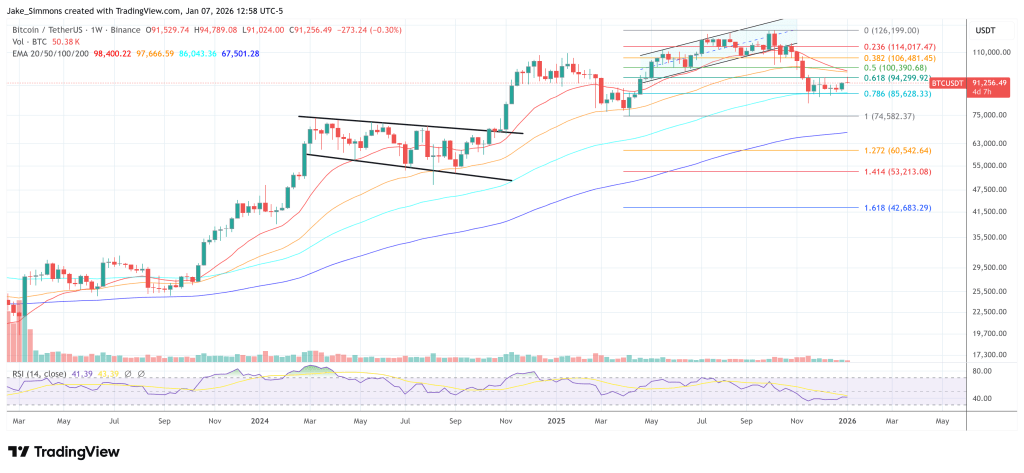
At press time, Bitcoin traded at $91,256.
Featured image created with DALL.E, chart from TradingView.com