



Join Our Telegram channel to stay up to date on breaking news coverage
The Bitcoin price has dropped 7% over the last 24 hours to $83,237, as JPMorgan analysts explain that the latest weakness in the cryptocurrency is driven more by short-term market sentiment and liquidity conditions than by the recent decline in the US dollar.
Despite the greenback losing ground, Bitcoin has failed to stage its usual inverse rally, highlighting its current behavior as a risk-sensitive asset rather than a traditional hedge against currency weakness.
JPMorgan analysts note that the U.S. dollar’s recent slide has been driven mainly by short-term capital flows, tariffs, and shifts in investor sentiment, rather than any meaningful change in growth prospects or the Federal Reserve’s policy outlook.
Although the dollar index (DXY) has fallen roughly 10% over the past year, strategists point out that interest rate differentials have actually moved in favor of the US since the beginning of the year. This shows the dollar’s weakness may be temporary, similar to the brief decline seen last April, with stabilization expected as the U.S. economy shows resilience.
Weaker dollar fails to spur Bitcoin gains, but there’s a reason for that, JPMorgan says
Dollar declining but Bitcoin flat: JPMorgan identifies structural shift in crypto correlations. Historic “digital gold” narrative challenged when traditional safe-haven behavior disappears.…
— Dr Efi Pylarinou (@efipm) January 29, 2026
Bitcoin Remains Tied to Risk Sentiment
JPMorgan further argues that Bitcoin’s underperformance highlights how investors currently perceive the asset. Instead of functioning as a store of value like gold, Bitcoin continues to trade in line with broader risk sentiment and global liquidity trends.
This was evident after the Federal Reserve kept interest rates unchanged and Chair Jerome Powell maintained a hawkish stance, which weighed on risk assets, including cryptocurrencies. In contrast, gold and other hard assets have rallied strongly amid the same dollar weakness, benefiting from their established role as macro hedges.
JPMORGAN: #BITCOIN FAILS TO RALLY DESPITE 10% DROP IN DOLLAR INDEX
JPMorgan Private Bank notes that while the U.S. Dollar Index has fallen 10% over the past year, #Bitcoin is down 13%, breaking its #usual inverse correlation with dollar weakness. Analysts say the dollar’s… pic.twitter.com/yfmQU6uiEv
— CryptOpus (@ImCryptOpus) January 29, 2026
Looking ahead, JPMorgan expects Bitcoin to lag traditional inflation and currency hedges until macro fundamentals, such as shifts in growth expectations or interest rate dynamics, take over. For now, subdued trading volumes and the upcoming crypto options expiry continue to limit upside momentum for BTC.
Bitcoin Breaks Key Support at $85K as RSI Signals Oversold Levels
The Bitcoin price has broken below a key support zone around $85,000, signaling a bearish breakout on the 4-hour chart. The move comes after a period of sideways consolidation within this major support area, indicating that the previous level of buyer interest failed to hold. The breakout is accompanied by a sharp price drop to $83,397, highlighting increased selling pressure in the short term.
The Relative Strength Index (RSI) has fallen to 23.27, entering deeply oversold territory. This suggests that while sellers are dominant, the market may be due for a temporary relief bounce or consolidation, though the prevailing trend remains bearish until support levels are regained. Historically, similar breaks below major support zones have often led to accelerated downside moves, meaning traders should be cautious of further declines.
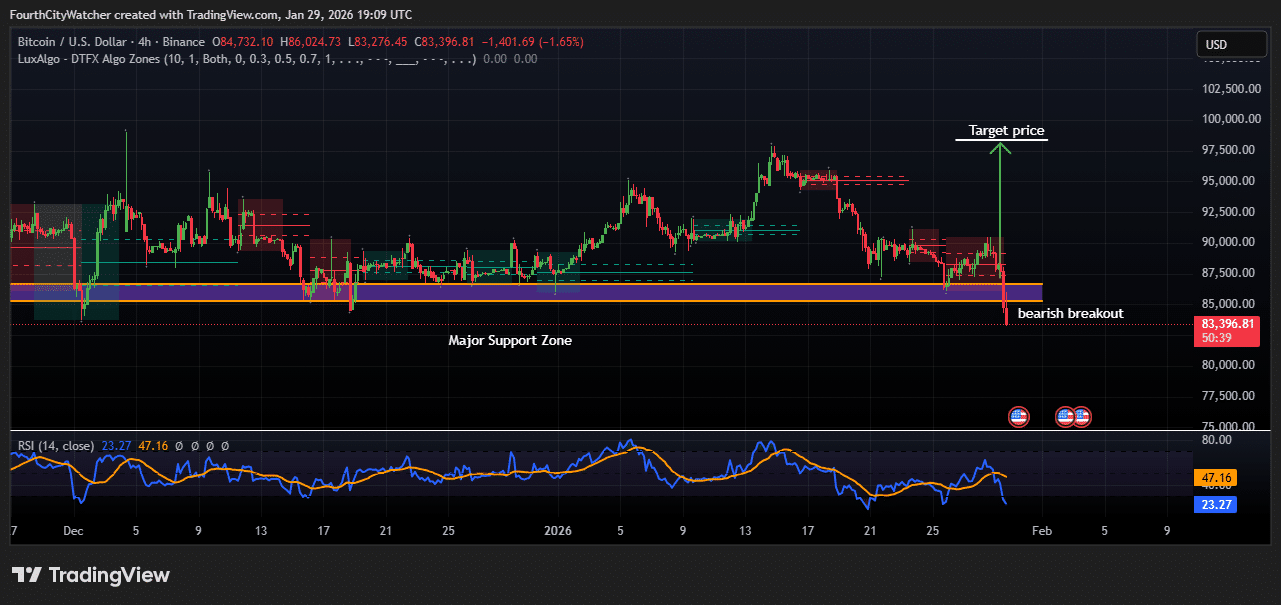
BTCUSD Chart Analysis. Source: Tradingview
Bitcoin Faces Short-Term Downside
Resistance from prior price congestion appears near $87,500–$88,000, which could act as a short-term ceiling if a corrective rebound occurs. The chart also indicates a longer-term target price above $95,000, but reaching this level would require a significant reversal in momentum and reclaiming previously lost support.
For now, the combination of a bearish breakout, oversold RSI, and failure to maintain the support zone positions Bitcoin as vulnerable to further short-term downside, while highlighting that any bounce could be met with strong selling pressure.
Overall, the technical picture favors sellers, with the major support zone now acting as a potential reference point for monitoring market reaction. Traders should watch for RSI recovery signals and price action around the broken support to identify potential reversal opportunities or continuation of the downtrend.
Related Articles:
Best Wallet – Diversify Your Crypto Portfolio

- Easy to Use, Feature-Driven Crypto Wallet
- Get Early Access to Upcoming Token ICOs
- Multi-Chain, Multi-Wallet, Non-Custodial
- Now On App Store, Google Play
- Stake To Earn Native Token $BEST
- 250,000+ Monthly Active Users
Join Our Telegram channel to stay up to date on breaking news coverage