




A resurfaced clip from Ripple CEO Brad Garlinghouse’s appearance at XRP Australia Sydney 2026 is drawing fresh attention after he linked Ripple’s early battles to material in the latest Epstein document release. The comment matters because it reframes Ripple’s long-running grievance in Washington and in crypto itself as something deeper than routine rivalry: a sign, Garlinghouse suggested, that parts of the industry saw Ripple as a real threat.


Speaking on stage in Sydney on Feb. 27, Garlinghouse said Ripple co-founder Chris Larsen had long sounded “a little conspiratorial” about the forces lining up against the company. Then he added:
“Now that we have seen the public Epstein files, you’re like, holy shit, he’s kind of right. And what’s interesting about it, they were afraid of us. They were afraid of us because the technology was ahead of its time and it was a threat. And they were trying to do things to put pressure on it. And again, I don’t think I totally appreciated in the earliest days how prescient some of Chris’s concerns were about that stuff. But in retrospect, it was.”
🫡 @bgarlinghouse reveals:
“We laughed off @chrislarsensf‘s conspiracy theories back then. Then the Epstein files dropped.
Holy sh*t he was right.
They were afraid of us. The technology was ahead of its time, and powerful people were actively trying to suppress it. #XRP pic.twitter.com/qKVriTd262
— Xaif Crypto🇮🇳|🇺🇸 (@Xaif_Crypto) March 7, 2026
The Connection Between Ripple And Epstein
The video is only now circulating widely in XRP circles, but the backdrop is the Justice Department’s Jan. 30 release of more than 3 million additional pages under the Epstein Files Transparency Act.
Expert Claims Ripple Is Next to Secure Fed Master Account After Kraken Win— Here’s Why
What, exactly, is the Ripple connection? Not a disclosed business partnership with Epstein, and not evidence that Epstein directed action against Ripple. The link comes from a 2014 email that surfaced in the file dump. Austin Hill, then a Blockstream co-founder, emailed Jeffrey Epstein and Joichi Ito, with Reid Hoffman copied, to complain about investor support for Ripple and Stellar. The email framed those rival projects as harmful to the Bitcoin-focused ecosystem Blockstream was trying to build and pushed recipients to reconsider their allocations.
That distinction is crucial. Ripple appears in the documents because it was part of an early power struggle over which crypto networks and companies would win capital, talent and legitimacy. In one quoted passage from the 2014 correspondence, Hill wrote: “Ripple, and Jed’s new Stellar are bad for the ecosystem we are building, and it does our company damage to have investors who are backing two horses in the same race.” He then reportedly urged investors to “reduce or take your allocation away,” effectively forcing a choice.
The context around Epstein’s presence on that chain is also more mundane, if no less uncomfortable for the industry. Fortune reported that emails in the DOJ release show Epstein had exposure to Blockstream through a fund associated with former MIT Media Lab director Joi Ito, while the broader file dump has renewed scrutiny of Epstein’s ties to early crypto investors, Bitcoin development circles and MIT-linked networks.
That helps explain Garlinghouse’s argument. His point was not that Epstein personally ran an anti-Ripple operation. It was that the newly public records seem to validate a long-held suspicion inside Ripple: that influential figures in the early Bitcoin orbit treated Ripple as something to be boxed out, not merely debated. Still, the released documentation stops well short of proving coordination with regulators or a hidden hand behind the SEC’s later case against Ripple.
At press time, XRP traded at $1.34.
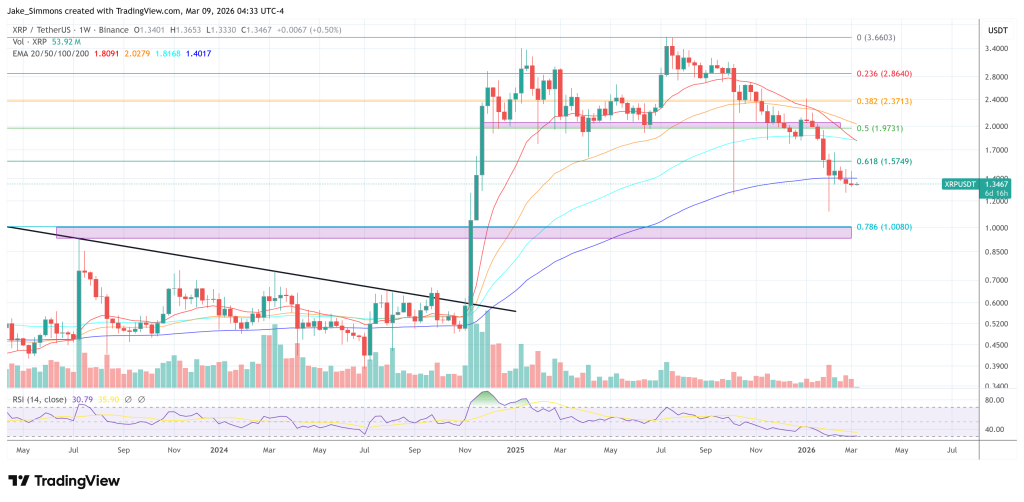
Featured image created with DALL.E, chart from TradingView.com


Editorial Process for bitcoinist is centered on delivering thoroughly researched, accurate, and unbiased content. We uphold strict sourcing standards, and each page undergoes diligent review by our team of top technology experts and seasoned editors. This process ensures the integrity, relevance, and value of our content for our readers.