



Ethereum and Solana are once again under close watch as fresh data reveals how both networks are performing, with recent fee metrics and on-chain activity offering a clearer picture of where momentum currently sits.
Ethereum Vs. Solana: Fee Dominance And Growing Activity
Recent figures directly address how both networks compare, showing Ethereum building a clear lead in economic activity. Data shared on April 24, 2026, by @ETH_Daily revealed that Ethereum had been generating more total fees than Solana for over a week. In the most recent 24-hour snapshot, Ethereum recorded approximately $2.7 million in fees, while Solana produced about $70,000. This 40 times gap highlights a sustained difference rather than a short-term fluctuation.
Related Reading
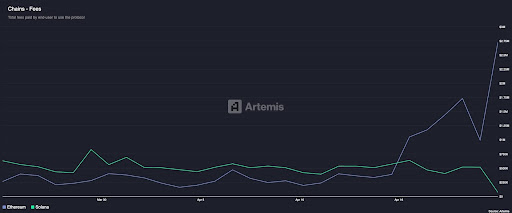
The fee chart tied to this update provides further clarity. Ethereum’s fee levels, which had been moving within moderate ranges earlier in the period, surged sharply toward nearly $2.75 million. In contrast, Solana’s fees fluctuated within a tighter band before declining significantly, eventually approaching minimal levels.
Beyond fees, on-chain data adds another layer to the comparison. On April 27, 2026, @CryptoQuant reported that Ethereum’s active addresses had climbed to record highs even as its price moved lower. The dataset, attributed to CryptoOnchain, shows activity nearing 600,000 addresses while price levels remain below previous peaks near $4,000 and closer to around $2,300. This divergence between rising participation and softer price action suggests that Ethereum’s usage is expanding independently of market valuation.
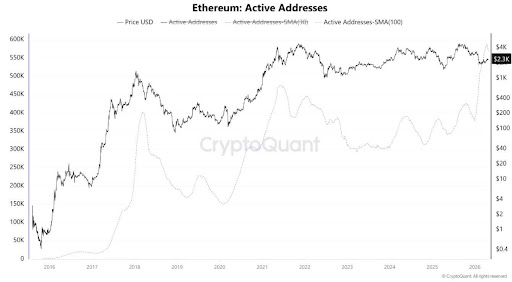
The combination of strong fee generation and increasing address activity points to growing demand, particularly in areas involving higher-value transactions and decentralized finance. The fact that users continue to transact despite higher costs indicates that Ethereum is capturing a larger share of meaningful economic activity.
Ethereum Vs. Solana: Usage Patterns And Market Signals
Looking at the same period, Solana’s performance reflects a different activity structure. The network’s lower fee output suggests that transaction values are comparatively smaller or that overall high-value usage has declined. This does not diminish its role in the market, but it does highlight a gap when measured by revenue generated from network use.
Related Reading
The contrast becomes more defined when aligning both fee data and on-chain signals. Ethereum’s sustained lead in fees over more than a week indicates consistent demand for its block space, while Solana’s lower figures point to a network where activity is either less monetized or concentrated in lower-cost transactions. This difference is significant because fees are often viewed as a direct reflection of how much value users are moving across a blockchain.
At the same time, the divergence identified by CryptoQuant reinforces Ethereum’s position, with rising active addresses during a period of price weakness signaling sustained engagement. No comparable signal appears for Solana in the same dataset, leaving Ethereum with clearer indicators of growing usage. Overall, the data shows Ethereum with stronger underlying activity and higher economic throughput, while Solana reflects more moderately monetized usage during this period.
Featured image from Dune Analytics, chart from TradingView.com