

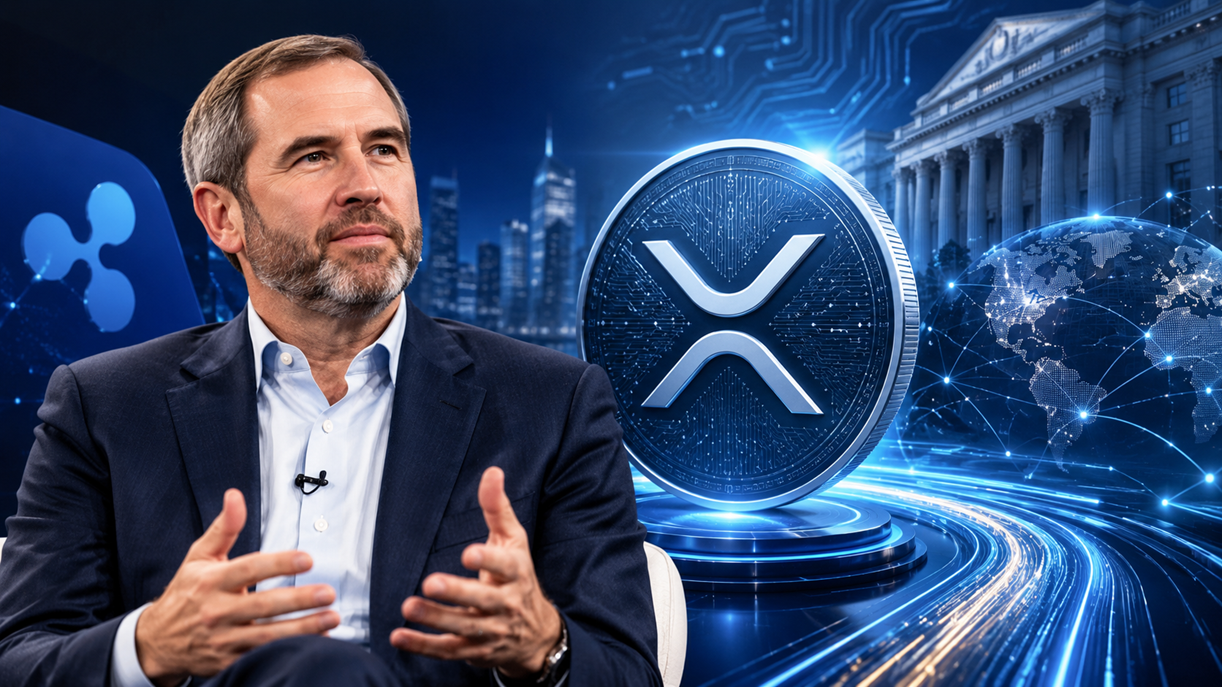


Ripple CEO Brad Garlinghouse used a Consensus 2026 interview with CoinDesk to frame the XRP community as one of crypto’s most durable forces, while warning that chain maximalism remains a drag on the industry’s broader adoption story.


Speaking after a period of major dealmaking for Ripple, Garlinghouse said the company’s recent acquisitions and product expansion are meant to deepen the practical use of XRP, not simply amplify market speculation. He also argued that the crypto industry is entering a more institutionally relevant phase, with tokenization, collateral use cases and traditional finance partnerships becoming central themes.
Garlinghouse Says XRP Community Is At Its Most Active Point
Asked about Ripple’s brand and the unusually loyal online base around XRP, Garlinghouse pointed to the community as one of crypto’s defining strengths. He said the industry has moved a long way from the period when “crypto” was still treated as a reputational risk in traditional finance circles.
“I remember the first time I went to Davos, I ran into a central banker from another country,” Garlinghouse said. “He’d met with him previously. He’s like, I’m surprised you’re here. You know, here crypto is still a bad word. That was about seven years ago.”
That perception, he argued, has changed substantially. Crypto is no longer operating only at the margins of finance, and communities like the XRP Army have helped sustain networks through regulatory conflict, market drawdowns and long product cycles.
“On the topic of the XRP army, look, one of the greatest things about crypto in general is the community behind it,” Garlinghouse said. “The people who see the opportunity for rewiring financial infrastructure, using technologies that reduce cost and improve speed. Like these are unlocks like the XRP army has been an unbelievable supportive group of allies.”
Garlinghouse said he had recently attended XRP Las Vegas and described the ecosystem’s energy as unusually strong. “It was the most vibrant, the most active that that community has ever been,” he said. “It was really spectacular.”
Ripple CEO Pushes Back On One-Chain Thinking
At the same time, Garlinghouse drew a line between community strength and tribalism. While Ripple has long been closely associated with XRP, he said the industry should not frame adoption as a zero-sum competition between networks.
“I have also said to that community and to the entire crypto community, tribalism is bad for our industry,” Garlinghouse said. “I’ve never been an XRP maxi. And people who are out there kind of just think it’s not going to be a one chain world. It’s going to be a multi-chain world.”
That remark matters because XRP remains one of the most polarizing large crypto assets, with a highly active supporter base and a long history of regulatory scrutiny in the United States. Garlinghouse’s message was not that XRP should become less central to Ripple’s strategy, but that the industry’s next growth phase will likely depend on interoperability, institutional trust and practical liquidity across multiple networks.
He made that point while emphasizing that Ripple still sees itself as a major advocate for the XRP ecosystem. “Ripple has always been the most interested advocate in the XRP ecosystem,” Garlinghouse said. “We own a ton of XRP that doesn’t give us control of XRP. We’re not proof of stake in how that architecture works.”
Acquisitions Framed As XRP Utility Push
Garlinghouse also linked Ripple’s acquisition strategy to XRP’s role in institutional markets. He said the company’s recent dealmaking, including its move into prime brokerage through Hidden Road, is designed to make XRP more usable as collateral across institutional platforms.
“All the acquisitions we’ve made, all the building we’re doing is in service of how do we accelerate the adoption, the usefulness of XRP, the liquidity of XRP and the trust of XRP,” he said.
Garlinghouse contrasted Ripple’s growth posture with crypto firms cutting headcount and attributing part of that shift to artificial intelligence. He said Ripple is using AI across finance, marketing, product targeting and engineering, but not as a headcount-reduction story.
“Our core code writing is now, I think the stat was around 75% is enabled one way or another or written by AI,” Garlinghouse said. He described AI as an accelerant for growth rather than a justification for layoffs.
On regulation, Garlinghouse remained optimistic that US crypto legislation could advance before the midterms, pointing to recent Senate momentum and the possibility of a markup in May. He said that if a bill gets out of committee, he sees a high likelihood of bipartisan support on the Senate floor.
At press time, XRP traded at $1.4258.
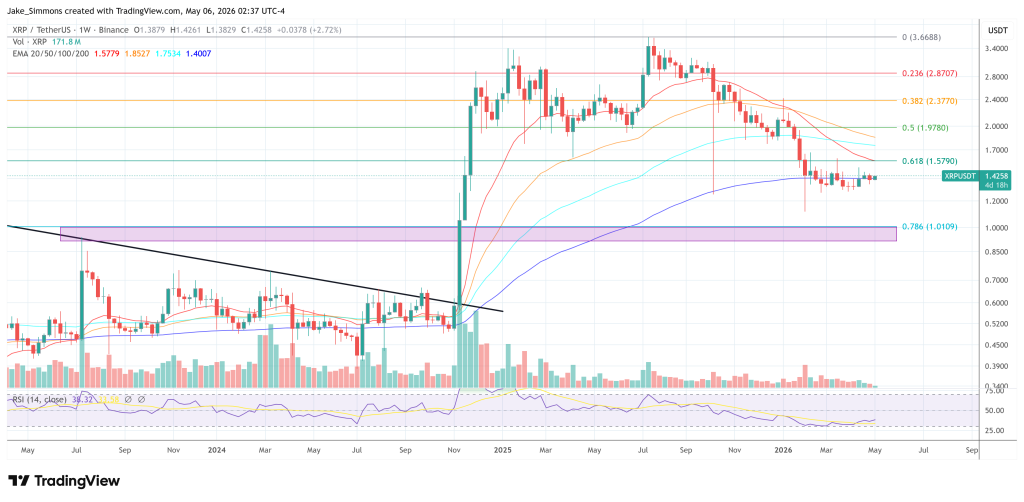
Featured image created with DALL.E, chart from TradingView.com


Editorial Process for bitcoinist is centered on delivering thoroughly researched, accurate, and unbiased content. We uphold strict sourcing standards, and each page undergoes diligent review by our team of top technology experts and seasoned editors. This process ensures the integrity, relevance, and value of our content for our readers.