


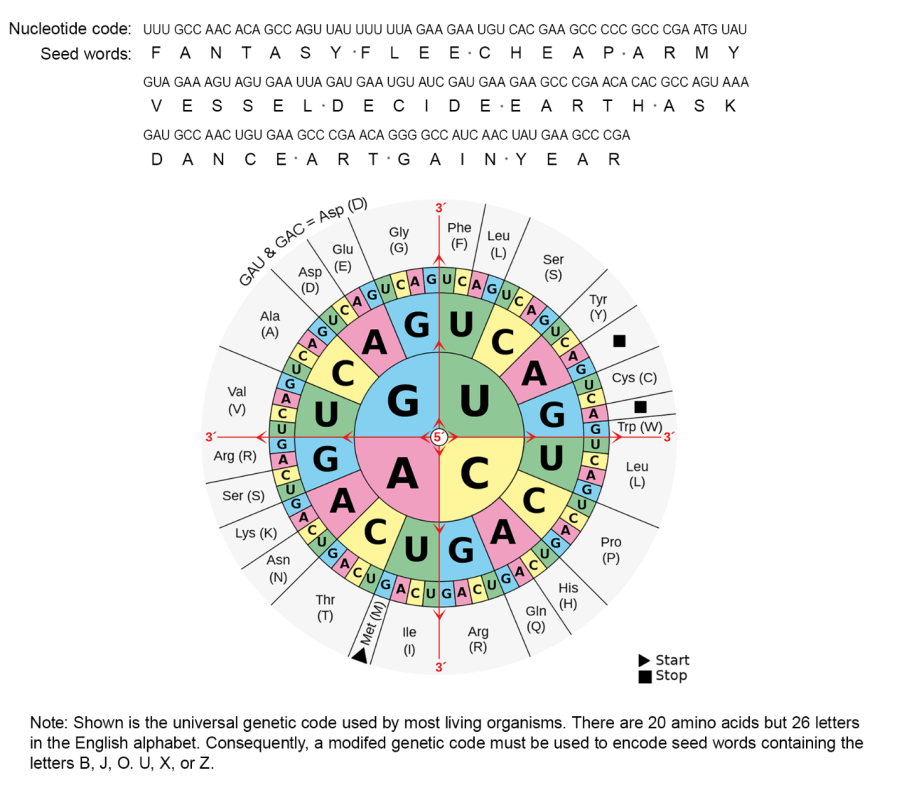
I recently converted a Bitcoin seed phrase into a DNA sequence, just because I can. Using only the first four letters of the BIP39 seed words, a 12-word seed phrase can be stored in a mere 48 nucleotides of DNA. (For comparison, the average gene is several thousand nucleotides long, and the complete human genome contains over 3 billion nucleotides). Any genetics graduate student could, in just a few days, turn my seed word sequence into an actual strand of DNA and insert that DNA into E. coli or some other suitable host for storage (and propagation) inside a living organism.




DNA is just one modality for storing and transmitting information. There are numerous other ways to do so and once information is widely distributed it is nearly impossible to extinguish, which is why it will be impossible to stop Bitcoin on a global scale with regulation, legislation, or even violence. The mere fact that you can store a bitcoin private key in DNA demonstrates the futility of attempting to ban Bitcoin. Once unleashed, information is hard to contain.

But why is information so hard to contain? Perhaps because information is a fundamental entity of the universe. For centuries scientists thought the universe was made only of matter and energy. Today, we know it is made of matter, energy, and information. Information can be stored in matter and transmitted using energy, but information itself is neither. Einstein showed us that matter and energy are interchangeable (E=mc2) but in toto cannot be created nor destroyed. By contrast, information can be created and destroyed, but neither is easy. And once information is created and widely distributed, it is increasingly difficult to destroy.

The Parts of Information
Information is meant to be sent and received between two or more parties. It is done with a purpose by the sender and is meant to spur action in the receiver. There are five hierarchical components to information:


- Fidelity
- Syntax (code or grammar)
- Semantics (meaning)
- Pragmatics (action)
- Apobetics (purpose)
Fidelity
Fidelity is the lowest element of information, but it is absolutely necessary for successful transmission. It was once a major issue for cell phone and internet communication. Remember the “Can you hear me now?” commercial? With technical advancements, low fidelity eventually became high fidelity (which weirdly became wireless fidelity, or Wi-Fi). Generally, we are not concerned with fidelity unless it is lacking. (Can you hear me now?)

The Code and Language
Syntax refers to the code or grammar used for transmitting information. A code is a set of symbols that represent temporally or spatially interconnectable bits of information. That is, symbols can be strung together in time or space to achieve the next level of information (semantics). The symbols used can vary tremendously. They include, among other things, the letters that make up an alphabet, hand gestures (e.g., American Sign Language), musical notes (e.g., those old modem connections and touch tone phones), or the nucleotides in DNA and RNA. The number of symbols used can vary, as well. Most alphabets use 20-35 letters, the nucleotide code uses four chemicals (abbreviated A, U, C, and G), and the binary code employed by computers has just two symbols (0 and 1) representing the on and off states. The number and type of symbols employed are not selected randomly. For instance, they may be determined by the mode of transmission or to meet a specific need (Table 1).
Table 1: Symbols may be chosen for mode of transmission or to meet a specific need.
A common code is essential for information to be successfully communicated. That is, the code must be known to both the sender and the receiver. Also, because the code is not itself the information but merely the purveyor of information, any particular code can be translated to any other code. For example, written human languages can be translated from one to another:
Go tell it on the mountain…
Va le dire sur la montagne…
Ve a contario en la montaña…
The above phrase can also be translated, using human eyes, brain, and mouth, from symbols on a page into sound waves (acoustic symbols) in the air, which can be picked up by a microphone and converted to electrical signals in wires and then to radio waves transmitted through space to be picked up by an antenna on the space station, turned back into electrical signals, and then converted by a speaker back into sound waves to be heard by the ears of another human. In the ears of our human astronaut, the signal is converted from waves of air to waves of fluid in the cochlea and then to electrical nerve impulses carried to the brain to be interpreted by neurons. In the brain, those neurons somehow make sense of the original string of symbols, which brings us to the next level of information: semantics or meaning.
Semantics, Pragmatics, and Apobetics
Semantics is the meaning or intent of a message (a string of symbols). The allocation of meaning to symbols is a mental process. This doesn’t happen at the machine level but at the human level. When you read a book, you are not interested in fidelity (unless it is lacking) or syntax (unless the grammar is horrible or it’s a language you do not understand). Instead, you are interested in the meaning conveyed by the message, i.e., the semantics. Although computers can store and transmit information with ease, and can even perform logic operations via transistors, they cannot meaningfully interpret information the way a human can. Do raspberry pi nodes, hardware wallets, or ASICs understand Bitcoin the way a human does? I think not.
The aim of meaningful communication is to prompt some action in the recipient. This aim for action represents the pragmatic level of information. The reason the sender wishes to prompt this response is the purpose of the information, which is the apobetic level of information. These highest levels of information require genuine intelligence on both parties, even a will. Whether or not computers can ever possess a will remains to be seen.
“Go tell it on the mountain…” is a string of symbols (code) that create a meaningful message (semantics) with the sender expecting (apobetics) some response from the receiver (pragmatics). The message can only be received if transmitted adequately (good fidelity).
Bitcoin as Information
Bitcoin (the program) is computer code written in a particular coding language. From the software to the blockchain to the key pairs of wallets, bitcoin is information. This information can be stored, transmitted, and replicated in flash drives, printed books, or DNA molecules. Because it is now so widely dispersed, it is virtually impossible at this point to destroy. Politicians and bankers may not like it, but the genie is out of the bottle and cannot be stopped now. As they say, you cannot ban Bitcoin, you can only ban yourself from using Bitcoin.
Fidelity and syntax are the operational parts of information. Semantics, pragmatics, and apobetics are the higher levels of information concerned with the purpose and response of intelligent beings based on the meaning of the message. In Bitcoin, fidelity – or clarity of transmission – is achieved by the internet (and has even been accomplished by HAM radio) connecting a network of nodes, miners, and wallets. The syntax of Bitcoin consists of the coding languages used to write and execute Bitcoin Core and related software on those devices. The meaning, or semantics, of Bitcoin is a perfectly scarce, immutable, digital token. The highest purposes of Bitcoin – the pragmatics and apobetics – are demonstrated in the users that run miners, nodes, and wallets who are motivated and seeking to secure their wealth from theft, either by robbery or debasement.
The internet is now a mature and high-fidelity communication system. It cannot be destroyed without simultaneously destroying humanity as we know it. The computer codes and languages utilized by Bitcoin are sufficiently distributed such that eliminating them is essentially impossible. But even if you could somehow destroy the fidelity and syntax of the network, the idea of Bitcoin – the semantics, pragmatics, and apobetics – is too widely distributed to defeat. At this point, it has found its way into the minds of millions of people around the globe. Perhaps you could destroy the internet and every last hard drive holding the blockchain and every last computer running Bitcoin, but you would have to hunt down every last Bitcoiner to eradicate the idea of Bitcoin. And who knows, due to the ungovernable actions of some mad scientist, you might have to hunt down all the E. coli, too.
This is a guest post by Daniel Howell. Opinions expressed are entirely their own and do not necessarily reflect those of BTC Inc or Bitcoin Magazine.