





Key Takeaways
- The Coldcard exploit has drained 1,431.97 BTC since July 30, pushing holders to secure funds.
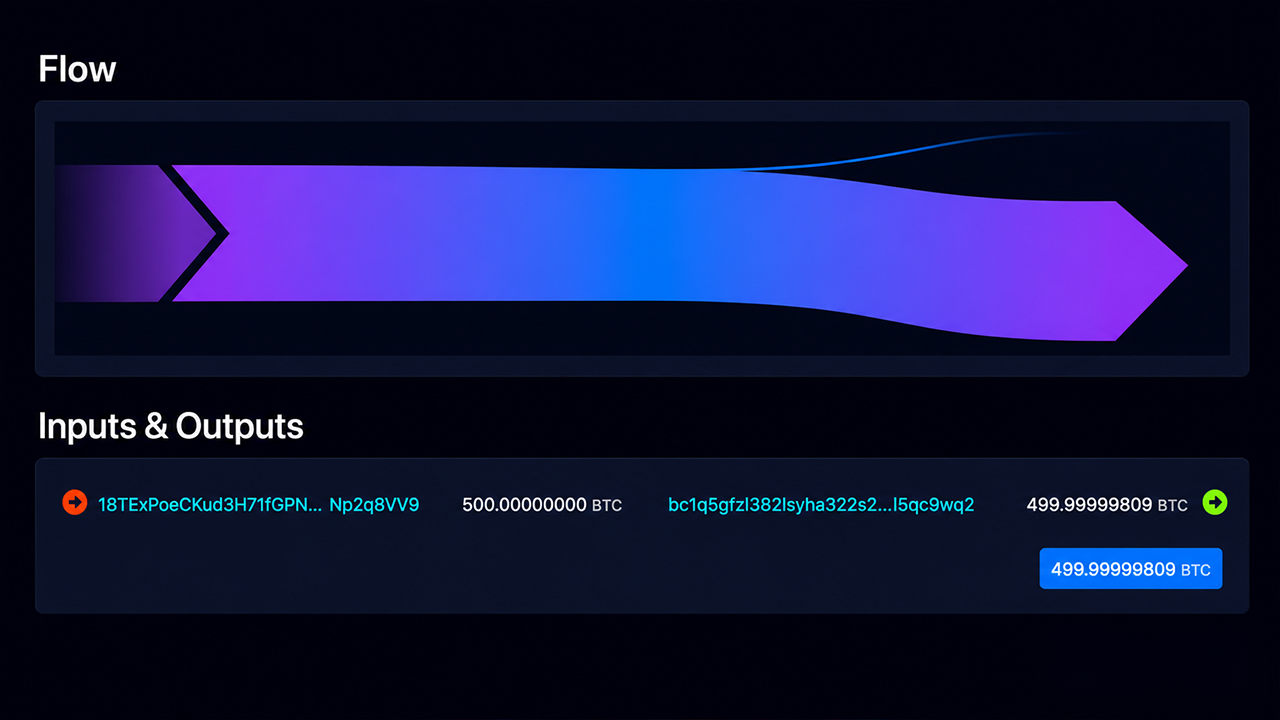
- Whale Alert spotted a 500 BTC wallet from Dec. 2013 moving $31.32M to a new address.
- More old and dormant bitcoin could move as security fears persist.
Two days ago, on Aug. 1, Bitcoin.com News reported that the Coldcard exploit appeared to be driving bitcoin holders toward centralized exchanges and custodians, while long-dormant BTC also began stirring back to life. To date, Coldcard’s flawed firmware and random number generator have resulted in an estimated 1,431.97 BTC being swept and stolen.
A 500 BTC Transfer From 2013
In the last report, 306 BTC from long-dormant wallets moved between July 30 and Aug. 1, potentially driven by fear surrounding the exploit. This trend has not slowed since that report, and on Monday, a long-dormant 2013 address shifted a staggering 500 BTC worth $31.32 million. The transfer was first flagged by btcparser.com and Whale Alert.
Blockchain explorer data shows the original Pay-to-Public-Key-Hash (P2PKH) address was created on Dec. 6, 2013. At the end of 2013, bitcoin had just broken above the $1,000 mark for the first time, and on that day, 1 BTC was changing hands at $1,042 per coin. That put the wallet’s 500 BTC stash at roughly $521,000 when it was originally acquired.
The Security Dilemma
Data from Arkham Intelligence shows the receiving Pay-to-Witness-Public-Key-Hash (P2WPKH) address is not tagged as any known exchange, custodian, institution, or other identifiable entity. For early bitcoin adopters, a wallet untouched for more than a decade represents far more than a balance. It reflects a decision made in 2013, when bitcoin had only recently broken above $1,000, and most of the world had never heard of it.
Many holders from that era embraced self-custody as a core principle, relying on hardware wallets instead of placing trust in centralized exchanges. The Coldcard firmware flaw cuts directly against that philosophy because it threatens the one thing those users sought to protect: exclusive control over their private keys. Shifting 500 BTC is less about market timing than recognizing that a wallet created years ago may no longer meet today’s security standards.
Protecting Capital Before It’s Too Late
The blockchain activity also fits an increasingly difficult pattern to ignore. More than 1,400 BTC has already been swept through the Coldcard exploit, while hundreds of additional coins from long-dormant wallets have moved voluntarily since July 30. For many longtime holders, the choice has become straightforward: trust that the aging wallet generation was never compromised or migrate funds before someone else makes that decision for them.
Choosing to move such a large balance, despite exposing an address that had remained silent for years, signals a security-driven response rather than a trading decision. The blockchain is showing that capital preservation, not speculation, may have become the priority for some of bitcoin’s oldest holders.
Hero/Feature image credit: mempool.space.