




Key Takeaways
- Bitcoin held near $65,000 as Coldcard losses potentially approached $130 million.
- BIP-110 stalled after 2 blocks as roughly 99.85% of hash stayed with Bitcoin.
- Bitcoin traders now watch $64,000 support and $66,000 resistance this week.
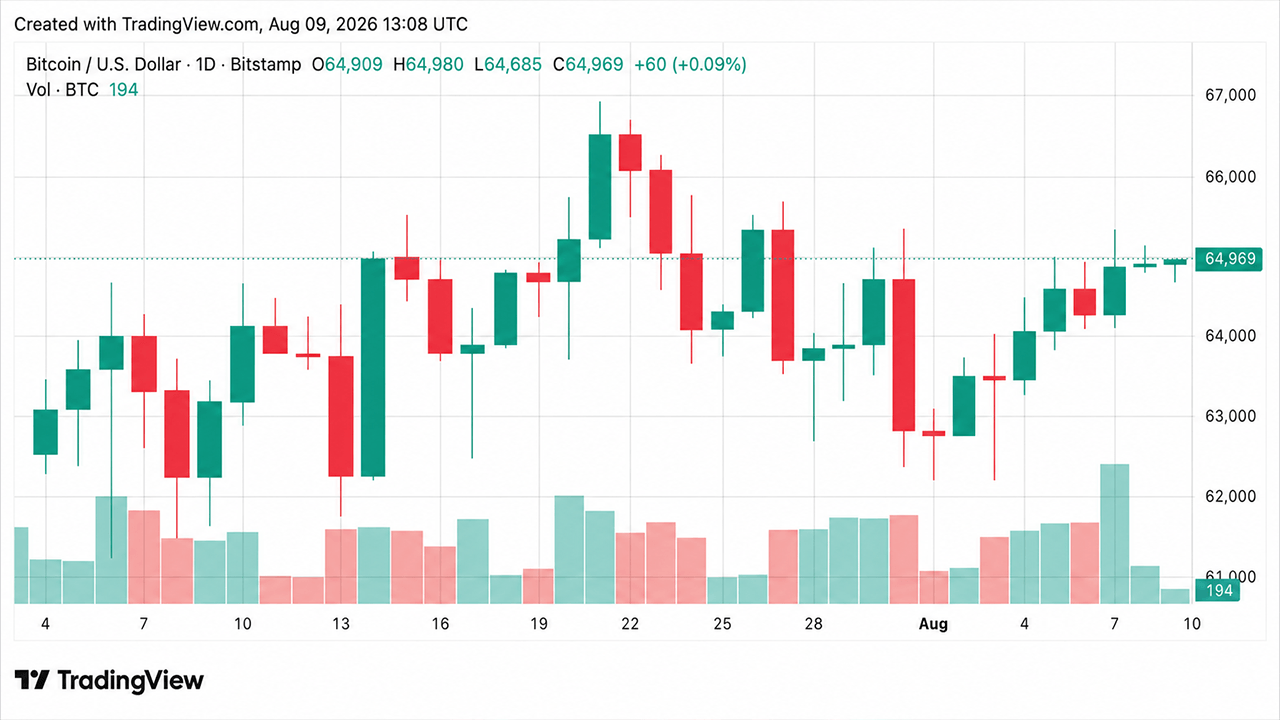
Over the past 48 hours, BTC traded largely between $64,500 and $65,250. By Sunday morning, Aug. 9, bitcoin was changing hands around $64,800 to $64,900, with neither event producing the kind of sharp sell-off that often follows major security failures or contentious network disputes.
Coldcard Crisis Fails to Crack Bitcoin’s Range
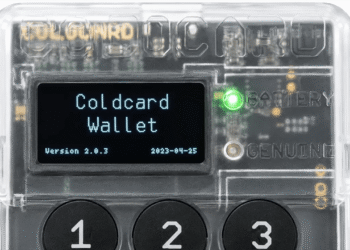
The more financially damaging event involves Coldcard, a hardware wallet manufactured by Coinkite. A firmware flaw introduced in March 2021 weakened the randomness used to generate some wallet seeds, leaving certain devices vulnerable to offline attacks capable of reconstructing private keys.
Attacks began July 30. The first major wave drained roughly 594 to 1,196 BTC from more than 1,100 addresses in less than an hour. Subsequent thefts pushed high-confidence loss estimates to roughly 1,596 to 1,719 BTC, while suspected activity could raise the total to about 2,055 BTC, worth roughly $133 million at prevailing prices.
Coinkite released patched firmware and advised affected users to create entirely new seeds and move their funds. Updating a vulnerable device alone cannot repair an old seed because the weakness was embedded when the seed was originally generated. The incident therefore became a serious self-custody failure, but not a failure of Bitcoin’s blockchain, monetary rules or mining network.
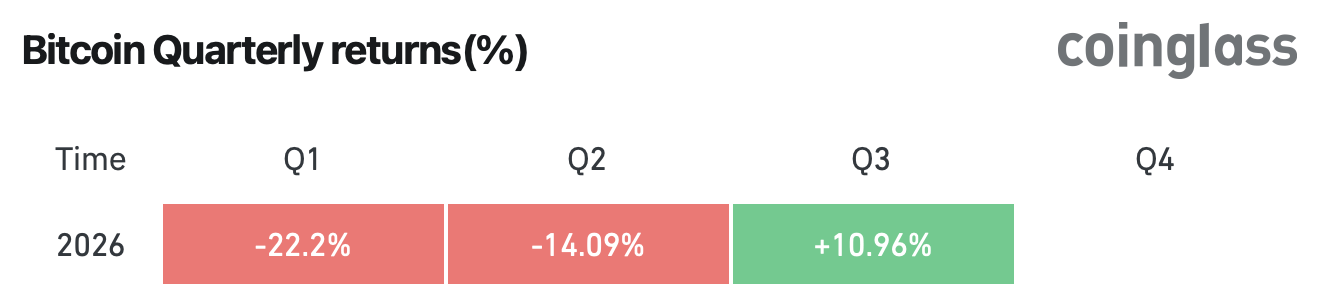
That distinction appears to matter to traders. Rather than treating the theft as a systemic bitcoin problem, the market largely priced it as a product-specific security breach. The stolen coins represented only a small fraction of circulating supply, and the broader network continued operating normally.
BIP-110 Split Hits a Wall Almost Immediately
Bitcoin then faced a separate test when BIP-110 enforcement began around block 961632. The proposal sought to temporarily restrict certain forms of nonfinancial data stored on Bitcoin and relied on a 55% miner-signaling threshold that never came close to being reached. Support hovered around 2.53% near the final signaling period.
When enforcing nodes began rejecting blocks that did not signal BIP-110, a minority chain emerged. Roughnecks produced two BIP-110 blocks, but the branch quickly stalled while Bitcoin’s dominant chain continued stacking blocks. The minority branch inherited Bitcoin’s full mining difficulty despite commanding only a tiny fraction of the network’s hash, making additional blocks painfully slow to produce.
By Aug. 9, the alternative chain was effectively stranded. Statistics show that roughly 99.85% of hash remained with the main Bitcoin chain, leaving the BIP-110 branch facing an extraordinary wait to reach the 2,016-block difficulty adjustment that could make mining easier. Discussions about changing its proof-of-work algorithm would effectively create a separate network and asset rather than altering Bitcoin itself.
Bitcoin Traders Keep Their Eyes on $64,000
Through both episodes, bitcoin’s price remained unusually quiet. The past 24 hours were marked by narrow intraday moves, with highs near $65,000 to $65,150 and lows in the upper $64,000s. No meaningful volume spike or directional candle tied directly to either Coldcard developments or the BIP-110 split has been recorded.
Momentum indicators also pointed to indecision on Sunday morning. The 14-period relative strength index hovered around 53 to 55, a neutral reading, while the moving average convergence divergence (MACD) indicator remained largely flat on shorter time frames. Immediate support sits around $64,000 to $64,500, with stronger demand near $62,000 to $63,000. Resistance remains clustered around $65,000 to $65,500, followed by $66,000 to $67,000.
The coming week may determine whether that calm survives. A sustained move above $65,500 to $66,000 with stronger volume could open the door toward $67,000 to $69,000, while a break below $64,000 could put $62,000 to $63,000 back in play. Traders will also be watching U.S. spot bitcoin ETF flows, macroeconomic data, exchange flows and whether weekday trading volume returns after the weekend lull.
For now, the striking part of the story is what did not happen. A hardware wallet exploit and a live minority-chain split both arrived within the same week, yet BTC stayed pinned inside a very narrow range. The next meaningful move may depend less on either controversy than on liquidity, institutional flows and whether buyers or sellers finally break the $64,000 to $66,000 corridor.