




Bit Digital funded the majority-owned AI infrastructure company WhiteFiber without selling Ethereum or issuing new shares, but the route added a new dependency to its crypto treasury.
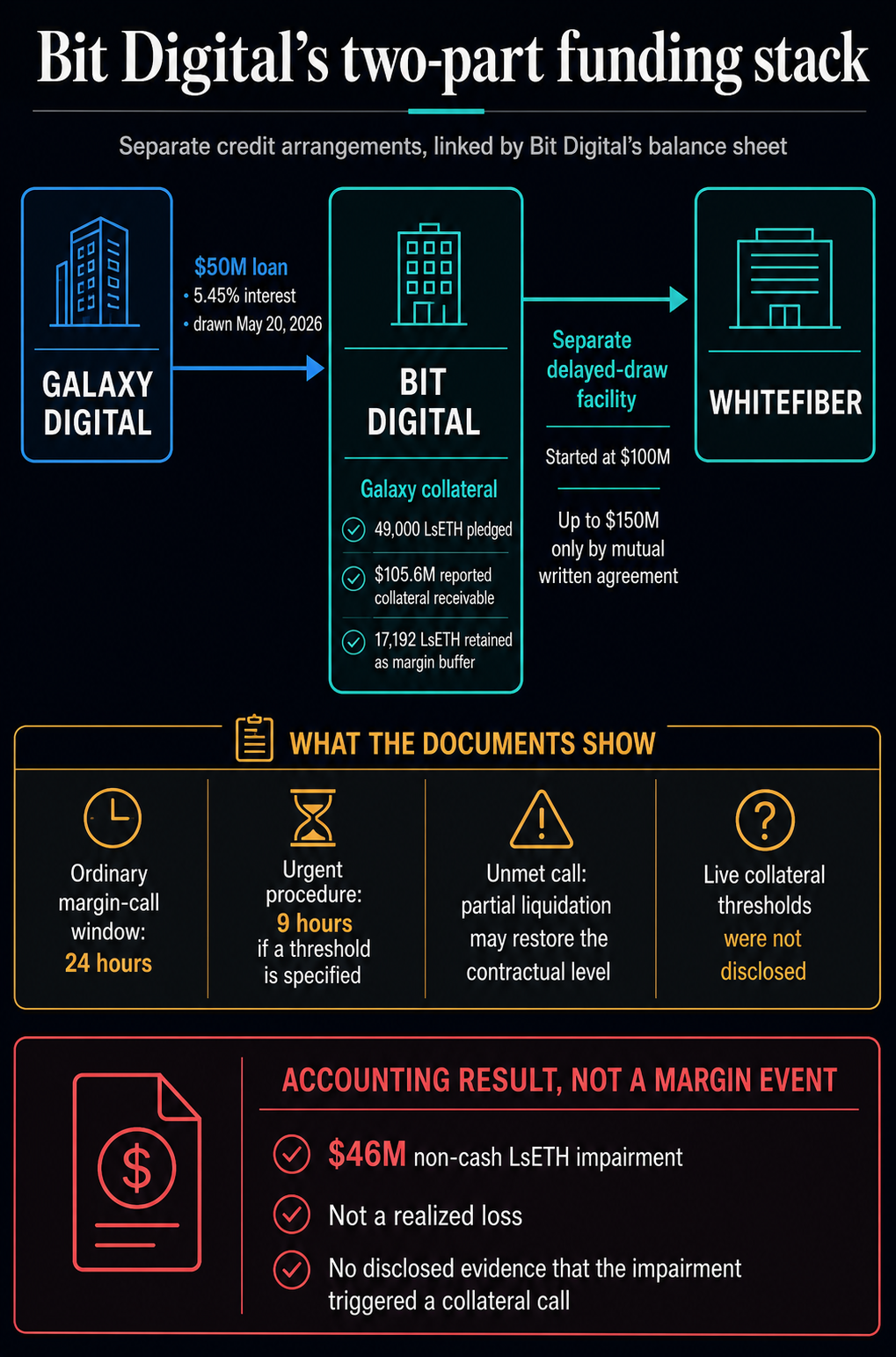
Galaxy Digital lent Bit Digital $50 million in a borrowing associated with 49,000 pledged LsETH, and Bit Digital separately became a lender to WhiteFiber.
The company said in its second-quarter results that it converted 73,235 ETH into 66,192 LsETH, the liquid-staking token it received in the exchange. It reported the pledged 49,000 LsETH as a $105.6 million digital-asset collateral receivable and retained 17,192 LsETH, worth $27.6 million, as a buffer against margin requirements.

Bit Digital drew the $50 million from Galaxy on May 20 at a 5.45% interest rate. The separate WhiteFiber delayed-draw facility started at $100 million and could rise to $150 million only by mutual written agreement.


LsETH is associated with Bit Digital’s company-level Galaxy borrowing. WhiteFiber’s facility is backed by a pledge of Enovum NC-1 Topco stock and a separate parent guaranty from White Fiber Operating Partnership.
Galaxy’s master loan agreement gives Bit Digital 24 hours after an ordinary margin-call notice to add collateral. If a required call is not met, Galaxy can partially liquidate collateral to restore the contractual level. A faster nine-hour procedure may apply if an urgent threshold is specified.
The public documents establish price-sensitive margin mechanics, but not Bit Digital’s proximity to a call or liquidation.

The impairment was an accounting hit, not a sale
The same quarterly release recorded a $46 million non-cash impairment on LsETH, and Bit Digital said it sold no ETH during the quarter. LsETH is carried at cost less impairment, unlike ETH’s fair-value treatment, so the charge was not a realized loss.
ETH staking revenue fell to $900,000 from $2.3 million in the first quarter, while net loss attributable to Bit Digital shareholders reached $107.2 million. The impairment was only one component of those results and does not indicate that the Galaxy loan breached a collateral threshold.

A sudden shift in Ethereum staking is draining billions from exchanges toward a new corporate elite
Ethereum’s stablecoin and tokenized Treasury base gives corporate ETH treasuries a clearer institutional case than simple crypto exposure.


The financing preserved the ETH position and avoided immediate dilution, but it also made part of the treasury’s value relevant to WhiteFiber’s funding chain.
That trade-off is now part of a broader capital-allocation debate: CEO Sam Tabar said the board is evaluating share repurchases, subject to board and shareholder approval.