





• About
  • FAQ
  • Earn Bitcoin while Surfing the net
  • Buy & Sell Crypto on Paxful
Newsletter
Approx Foundation
  • Home
    • Home – Layout 1
  • Bitcoin
  • Ethereum
  • Regulation
  • Market
  • Blockchain
  • Business
  • Guide
  • Contact Us
No Result
View All Result
  • Home
    • Home – Layout 1
  • Bitcoin
  • Ethereum
  • Regulation
  • Market
  • Blockchain
  • Business
  • Guide
  • Contact Us
No Result
View All Result
Approx Foundation
No Result
View All Result
Home Regulation

Ethereum has a $5 billion staking traffic jam

Moussa by Moussa
August 31, 2026
in Regulation
0
Ethereum has a $5 billion staking traffic jam
189
SHARES
1.5k
VIEWS
Share on FacebookShare on Twitter

Related articles

Ledger patched critical signing bugs months after writing the fixes

Ledger patched critical signing bugs months after writing the fixes

August 28, 2026
Ethereum’s plan to triple network speed could silently break millions of existing smart contracts

Ethereum’s plan to triple network speed could silently break millions of existing smart contracts

August 28, 2026


More than 2 million ETH is waiting to enter Ethereum staking as the amount already staked reaches a record high.

Ethereum’s validator activation queue held 2.059 million ETH at 12:37 UTC on Aug. 30, leaving a deposit joining the back of the line facing an estimated wait of about 35 days and 18 hours.

The backlog comes as more than 42 million ETH, nearly 35% of the cryptocurrency’s supply, is already staked. Both measures have climbed to record highs, extending a broader increase in capital committed to Ethereum’s proof-of-stake system.

Only 96 ETH was waiting in the validator exit queue at the same snapshot.

That imbalance shows demand for staking capacity remains well above Ethereum’s ability to activate deposits, even after the entry backlog declined from more than 4 million ETH earlier this year. It also creates a cost for participants because ETH waiting for activation does not yet earn consensus rewards.

At current staking rates, the 2.06 million ETH backlog represents roughly 141 to 148 ETH of potential consensus rewards per day, worth about $348,000 to $366,000 at an ETH price near $2,466.

The estimate represents delayed reward opportunity rather than a realized loss, since deposits already closer to the front of the queue will activate sooner.

Record staking runs into Ethereum’s throughput limit

Ethereum deliberately limits how quickly stake can enter and leave its validator set to prevent abrupt changes to the network’s security structure.

Under the Electra consensus rules, activations and exits are currently capped at 256 ETH per epoch. With an epoch lasting about 6.4 minutes, the network can process roughly 57,600 ETH per day through each side of the validator churn mechanism.
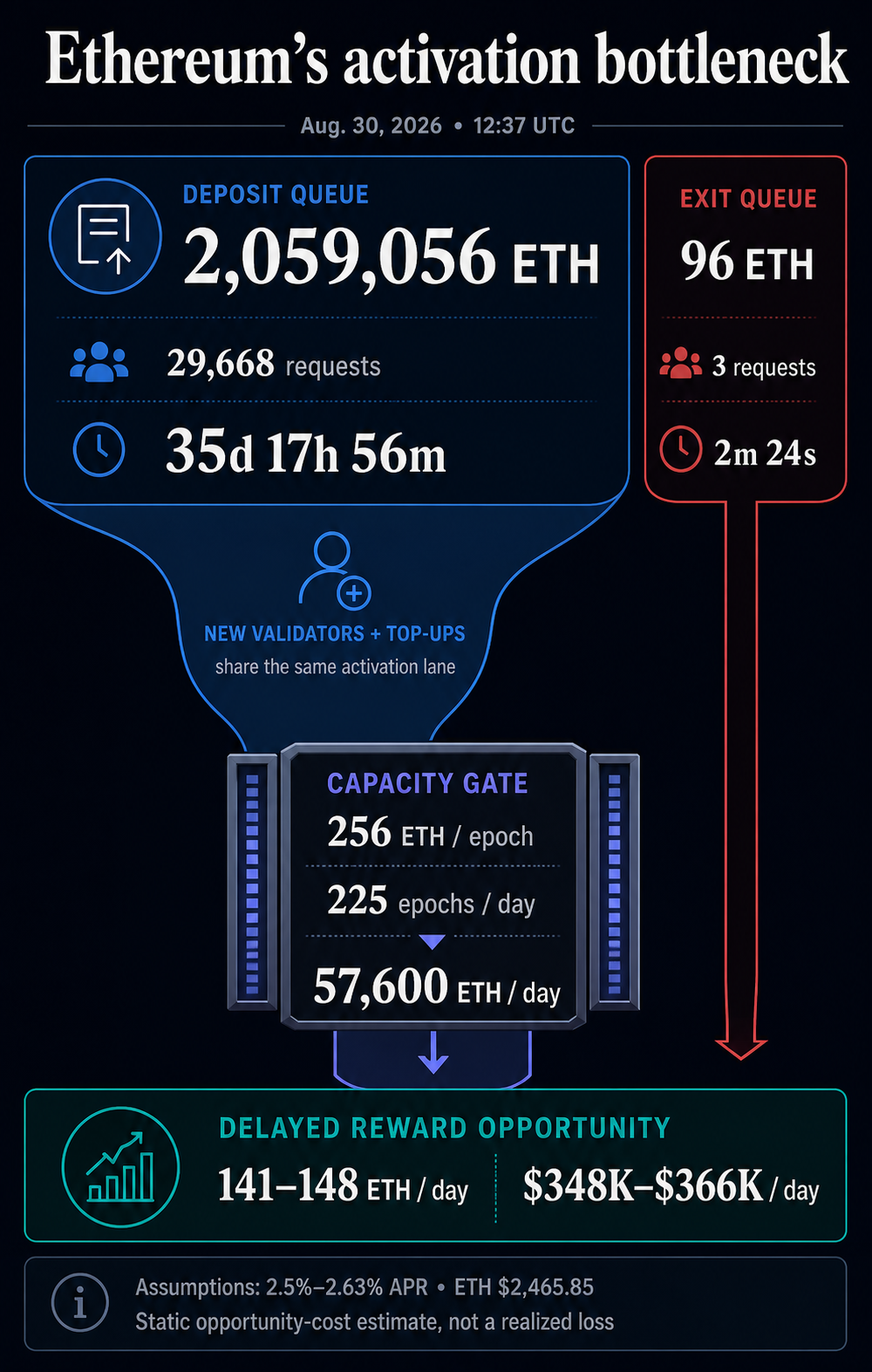
Ethereum activation queue infographic showing 2,059,056 ETH waiting behind a 256 ETH-per-epoch capacity gate while 96 ETH waits to exit.Ethereum activation queue infographic showing 2,059,056 ETH waiting behind a 256 ETH-per-epoch capacity gate while 96 ETH waits to exit.

When deposits arrive faster than that capacity, the activation queue grows.

Beaconcha.in counted 29,668 pending deposit requests on Aug. 30, but that figure should not be read as 29,668 new validators.

Electra changed Ethereum staking by allowing compounding validators to hold an effective balance of up to 2,048 ETH while retaining the 32 ETH minimum. Top-ups to existing validators pass through the same activation lane as deposits funding new validators.

The Daily Brief

The signal, before the noise.

Start your day with the crypto stories moving markets, decoded by CryptoSlate’s editors.

One email. Everything that matters.

Free to join. Unsubscribe any time.

Whoops, looks like there was a problem. Please try again.

You’re on the list. Your next Daily Brief is on its way.

The 2.06 million ETH backlog therefore combines potential new stake with balance additions by existing operators. It does not establish that investors recently purchased 2.06 million ETH or that the entire amount represents fresh institutional demand.

The broader direction is clearer.

Staked ETH has climbed from about 36 million, or nearly 30% of supply, in January to more than 42 million in late August. At the same time, almost no stake was waiting to deactivate at the Aug. 30 snapshot.

The activation backlog itself has been moving lower. A Morgan Stanley Ethereum Trust filing recorded about 3.64 million ETH waiting and a 63-day delay on May 18, while Lido, the dominant liquid staking service provider, said the queue had exceeded 4 million ETH in January before falling to 2.9 million at the end of June.

The latest 2.06 million ETH reading extends that decline, but the queue remains large enough to impose a roughly five-week delay on new entrants.

Five-week wait puts a price on staking demand

That delay becomes increasingly important as funds, exchanges and institutional staking products compete for access to Ethereum’s validator set.

A Morgan Stanley Ethereum Trust filing states that ETH allocated for staking would not accrue rewards while waiting for activation.

Ethereum’s staking page showed an annual reward rate around 2.5%, while a contemporaneous queue tracker put it near 2.63%.

Applied to the pending balance, that range implies about 141 to 148 ETH of consensus-reward opportunity each day.

A 32 ETH deposit joining at the back of the queue would forgo roughly 0.078 to 0.082 ETH in potential consensus rewards over the displayed 35.75-day wait, worth about $193 to $203 at the captured ETH price.

Those calculations assume unchanged staking rates and prices and exclude execution-layer rewards, maximal extractable value, provider fees, and compounding.

Who ultimately absorbs the delay also depends on the product.

A solo validator directly waits without earning consensus rewards. An exchange, fund or liquid-staking provider can spread the cost across a pool, absorb some of it or pass it through to users under its own terms.

Lido has already highlighted the economics of long activation waits, saying in its first-half report that foregone rewards made some stVault deposits unattractive.

Ethereum is therefore confronting an unusual consequence of record staking participation: demand to secure the network is high enough that access to the validator set itself has become scarce.

With more than 42 million ETH already staked and another 2.06 million ETH waiting for activation, the immediate constraint is not investors trying to leave. It is how quickly Ethereum can process those still trying to get in.




Source link

Share76Tweet47

Related Posts

Ledger patched critical signing bugs months after writing the fixes

Ledger patched critical signing bugs months after writing the fixes

by Moussa
August 28, 2026
0

Crypto wallet maker Ledger is urging its Ethereum app users to update again after two signing flaws remained in its...

Ethereum’s plan to triple network speed could silently break millions of existing smart contracts

Ethereum’s plan to triple network speed could silently break millions of existing smart contracts

by Moussa
August 28, 2026
0

Ethereum's next attempt to expand base-layer throughput includes contracts and transactions that create persistent state, which would cost far more...

Ethereum and Solana are hosting trillions in dollar volume, yet their native tokens risk losing direct consumer demand

Ethereum and Solana are hosting trillions in dollar volume, yet their native tokens risk losing direct consumer demand

by Moussa
August 28, 2026
0

Matt Corallo followed up on an earlier post on Aug. 25, addressing what stablecoin users increasingly see: apps routing around ETH,...

Staking Ethereum could soon look entirely different under a new deposit proposal

Staking Ethereum could soon look entirely different under a new deposit proposal

by Moussa
August 27, 2026
0

Ethereum developers have opened an early proposal to make the staking deposit system flexible enough to accept future quantum-resistant validator...

Ethereum EIP-8148 draft: custom sweep thresholds

Ethereum EIP-8148 draft: custom sweep thresholds

by Moussa
August 25, 2026
0

Ethereum is considering a change that would let compounding validators set how much ETH should remain on a validator before...

Load More

youssufi.com

sephina.com

[vc_row full_width="stretch_row" parallax="content-moving" vc_row_background="" background_repeat="no-repeat" background_position="center center" footer_scheme="dark" css=".vc_custom_1517813231908{padding-top: 60px !important;padding-bottom: 30px !important;background-color: #191818 !important;background-position: center;background-repeat: no-repeat !important;background-size: cover !important;}" footer_widget_title_color="#fcbf46" footer_button_bg="#fcb11e"][vc_column width="1/4"]

We bring you the latest in Crypto News

[/vc_column][vc_column width="1/4"][vc_wp_categories]
[/vc_column][vc_column width="1/4"][vc_wp_tagcloud taxonomy="post_tag"][/vc_column][vc_column width="1/4"]

Newsletter

[vc_raw_html]JTNDcCUzRSUzQ2RpdiUyMGNsYXNzJTNEJTIydG5wJTIwdG5wLXN1YnNjcmlwdGlvbiUyMiUzRSUwQSUzQ2Zvcm0lMjBtZXRob2QlM0QlMjJwb3N0JTIyJTIwYWN0aW9uJTNEJTIyaHR0cHMlM0ElMkYlMkZhcHByb3gub3JnJTJGJTNGbmElM0RzJTIyJTNFJTBBJTBBJTNDaW5wdXQlMjB0eXBlJTNEJTIyaGlkZGVuJTIyJTIwbmFtZSUzRCUyMm5sYW5nJTIyJTIwdmFsdWUlM0QlMjIlMjIlM0UlM0NkaXYlMjBjbGFzcyUzRCUyMnRucC1maWVsZCUyMHRucC1maWVsZC1maXJzdG5hbWUlMjIlM0UlM0NsYWJlbCUyMGZvciUzRCUyMnRucC0xJTIyJTNFRmlyc3QlMjBuYW1lJTIwb3IlMjBmdWxsJTIwbmFtZSUzQyUyRmxhYmVsJTNFJTBBJTNDaW5wdXQlMjBjbGFzcyUzRCUyMnRucC1uYW1lJTIyJTIwdHlwZSUzRCUyMnRleHQlMjIlMjBuYW1lJTNEJTIybm4lMjIlMjBpZCUzRCUyMnRucC0xJTIyJTIwdmFsdWUlM0QlMjIlMjIlM0UlM0MlMkZkaXYlM0UlMEElM0NkaXYlMjBjbGFzcyUzRCUyMnRucC1maWVsZCUyMHRucC1maWVsZC1lbWFpbCUyMiUzRSUzQ2xhYmVsJTIwZm9yJTNEJTIydG5wLTIlMjIlM0VFbWFpbCUzQyUyRmxhYmVsJTNFJTBBJTNDaW5wdXQlMjBjbGFzcyUzRCUyMnRucC1lbWFpbCUyMiUyMHR5cGUlM0QlMjJlbWFpbCUyMiUyMG5hbWUlM0QlMjJuZSUyMiUyMGlkJTNEJTIydG5wLTIlMjIlMjB2YWx1ZSUzRCUyMiUyMiUyMHJlcXVpcmVkJTNFJTNDJTJGZGl2JTNFJTBBJTNDZGl2JTIwY2xhc3MlM0QlMjJ0bnAtZmllbGQlMjB0bnAtcHJpdmFjeS1maWVsZCUyMiUzRSUzQ2xhYmVsJTNFJTNDaW5wdXQlMjB0eXBlJTNEJTIyY2hlY2tib3glMjIlMjBuYW1lJTNEJTIybnklMjIlMjByZXF1aXJlZCUyMGNsYXNzJTNEJTIydG5wLXByaXZhY3klMjIlM0UlQzIlQTBCeSUyMGNvbnRpbnVpbmclMkMlMjB5b3UlMjBhY2NlcHQlMjB0aGUlMjBwcml2YWN5JTIwcG9saWN5JTNDJTJGbGFiZWwlM0UlM0MlMkZkaXYlM0UlM0NkaXYlMjBjbGFzcyUzRCUyMnRucC1maWVsZCUyMHRucC1maWVsZC1idXR0b24lMjIlM0UlM0NpbnB1dCUyMGNsYXNzJTNEJTIydG5wLXN1Ym1pdCUyMiUyMHR5cGUlM0QlMjJzdWJtaXQlMjIlMjB2YWx1ZSUzRCUyMlN1YnNjcmliZSUyMiUyMCUzRSUwQSUzQyUyRmRpdiUzRSUwQSUzQyUyRmZvcm0lM0UlMEElM0MlMkZkaXYlM0UlM0NiciUyRiUzRSUzQyUyRnAlM0U=[/vc_raw_html][/vc_column][/vc_row]
No Result
View All Result
  • Contact Us
  • Homepages
  • Business
  • Guide

© 2024 APPROX FOUNDATION - The Crypto Currency News