




Key Takeaways
- Binance XRP open interest fell about 32% from Aug. 22 to Sept. 17.
- Selling pressure intensified across centralized spot markets and Binance perpetual futures.
- XRP’s price declined far less than derivatives exposure over the period.
XRP Open Interest Drops Nearly One-Third
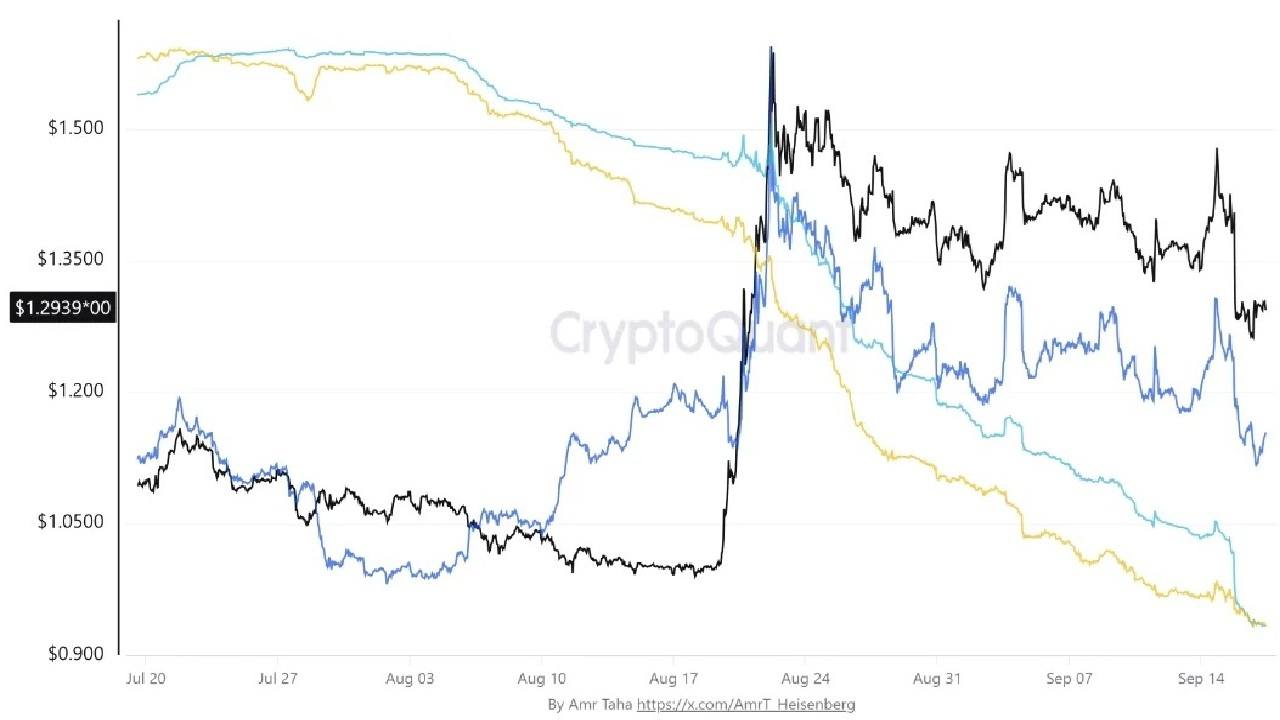
XRP traders have sharply reduced derivatives exposure while aggressive sellers continue to dominate order flow, according to an analysis published by Cryptoquant on Sept. 17. Cryptoquant contributor Amr Taha found that Binance XRP open interest fell from about $323 million on Aug. 22 to roughly $219 million on Sept. 17, a decline of about 32%.
XRP fell roughly 11% over the same period, meaning open interest contracted almost three times as fast as price. The divergence points to substantial deleveraging in the derivatives market.
The analyst summarized the shift:
“The key signal is clear: XRP traders are reducing derivatives exposure while sell-side taker activity remains elevated across both futures and spot markets.”
Open interest represents derivatives positions that remain outstanding. CME Group defines open interest as the number of futures contracts that remain outstanding. A decline generally indicates positions are closing faster than new ones are opening.
The latest reading reverses an earlier rebound. On Sept. 6, Binance XRP open interest stood near $244 million, after its seven-day change had recovered from negative 27% on Aug. 29 to positive 1%. Open interest has since resumed its decline.
Spot CVD Falls to Negative $2.1 Billion
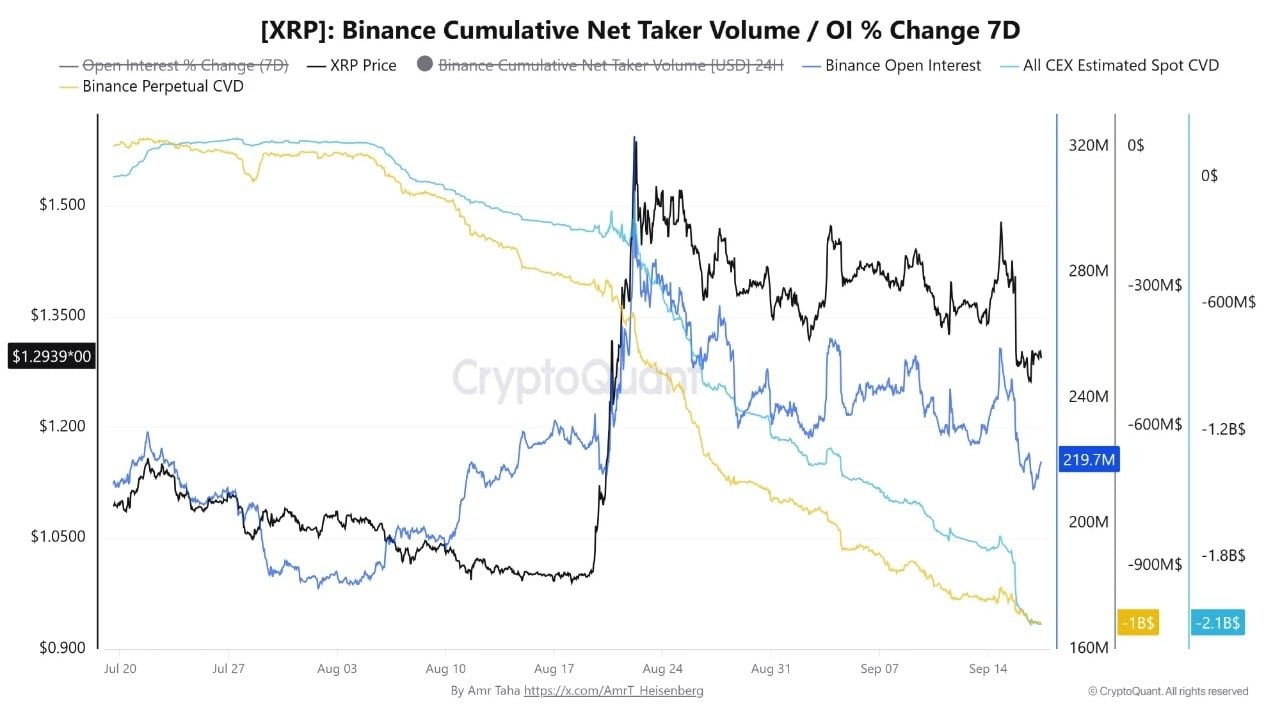
Selling pressure has intensified more sharply in spot markets than in Binance perpetual futures. Estimated cumulative volume delta (CVD), which tracks the difference between aggressive market buys and sells, fell from about negative $111 million on Aug. 22 to negative $2.1 billion on Sept. 17 across centralized spot exchanges.
A falling CVD indicates that taker-initiated selling exceeds buying. Binance perpetual CVD fell from roughly negative $361 million to negative $1 billion over the same period. Perpetual futures allow traders to maintain leveraged crypto positions without an expiration date, making them a key part of XRP’s leveraged derivatives market. Spot CVD deteriorated by nearly $2 billion, more than three times the roughly $639 million decline in perpetual CVD, showing that selling extended well beyond leveraged derivatives.
The trend has also deepened since early September. Estimated spot CVD stood near negative $1.4 billion on Sept. 6, meaning the reading fell by another roughly $700 million by Sept. 17.
Deleveraging Reduces Outstanding XRP Exposure
Falling open interest alongside increasingly negative CVD is consistent with traders closing leveraged positions while aggressive selling continues. The combination shows a shrinking derivatives base even as sell-side activity remains elevated.
A smaller derivatives base may reduce highly leveraged exposure and help cool leverage-related imbalances. The analyst added:
“If short positioning becomes dominant among the remaining open positions, funding rates could move further into cooling or negative territory.”
The derivatives contraction is occurring alongside broader institutional developments around XRP. 21Shares has highlighted XRP’s fixed supply, utility, and expanding ETF access, while cumulative net inflows into U.S. spot XRP ETFs crossed $1.70 billion by Sept. 9.
XRP Market Developments Continue Beyond Trading Data
XRP’s market structure is also evolving while U.S. lawmakers continue debating broader digital asset rules. The Senate on Sept. 15 rejected cloture on the motion to proceed to H.R. 3633 in a 49-50 vote, leaving the proposed federal digital asset market structure framework unresolved.
Ripple has maintained that the failed vote does not alter XRP’s existing U.S. legal position or the company’s business activity. Ripple said XRP’s established position remains unchanged after the CLARITY Act vote, while pointing to continued demand across payments, stablecoins, and institutional markets.
The analysis also stated:
“Historically, similar deleveraging phases have often favored price recovery, as excessive leverage is flushed out and the market becomes less vulnerable to long-liquidation cascades.”