




When the Markets in Crypto Assets Regulation (MiCA) came into force, it did something that had eluded the digital asset sector in Europe for years: it created a single, coherent rulebook.
For the first time, a crypto asset service provider (CASP) authorized in one Member State can passport its services across the European Union and European Economic Area, and clients across the bloc can choose among a growing field of licensed, supervised providers. That is a genuine achievement, and one the industry should not take for granted.
As the consultation on MiCA’s review closes, the focus should now be on calibration: keeping what works, and being honest about where the compliance burden has grown faster than the risks it is meant to address.
The value of a unified market
Start with what MiCA got right. Before it, a firm wanting to operate across Europe faced a patchwork of national regimes, divergent registration requirements, and, in some markets, no bespoke regime at all.
A unified market changes the economics of building a serious business. It lets providers invest in one authorization and one compliance architecture rather than 30, and it gives customers something they genuinely benefit from: choice among multiple providers competing on quality, price, service and security, all held to a common standard.
Related: MiCA is coming for DeFi vaults, but regulation will be difficult
Passporting is the mechanism that turns 30 fragmented markets into one addressable market of roughly 450 million people, and it is the single strongest reason for a globally mobile industry to build in Europe rather than elsewhere.
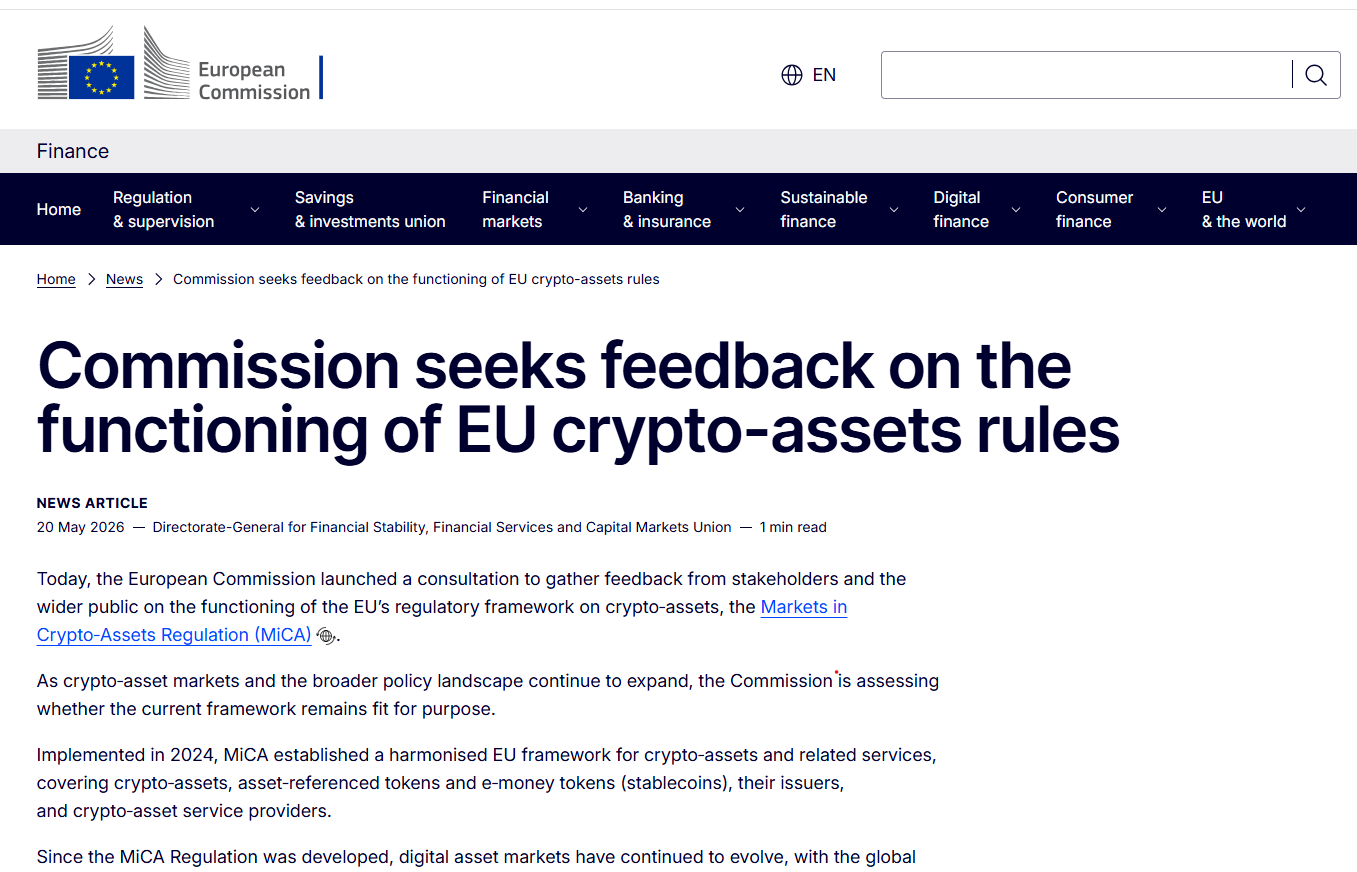
Consultation on MiCA’s review closes Sept. 30. Source: European Commission
MiCA has raised the barrier to entry by imposing a more demanding authorization and compliance framework. In return, however, an authorized CASP gains access not merely to a single Member State, but to the entire EU single market.
The relevant question for the review is therefore whether the obligations for market access remain proportionate to the scale of the market they unlock.
Regulate the risk, not the activity
The principle that should guide the review is straightforward: regulation should apply where there are real risks to market participants or to market stability, and it should be proportionate to those risks.
Where a service touches client money, custody of assets, market integrity, or financial stability, robust rules are not just acceptable but necessary. That is where supervisory attention belongs, and that is where the industry has the least to complain about.
Compliance frameworks should ultimately be judged by one standard: do they meaningfully reduce risk?
Over time, frameworks tend to accumulate rules, reporting requirements and documentation obligations, often adding complexity and cost without a corresponding risk-reduction benefit.
Related: MiCA focus shifts from rulemaking to supervision, ESMA chair says
A review should therefore challenge every requirement and retain only those that address a clear and material risk. Rules that pass that test should stay. Rules that do not should be simplified, streamlined, or removed. Proportionality is not a loophole; it is the discipline that keeps a rulebook credible.
Be honest about the cost curve
It should be said openly that compliance costs for CASPs have risen significantly under MiCA. That is not, by itself, a criticism. Some of that cost is the price of admission to a large and valuable market, and a well-run firm should be prepared to pay it. But cost is not a neutral fact for the market as a whole.
Compliance overhead falls hardest on smaller firms and newer entrants, the very participants who drive competition and innovation. When the fixed cost of being authorized climbs high enough, it stops being a safeguard and starts being a barrier to entry, entrenching incumbents and thinning out the choice that the single market was supposed to expand.
The risk to watch, therefore, is not any single rule but the cumulative direction of travel. If the review adds materially to the regulatory burden without a clear risk-based justification, the likely result is not a safer market but a smaller one: less innovation and fewer firms willing to build in Europe.
Related: Greece gets first MiCA entrants as watchdog denies Binance-Lagarde claim
Digital asset businesses are unusually mobile, and some may gradually direct new investment toward jurisdictions that offer comparable market access at lower friction. If that happens, European consumers end up with less choice, and European supervisors oversee a smaller share of a global activity that continues regardless.
What a good review looks like
None of this argues for deregulation. It argues for a review built around proportionality: use this opportunity to look hard at the requirements that generate cost without a matching benefit, to give firms room to innovate and build, and to ask, at every turn, whether a given obligation is protecting the market or merely taxing it. A few examples illustrate the point:
- Tiered regulation by size and risk: A small startup with a handful of clients should not face the same compliance burden and prudential requirements as a multinational corporation managing billions in assets. Introducing proportionate tiers based on asset volume, client base or systemic relevance would lower barriers to entry for emerging players while maintaining robust oversight where it matters most.
- Dual licensing for e-money tokens: Custody and transfer of EMTs can trigger additional regulation, such as Payment Service Directive (PSD2), on top of MiCA licensing. This overlap creates duplicative compliance costs and legal uncertainty without a clear consumer protection benefit. A clearer delineation — or a single-license pathway — would reduce friction while preserving supervisory coverage.
Payment Services Directive. Source: ECB
- Rigid reserve requirements for stablecoins: Issuers must hold at least 30% of reserves as bank deposits. In a rising-rate environment, this limits yield opportunities; in a banking crisis, it concentrates counterparty risk. A more flexible allocation framework — one that permits high-quality liquid assets beyond bank deposits — could strengthen resilience without compromising redemption capacity.
Europe has built something rare: a large, unified, credibly regulated market for crypto assets. The prize now is to keep it attractive to the firms that make it work.
Getting the balance right is in everyone’s interest, regulators and industry alike, and the coming months are the time to get it right.
The views, thoughts and opinions expressed here are the author’s alone and do not necessarily reflect or represent the views and opinions of Cointelegraph.