





Key Takeaways
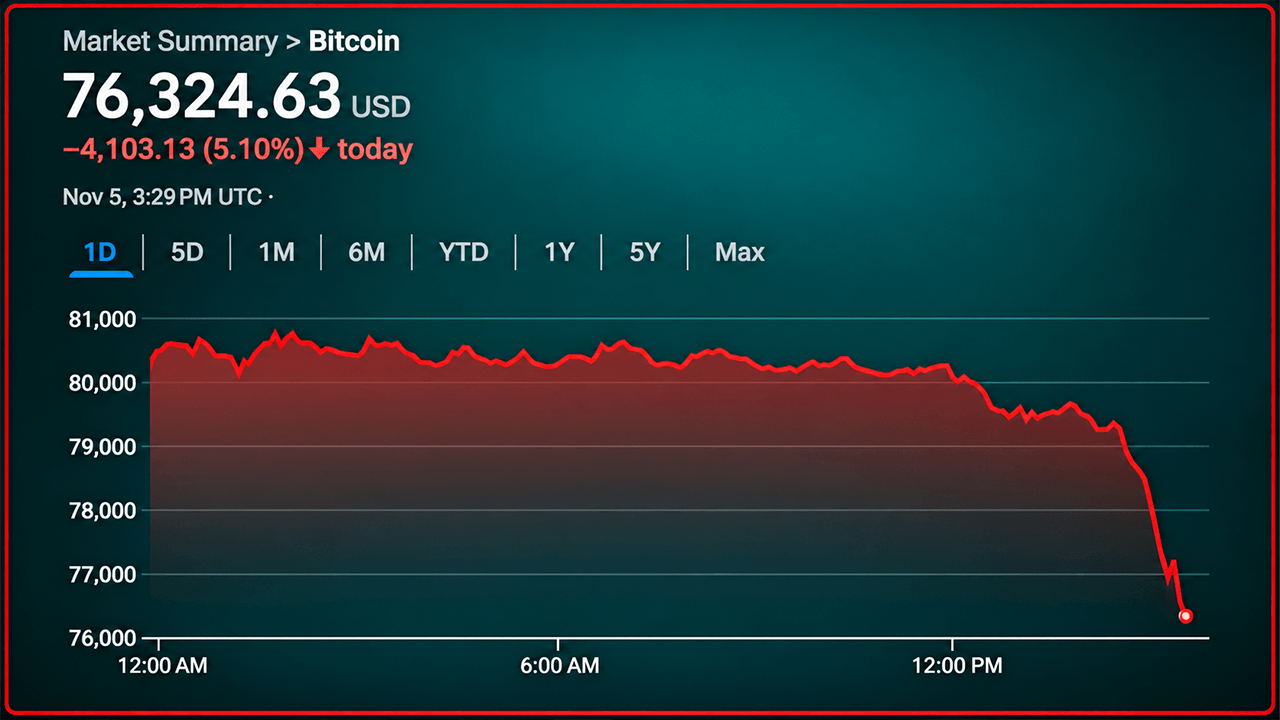
- Bitcoin fell $5,046 from its $81,105 peak to $76,059 on Nov. 5, 2026.
- Nasdaq weakness accompanied bitcoin’s retreat as Qualcomm and other semiconductor stocks declined.
- Bitcoin’s $75,600 to $76,000 support zone faces renewed pressure following Thursday’s selloff.
Editor’s Note: This article was updated to note that by 10:55 a.m. ET, bitcoin had extended its intraday decline, touching a session low of $75,468 per coin on Bitstamp.
Bitcoin’s price fell approximately 6.22%, from Wednesday’s $81,105 peak to a low of $76,059 on Bitstamp on Thursday, Nov. 5, 2026. The value drop accelerated around 10 a.m. Eastern time as technology stocks declined, erasing much of the cryptocurrency’s post-election recovery.
Bitcoin Price Drops $4,338 as Selling Accelerates
Bitstamp’s hourly chart captures the reversal. Bitcoin climbed from approximately $75,618 on Wednesday to $81,105 before spending much of the following hours consolidating near $80,000. That stability cracked Thursday morning as bitcoin fell below $77,000.
The five-minute chart shows BTC trading near $80,160 earlier in the session before slipping through $79,000, $78,000 and eventually $77,000. Selling accelerated a great deal after 9:30 a.m., with consecutive declining candles and expanding trading volume accompanying the retreat. By approximately 10:13 a.m., Bitstamp recorded a low of $76,059, bringing bitcoin within striking distance of Wednesday’s earlier lows.
Why Is Bitcoin Falling Today as a Tech Stock Selloff Hits Nasdaq?
The bitcoin selloff coincided with another beating for semiconductor and artificial intelligence-related stocks. Reuters reported Thursday that American chipmaker Qualcomm (QCOM) fell approximately 10% in premarket trading following disappointing smartphone chip sales. Graphics processor manufacturer Nvidia (NVDA), Intel (INTC), and other semiconductor companies also faced major selling pressure.
The technology-heavy Nasdaq Composite opened approximately 0.7% lower, while the S&P 500 declined 0.2%. The Dow Jones Industrial Average, meanwhile, gained roughly 0.6%, illustrating the division between technology shares and the broader market. By 10:30 a.m., the Nasdaq lost 4% against the U.S. dollar. The NYSE shed a percentage point, the Dow was down 1.8% and the S&P 500 lost close to 3% in the same timeframe.

Bitcoin appeared caught in the crossfire. The leading crypto asset frequently trades alongside speculative technology investments during periods of heightened uncertainty. Thursday’s simultaneous declines suggest investors were trimming exposure to risk-sensitive assets, although the drawdown alone cannot establish the precise cause of bitcoin’s selling.
Bitcoin’s Post-Election Rally Runs Into Fresh Resistance
Wednesday offered an entirely different picture. Following Democrats’ victories in both congressional chambers during the Nov. 3 midterm elections, U.S. equities rallied as investors welcomed greater political clarity. Bitcoin also recovered from below $76,000, eventually reaching the $81,000 neighborhood.
That relief proved short-lived. Thursday’s selling followed renewed concerns about artificial intelligence infrastructure spending and possible regulatory restrictions affecting data centers. Reuters reported that investors were assessing how the election results might affect future construction and energy-intensive technology projects. Cryptocurrency markets also entered the session carrying concerns surrounding the $6.3 billion Binance security breach on Oct. 29 and uncertainty about Washington’s regulatory direction.
The combination left bitcoin particularly exposed when technology stocks faltered, although the relative influence of these developments remains difficult to quantify.
Bitcoin’s $76,000 Support Level Faces Another Test
The immediate technical picture now centers on two price zones. The first sits around $75,600 to $76,000, where buyers previously helped reverse Wednesday’s decline. A sustained break beneath that area would weaken the latest recovery attempt. With a slide to $76,059, the $76,000 zone looks weaker.
The second spans $80,000 to $81,105, where bitcoin struggled to maintain its post-election gains. Reclaiming that territory would provide a stronger indication that buyers had regained control. Neither level guarantees a reversal. For now, the contradiction is striking. Wednesday’s election results helped propel bitcoin toward $81,000, yet barely a day later, technology-sector selling had erased the advance.
The selling pressure extended well beyond bitcoin, with Coinglass data showing $838.54 million in cryptocurrency liquidations over the preceding 24 hours, affecting 166,904 traders. Long positions absorbed a punishing $741.04 million, representing 88.4% of the total, while short liquidations accounted for $97.50 million.
Bitcoin led individual assets with $213.31 million in liquidations, followed by ethereum at $122.13 million. More strikingly, at 10:30 a.m. ET, approximately $554.66 million in positions were wiped out during the latest hour alone, including $520.29 million in bullish bets. With Binance accounting for 46.8% of liquidations by exchange, the figures reveal how quickly leveraged optimism unraveled as bitcoin approached the critical $75,600 to $76,000 support zone.
Bitcoin’s next technical test centers on the $75,600 to $76,000 support zone, where a sustained breakdown would threaten to erase Wednesday’s post-election recovery entirely.
Update: By 10:55 a.m. ET, bitcoin’s intraday low on Bitstamp tapped $75,468 per coin.