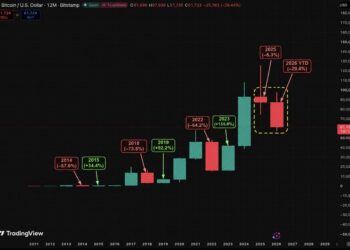




Bitcoin is trading just above its realized price, the average cost of every coin on the network, and a break below that level would put the average holder at a loss for the first time since early 2023, Glassnode, an onchain analytics firm posted Friday.
The price of bitcoin sat near $61,700 on Friday after sliding below $62,000. The realized price is a measure of what holders paid, not where the market trades. When bitcoin trades above it, the typical coin is sitting on a gain. Below it, the typical coin is underwater.
The margin is thin. The firm said the MVRV ratio, which compares bitcoin’s market value with its realized value, sits “just above 1.” A reading of 1 means the market price has fallen all the way to the realized price.
What the realized price measures
Realized price values each coin at the price it last moved on the blockchain, then averages across the supply. Look Into Bitcoin describes it as bitcoin’s average cost basis. Because it tracks the price when coins last changed hands, it moves far more slowly than the market.
The MVRV ratio expresses the same idea as a multiple. Above 1, holders are in profit on average. Below 1, they are not. A reading just above 1 means the market price is only a sliver higher than what the average coin cost.
The firm did not give the exact realized price in its post, which included a chart. That leaves the exact cushion between today’s price and the average cost basis unstated. Bitcoin Magazine Pro’s full realized price chart sits behind a login, so the current level could not be confirmed independently for this report.
“The average Bitcoin holder is still in profit,” the firm wrote. “The margin is thin.”
Outflows and liquidations add to the pressure
The slide has come with heavy selling from funds. BlackRock’s iShares Bitcoin Trust (IBIT) lost about $541 million on Thursday, its largest one-day outflow since it launched in January 2024, Bloomberg reported. U.S. spot bitcoin ETFs lost about $582 million in total that day.
The selling stands out against the buying earlier in the fall. Institutions piled into bitcoin ETFs through the third quarter, pushing their combined holdings to a record, Bitcoin Magazine reported this week.
Leveraged traders took losses too. More than $700 million in leveraged crypto positions were liquidated over 24 hours, and about 86% of them were bets on higher prices. Bitcoin accounted for roughly $200 million of the total.
CoinShares sees range trading through 2027
CoinShares head of research James Butterfill said the drop is part of a longer downturn rather than the start of a new one. “I see this as a continuation of the existing bear market rather than the start of another,” he said in a note dated Nov. 18.
The note frames Friday’s price action as a late stage of a decline that began well before November. Butterfill pointed to whale selling that weighed on prices from late 2025, expectations of higher interest rates and weakness in technology stocks, all of which have kept buyers cautious.
“Our base case remains range trading around USD 60k to 90k through much of 2027, until falling inflation gives monetary policy room to ease,” he said. “Geopolitics will have a considerable say in that.”
A move through the realized price would put bitcoin near the bottom edge of that range. The firm said holders as a group have not been in loss since early 2023.
A sustained breakout, Butterfill said, would likely require “a change in the policy outlook, renewed whale participation or both.”