





Ethereum’s new Defi security tool system is designed to prevent decentralized finance (DeFi) exploits before they settle but is raising questions about how far transaction filtering should go on Ethereum.


Developed by Phylax and integrated with block builder Titan Builder, the technology allows applications to block transactions that could cause harmful outcomes. The system could help protocols defend against hackers and prevent significant financial losses. However, it also introduces a potential mechanism for freezing smart contract functions, prompting concerns about whether a security measure could eventually become a tool for censorship or centralized control.
The debate comes as Ethereum continues to address vulnerabilities across its DeFi ecosystem while facing questions about the concentration of power among a relatively small number of block builders.
Phylax Introduces Circuit Breakers to Stop DeFi Exploits
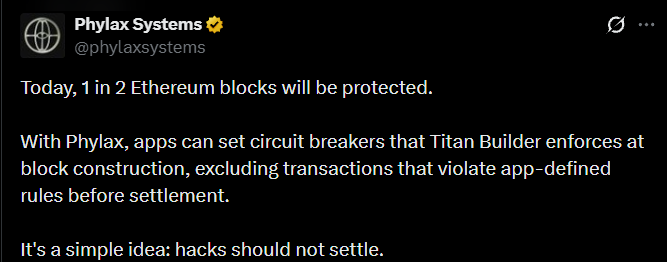
Announced on November 10, Phylax’s integration with Titan Builder allows Ethereum applications to establish rules that filter out potentially harmful transactions during block construction.
Titan checks transactions against these rules before deciding whether to include them in its blocks. Phylax says Titan produces approximately one in every two Ethereum blocks, giving the integration significant reach across the network. The objective is to prevent exploits from being finalized rather than relying on monitoring tools or emergency responses after an attack has already begun.
Phylax illustrated the system’s potential using a vulnerable DeFi vault that could mistakenly release $1 million to a user whose shares were worth only $1,000. A circuit breaker could impose a limit on the amount leaving the vault in a single transaction, preventing the funds from being drained.
Similar protections could potentially reduce losses in major incidents, including the reported $6.3 billion Binance hack and the $380 million Bitget exploit. In both cases, attackers were able to drain substantial amounts of cryptocurrency and move funds through decentralized protocols.
Fail-Open Settings Could Reduce the Risk of Frozen Contracts
Phylax founder and CEO Odysseas Lamtzidis says protocols can limit the possibility of a freeze by allowing transactions to proceed even when the security system is unavailable.
The company recommends a configuration known as fail-open behavior. Under this approach, a protocol does not automatically block transactions simply because the security checks cannot be completed.
Shapiro argued that fail-open protections should be mandatory rather than left to individual protocol decisions. He also suggested introducing time delays before security settings can be changed, preventing safeguards from being removed immediately.
The disagreement highlights a central challenge for DeFi developers: a system that blocks suspicious transactions may protect users from exploits, but the same mechanism could interrupt legitimate activity if its safeguards are unavailable or configured too restrictively.
Ethereum’s Concentrated Builder Market Raises Further Concerns
Beyond the possibility of frozen applications, researchers have questioned whether Phylax’s integration could reinforce the concentration of power within Ethereum’s block-building market.
Ethereum researcher Fan Zhang said the technology has become practical partly because the builder market is already concentrated. While he acknowledged its potential security advantages, particularly as AI-powered tools become more capable of identifying software vulnerabilities, he warned that the approach could introduce additional risks.
Ethereum researcher Sen Yang similarly warned that if major protocols rely on a small number of builders to enforce security rules, those builders could gain a competitive advantage and further strengthen their market position.
Ethereum’s proposed enshrined proposer-builder separation (ePBS), which is slated for the upcoming Glamsterdam upgrade, could reduce reliance on third-party relays. However, Yang noted that the proposal does not directly address the concentration of block builders.
Where Should Ethereum Draw the Line Between Security and Censorship?
Phylax maintains that its system does not give an outside authority control over Ethereum transactions because the filtering rules are established by the applications choosing to use it.
Lamtzidis described the technology as explicitly opt-in and compared its checks to conditions already embedded in smart contracts. From his perspective, censorship involves arbitrary decisions or coercion, whereas Phylax’s system applies rules selected by individual applications.
Stefanie Boss, co-author of research on censorship resistance and compliance behavior in Ethereum’s consensus mechanism, considers the security trade-off potentially acceptable. She noted that rules based on transaction outcomes may carry less risk than rules targeting specific users or participants.
Phylax’s system offers one possible approach, but its long-term implications will depend on how protocols configure the safeguards, how builders participate, and whether the broader Ethereum ecosystem can prevent security improvements from reinforcing existing centralization risks.
Do you think Phylax’s transaction-filtering system represents a necessary improvement to DeFi security, or could it create new censorship risks for Ethereum users? Should fail-open protections be mandatory for protocols adopting this type of technology?


Editorial Process for bitcoinist is centered on delivering thoroughly researched, accurate, and unbiased content. We uphold strict sourcing standards, and each page undergoes diligent review by our team of top technology experts and seasoned editors. This process ensures the integrity, relevance, and value of our content for our readers.