



• About
  • FAQ
  • Earn Bitcoin while Surfing the net
  • Buy & Sell Crypto on Paxful
Newsletter
Approx Foundation
  • Home
    • Home – Layout 1
  • Bitcoin
  • Ethereum
  • Regulation
  • Market
  • Blockchain
  • Business
  • Guide
  • Contact Us
No Result
View All Result
  • Home
    • Home – Layout 1
  • Bitcoin
  • Ethereum
  • Regulation
  • Market
  • Blockchain
  • Business
  • Guide
  • Contact Us
No Result
View All Result
Approx Foundation
No Result
View All Result
Home Business

Macbook Crypto Users Targeted By Advanced Malware Attack, Cybersecurity Firm Warns

approx by approx
January 24, 2024
in Business
0
Macbook Crypto Users Targeted By Advanced Malware Attack, Cybersecurity Firm Warns
189
SHARES
1.5k
VIEWS
Share on FacebookShare on Twitter


In the rapidly growing crypto industry, the widespread adoption of cryptocurrencies has attracted not only legitimate users but also cybercriminals seeking to exploit vulnerabilities. 

Recent findings from cybersecurity firm Kaspersky shed light on a sophisticated malware attack targeting Macbook users in the crypto space. 

Harvesting Sensitive Data From Infected Mac Systems

Kaspersky Lab experts discovered that the attackers repacked pre-cracked applications as Package (PKG) files – a type of file format commonly used on Macbooks – and embedded a Trojan proxy and a post-installation script. 

The malware-laden applications were mainly distributed through pirated software channels. Once users attempted to install the cracked applications, they unknowingly triggered the infection process.

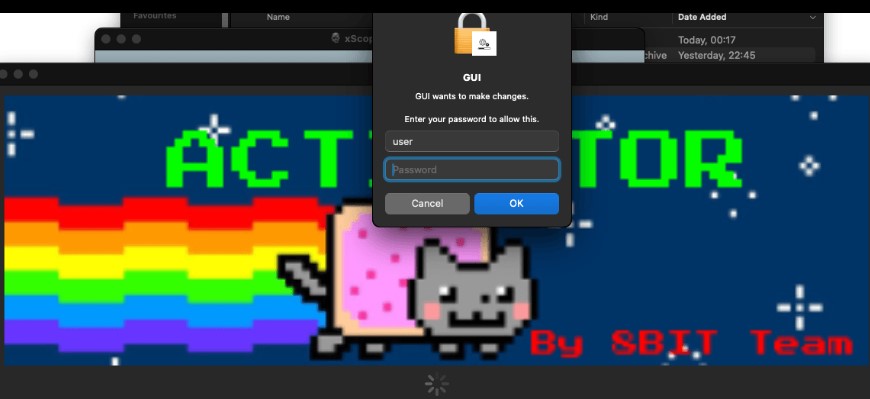
To deceive users, the infected installation package displayed a window with installation instructions, instructing them to copy the application to the /Applications/ directory and launch an application called “Activator.” 
Crypto
Activator window and password form to target crypto users. Source: Kaspersky

Although appearing unsophisticated at first glance, Activator prompted users to enter a password, effectively granting the malware administrator privileges.

Upon execution, the malware checked the system for an installed copy of the programming language Python 3 and, if absent, installed a previously copied version of Python 3 from the Macbook operating system directory. 

The malware then ” patched” the downloaded app by comparing the modified executable with a sequence hardcoded inside Activator. If a match was found, the malware removed the initial bytes, making the application appear cracked and functional to the user. However, the true intentions of the attackers became apparent as the malware initiated its main payload. 

The infected sample established communication with a command-and-control (C2) server by generating a unique Uniform Resource Locator (URL), or web address, through a combination of hardcoded words and a random third-level domain name. 

This method allowed the malware to conceal its activities within normal DNS server traffic, ensuring the payload download.

The decrypted script obtained from the C2 server – a remote server or infrastructure used by cybercriminals to control and manage their malware or botnet operations – revealed that the malware operated by executing arbitrary commands received from the server. These commands were often delivered as Base64-encoded Python scripts.

Furthermore, the malware harvested sensitive information from the infected system, including the operating system version, user directories, list of installed applications, CPU type, and external IP address. The gathered data was then sent back to the server.

Malware Campaign Targets Crypto Wallet Applications

While analyzing the malware campaign, Kaspersky observed that the C2 server did not return any commands during their investigation and eventually stopped responding. 

However, subsequent attempts to download the third-stage Python script led to the discovery of updates in the script’s metadata, indicating ongoing development and adaptation by the malware operators.

Additionally, the malware contained functions specifically targeting popular crypto wallet applications, such as Exodus and Bitcoin-Qt. 

If these applications were detected on the infected system, the malware attempted to replace them with infected versions obtained from a different host, apple-analyzer [.]com. 

These infected crypto wallets included mechanisms to steal wallet unlock passwords and secret recovery phrases from unsuspecting users.

The cybersecurity firm emphasized that malicious actors continue to distribute cracked applications to gain access to users’ computers. 

By exploiting user trust during software installation, attackers can easily escalate their privileges by prompting users to enter their passwords. Kaspersky also highlighted the techniques employed by the malware campaign, such as storing the Python script inside a domain TXT record on a DNS server, demonstrating the “ingenuity” of the attackers.

Crypto
The total crypto market cap dropped below $1.5 trillion on the daily chart. Source: TOTAL on TradingView.com

Featured image from Shutterstock, chart from TradingView.com



Source link

Related articles

WEMIX says attacker moved about $724,000 after contract breach

WEMIX says attacker moved about $724,000 after contract breach

July 26, 2026
CFTC Warns Prediction Markets Over Vague Self-Certification

CFTC Warns Prediction Markets Over Vague Self-Certification

July 26, 2026
Share76Tweet47

Related Posts

WEMIX says attacker moved about $724,000 after contract breach

WEMIX says attacker moved about $724,000 after contract breach

by approx
July 26, 2026
0

WEMIX suspended bridges, liquidity-pool trading and several services after an attacker compromised a WEMIX$-linked contract and moved 724,198 USDC.e. Source...

CFTC Warns Prediction Markets Over Vague Self-Certification

CFTC Warns Prediction Markets Over Vague Self-Certification

by approx
July 26, 2026
0

For the second time this year, the US Commodity Futures Trading Commission (CFTC) issued a warning to prediction markets operators...

Russia’s Biggest Bank Plans Crypto Trading Infrastructure By Year End

Russia’s Biggest Bank Plans Crypto Trading Infrastructure By Year End

by approx
July 26, 2026
0

Sberbank, Russia’s biggest bank, plans to build cryptocurrency trading infrastructure including a digital depository no later than Dec. 1 as...

Bitcoin OG selling eases as dormant BTC movement hits 4-year low: Thorn

Bitcoin OG selling eases as dormant BTC movement hits 4-year low: Thorn

by approx
July 26, 2026
0

Dormant Bitcoin activity fell to its lowest level since Q3 2022, suggesting long-term holders have slowed distribution after heavy profit-taking....

South Korea’s largest bank to launch payment service on JPMorgan’s Kinexys

South Korea’s largest bank to launch payment service on JPMorgan’s Kinexys

by approx
July 26, 2026
0

South Korea’s largest lender will use JPMorgan’s blockchain platform to support US dollar cross-border payments for import and export businesses...

Load More

youssufi.com

sephina.com

[vc_row full_width="stretch_row" parallax="content-moving" vc_row_background="" background_repeat="no-repeat" background_position="center center" footer_scheme="dark" css=".vc_custom_1517813231908{padding-top: 60px !important;padding-bottom: 30px !important;background-color: #191818 !important;background-position: center;background-repeat: no-repeat !important;background-size: cover !important;}" footer_widget_title_color="#fcbf46" footer_button_bg="#fcb11e"][vc_column width="1/4"]

We bring you the latest in Crypto News

[/vc_column][vc_column width="1/4"][vc_wp_categories]
[/vc_column][vc_column width="1/4"][vc_wp_tagcloud taxonomy="post_tag"][/vc_column][vc_column width="1/4"]

Newsletter

[vc_raw_html]JTNDcCUzRSUzQ2RpdiUyMGNsYXNzJTNEJTIydG5wJTIwdG5wLXN1YnNjcmlwdGlvbiUyMiUzRSUwQSUzQ2Zvcm0lMjBtZXRob2QlM0QlMjJwb3N0JTIyJTIwYWN0aW9uJTNEJTIyaHR0cHMlM0ElMkYlMkZhcHByb3gub3JnJTJGJTNGbmElM0RzJTIyJTNFJTBBJTBBJTNDaW5wdXQlMjB0eXBlJTNEJTIyaGlkZGVuJTIyJTIwbmFtZSUzRCUyMm5sYW5nJTIyJTIwdmFsdWUlM0QlMjIlMjIlM0UlM0NkaXYlMjBjbGFzcyUzRCUyMnRucC1maWVsZCUyMHRucC1maWVsZC1maXJzdG5hbWUlMjIlM0UlM0NsYWJlbCUyMGZvciUzRCUyMnRucC0xJTIyJTNFRmlyc3QlMjBuYW1lJTIwb3IlMjBmdWxsJTIwbmFtZSUzQyUyRmxhYmVsJTNFJTBBJTNDaW5wdXQlMjBjbGFzcyUzRCUyMnRucC1uYW1lJTIyJTIwdHlwZSUzRCUyMnRleHQlMjIlMjBuYW1lJTNEJTIybm4lMjIlMjBpZCUzRCUyMnRucC0xJTIyJTIwdmFsdWUlM0QlMjIlMjIlM0UlM0MlMkZkaXYlM0UlMEElM0NkaXYlMjBjbGFzcyUzRCUyMnRucC1maWVsZCUyMHRucC1maWVsZC1lbWFpbCUyMiUzRSUzQ2xhYmVsJTIwZm9yJTNEJTIydG5wLTIlMjIlM0VFbWFpbCUzQyUyRmxhYmVsJTNFJTBBJTNDaW5wdXQlMjBjbGFzcyUzRCUyMnRucC1lbWFpbCUyMiUyMHR5cGUlM0QlMjJlbWFpbCUyMiUyMG5hbWUlM0QlMjJuZSUyMiUyMGlkJTNEJTIydG5wLTIlMjIlMjB2YWx1ZSUzRCUyMiUyMiUyMHJlcXVpcmVkJTNFJTNDJTJGZGl2JTNFJTBBJTNDZGl2JTIwY2xhc3MlM0QlMjJ0bnAtZmllbGQlMjB0bnAtcHJpdmFjeS1maWVsZCUyMiUzRSUzQ2xhYmVsJTNFJTNDaW5wdXQlMjB0eXBlJTNEJTIyY2hlY2tib3glMjIlMjBuYW1lJTNEJTIybnklMjIlMjByZXF1aXJlZCUyMGNsYXNzJTNEJTIydG5wLXByaXZhY3klMjIlM0UlQzIlQTBCeSUyMGNvbnRpbnVpbmclMkMlMjB5b3UlMjBhY2NlcHQlMjB0aGUlMjBwcml2YWN5JTIwcG9saWN5JTNDJTJGbGFiZWwlM0UlM0MlMkZkaXYlM0UlM0NkaXYlMjBjbGFzcyUzRCUyMnRucC1maWVsZCUyMHRucC1maWVsZC1idXR0b24lMjIlM0UlM0NpbnB1dCUyMGNsYXNzJTNEJTIydG5wLXN1Ym1pdCUyMiUyMHR5cGUlM0QlMjJzdWJtaXQlMjIlMjB2YWx1ZSUzRCUyMlN1YnNjcmliZSUyMiUyMCUzRSUwQSUzQyUyRmRpdiUzRSUwQSUzQyUyRmZvcm0lM0UlMEElM0MlMkZkaXYlM0UlM0NiciUyRiUzRSUzQyUyRnAlM0U=[/vc_raw_html][/vc_column][/vc_row]
No Result
View All Result
  • Contact Us
  • Homepages
  • Business
  • Guide

© 2024 APPROX FOUNDATION - The Crypto Currency News