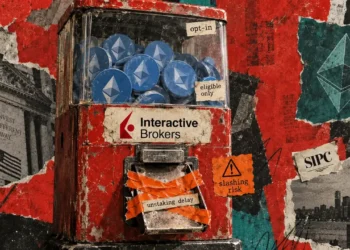




The average stablecoin liquidity per token declined from $1.8 million in 2021 to just $5,500 in March 2025, a 99.7% drop, forcing protocols to demonstrate sound reasons for investors to hold.
According to a recent report by research firm Decentralised, the drop illustrates how rising token issuance, now surpassing 40 million assets, has diluted available capital without a corresponding increase in demand or user retention.
The report frames this trend as evidence of a zero-sum dynamic in crypto capital allocation, where the influx of new tokens outpaces the expansion of capital pools, resulting in lower liquidity, weaker communities, and diminished engagement.
Without durable revenue sources, user interest frequently dissipates following short-term incentives such as airdrops. Without sustainable economic structures, attention has become a liability rather than an asset.
Liquidity compression
The report used stablecoin liquidity as a proxy for capital availability. It highlighted that the stagnation of new capital inflows amid surging token counts has left many crypto projects undercapitalized.
With fewer resources per token, the traditional 2021-era playbook — launching a community through Discord servers and airdrop campaigns — no longer produces lasting engagement.
Instead, the report argues, projects must now demonstrate product-market fit and sustained demand through revenue generation.
Revenue functions as a financial metric and as a mechanism for signaling relevance and economic utility. Protocols that generate and retain cash flows are better positioned to justify token valuations, establish governance legitimacy, and maintain user participation.
The report distinguished between mature platforms like Ethereum (ETH), which rely on ecosystem depth and native incentives, and newer protocols that must earn their place through consistent performance and transparent operations.
Varying capital needs and strategies
The report outlined four maturity stages for crypto projects: Explorers, Climbers, Titans, and Seasonals. Each category represents a different relationship to capital formation, risk tolerance, and value distribution.
Explorers are early-stage protocols operating with centralized governance and volatile, incentive-driven revenue. While some, such as Synthetix and Balancer, show short-term spikes in usage, their primary goal remains survival rather than profitability.
Climbers, with annual revenue between $10 million and $50 million, begin transitioning from emissions-based growth to user retention and ecosystem governance. These projects must navigate strategic decisions around growth versus distribution while preserving momentum.
Titans — such as Aave, Uniswap, and Hyperliquid — generate consistent revenue, have decentralized governance structures, and operate with strong network effects. Their focus is category dominance, not diversification. Due to the Titans’ established treasuries and operational discipline, they can afford to conduct token buybacks or other value-return programs.
Seasonals, by contrast, are short-lived phenomena driven by hype cycles and social momentum. Projects like FriendTech and PumpFun experience brief periods of high activity but struggle to maintain user interest or revenue consistency over the long-term.
While some may evolve, most remain speculative plays without enduring infrastructure relevance.
Revenue distribution models
Drawing parallels with public equity markets, the report noted that younger firms typically reinvest earnings while mature firms return capital via dividends or buybacks.
In crypto, this distinction is similarly tied to protocol maturity. Titans are well-positioned to implement buybacks or structured distributions, while Explorers and Climbers are advised to focus on reinvestment until operational fundamentals are secured.
According to the report, buybacks are a flexible distribution tool that is particularly suited for projects with volatile revenue or seasonal demand patterns.
However, the report cautioned that poorly executed buybacks can benefit short-term traders over long-term holders. Effective buyback programs require strong treasury reserves, valuation discipline, and transparent execution. Without these, distribution can erode trust and misallocate capital.
The trend mirrors broader shifts in traditional markets. In 2024, buybacks accounted for roughly 60% of corporate profit distribution, outpacing dividends.
This approach allows firms to modulate capital return according to market conditions, but governance risks remain if the incentives driving buyback decisions are misaligned.
Investor relations are key
The report identified investor relations (IR) as a critical but underdeveloped function across crypto projects. Despite public claims of transparency, most teams release financial data selectively.
To build durable trust with token holders and institutional participants, a more institutional approach, including quarterly reporting, real-time dashboards, and clear token distribution disclosures, is needed.
Leading projects are beginning to implement these standards. Aave’s “Buy and Distribute” program, backed by a $95 million treasury, allocates $1 million weekly for structured buybacks.
Hyperliquid dedicates 54% of revenue to buybacks and 46% to LP incentives, using revenue alone without external venture funding. Jupiter introduced the Litterbox Trust as a non-custodial mechanism to manage $9.7 million in JUP for future distributions only after reaching financial sustainability.
These examples show that responsible capital allocation depends on timing, governance, and communication, not just market conditions. As token liquidity per asset continues to decline, the pressure on projects to prove viability through cash flow and transparency will likely intensify.
Mentioned in this article