


Key Takeaways:
- Iran reopened the Strait of Hormuz, crashing Brent futures 10% to $87.19 and easing future energy inflation.
- Trump keeps CENTCOM’s blockade to calm markets until a 100% complete deal secures Iran’s nuclear assets next.
- With gas over $4 and CPI at 3.3%, Chevron urged conservation until the reopened strait cools costs next.
Oil Prices Plummet As Iran Opens Hormuz Strait Amidst Ceasefire Negotiations
The oil markets continue to face volatility fueled by the current Middle East conflict and the negotiations between the U.S. and Iran in the midst of a ceasefire.
On Friday, prices plummeted after an announcement ending Iran’s technical closure of the Strait of Hormuz, allowing all ships free passage. On social media, Iran’s Foreign Minister Abbas Araghchi declared:
“In line with the ceasefire in Lebanon, the passage for all commercial vessels through Strait of Hormuz is declared completely open for the remaining period of ceasefire, on the coordinated route as already announced by Ports and Maritime Organisation of the Islamic Rep. of Iran.”
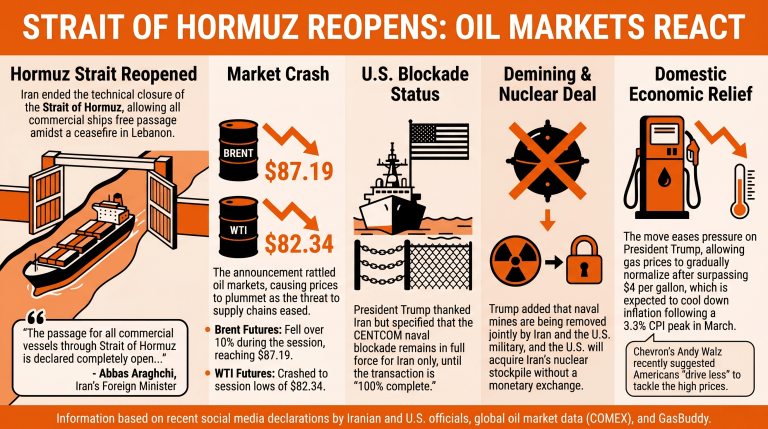
These remarks rattled oil markets, as COMEX Brent futures fell over 10% during the session, reaching $87.19. West Texas Intermediate (WTI) futures also experienced similar movements, with prices crashing as low as $82.34.
President Trump thanked Iran for reopening the Strait and specified that the naval blockade exerted by CENTCOM would “remain in full force and effect as it pertains to Iran, only, until such time as our transaction with Iran is 100% complete.” Also, the president stressed that this process should go very quickly, as most of the points have already been negotiated.
In subsequent posts, Trump added that all the mines that might be positioned in the strait were being removed by Iran and the U.S. military, and that the U.S. would get Iran’s nuclear stockpile without exchanging money.
The move eases pressure on the current administration as it could allow gas prices to gradually normalize after reaching over $4 per gallon, according to GasBuddy. This could prompt an inflation cooldown, after March’s CPI reached 3.3%, pushed by the energy index. This week, Chevron’s Andy Walz suggested Americans “drive less” and “try to conserve energy” to tackle the rise in gas prices.