



• About
  • FAQ
  • Earn Bitcoin while Surfing the net
  • Buy & Sell Crypto on Paxful
Newsletter
Approx Foundation
  • Home
    • Home – Layout 1
  • Bitcoin
  • Ethereum
  • Regulation
  • Market
  • Blockchain
  • Business
  • Guide
  • Contact Us
No Result
View All Result
  • Home
    • Home – Layout 1
  • Bitcoin
  • Ethereum
  • Regulation
  • Market
  • Blockchain
  • Business
  • Guide
  • Contact Us
No Result
View All Result
Approx Foundation
No Result
View All Result
Home Market

BIS Warns Stablecoins Are Breaking Capital Controls as Dollarization Accelerates

Moussa by Moussa
July 22, 2026
in Market
0
BIS Warns Stablecoins Are Breaking Capital Controls as Dollarization Accelerates
189
SHARES
1.5k
VIEWS
Share on FacebookShare on Twitter

Related articles

ETH, SOL Supply Growth Could Fall Below Gold by 2031

ETH, SOL Supply Growth Could Fall Below Gold by 2031

August 16, 2026
XRP Active Addresses Hit 2-Month High as Sentiment Turns Bearish

XRP Active Addresses Hit 2-Month High as Sentiment Turns Bearish

August 16, 2026


Key Takeaways

  • BIS researchers Hofmann, Mehrotra and Paulick studied 130+ economies and stablecoin data from 184 countries since 2017.
  • Capital controls cut bank dollarization by up to 32 percentage points but showed no effect on stablecoin inflows.
  • Stablecoin market capitalization has nearly tripled since 2023, led by USDT and USDC.

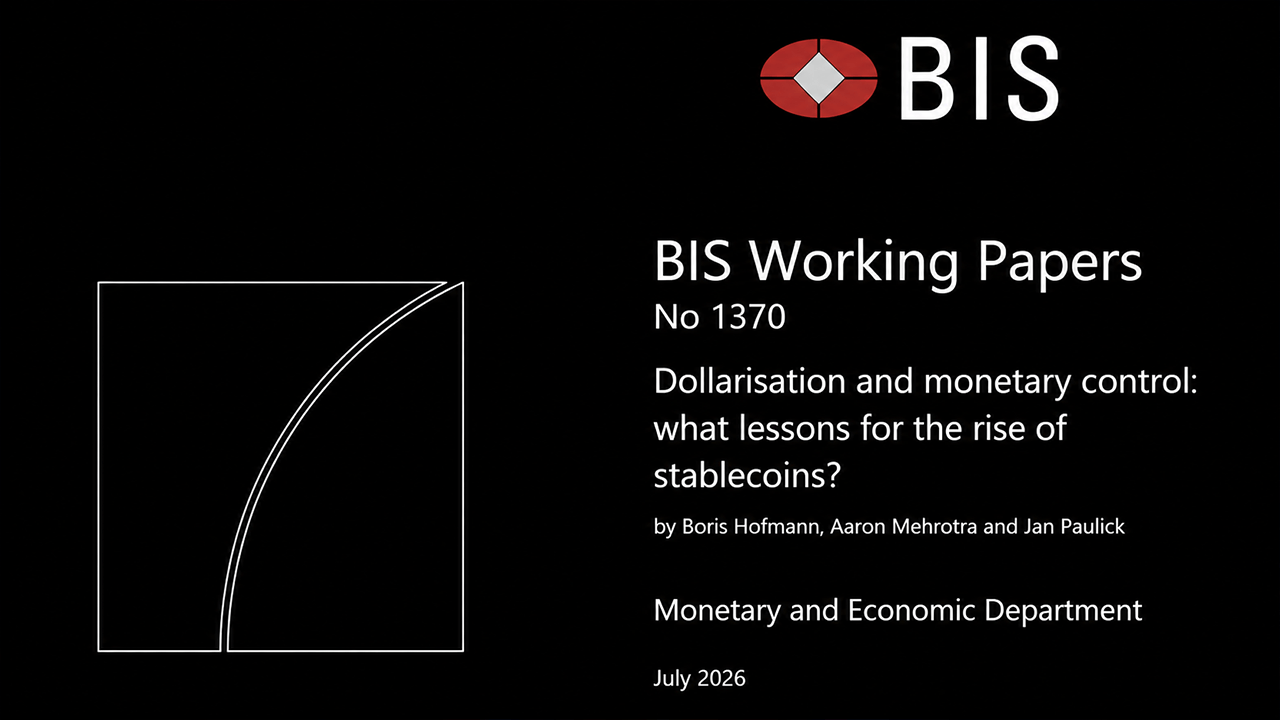
A Bank for International Settlements (BIS) working paper published in July 2026 by BIS economists Boris Hofmann, Aaron Mehrotra, and Jan Paulick compares the rise of stablecoins in emerging and developing economies to “deposit dollarisation,” the long-standing practice of holding savings in foreign-currency bank accounts. The paper draws on data covering more than 130 economies from 1990 to 2019 for deposit dollarisation, and stablecoin flow data from Chainalysis covering 184 countries from 2017 to 2024.

Stablecoin market capitalization has nearly tripled since 2023, driven almost entirely by the two largest U.S. dollar-pegged tokens, Tether’s USDT and Circle’s USDC, according to the paper. Those two tokens make up more than 80% of the total stablecoin market capitalization.

Same Drivers, Different Outcomes

The researchers found that deposit dollarization and stablecoin inflows respond to similar economic pressures. Both rise when a country’s exchange rate passes through strongly into local inflation, and both climb during financial crises.

One difference stood out. Banking crises are linked to higher stablecoin inflows, but not to higher deposit dollarization. Sovereign debt crises show the opposite pattern, pushing up deposit dollarization by 4 to 6 percentage points over a decade, with little effect on stablecoin inflows.

Hofmann, Mehrotra and Paulick wrote that the banking-crisis link makes sense given that stablecoins operate outside the traditional banking system, becoming more attractive when banks are the source of instability.

Gross stablecoin inflows relative to GDP were essentially zero across countries in 2019. By 2021, the median inflow rose to about 1.2% of GDP, with some countries seeing inflows near 7% of GDP. By 2023, the median had eased to roughly 0.9% of GDP.

Capital Controls Don’t Reach Stablecoins

The paper’s clearest finding for policymakers involves regulation. Countries that require approval for residents to hold foreign-currency bank accounts saw deposit dollarization ratios around 25 to 32 percentage points lower than countries without those rules, based on data from 2000 to 2016.

Stablecoins showed no such response. The researchers found no statistically significant relationship between restrictions on cross-border stablecoin use and the size of stablecoin inflows.

The paper attributes this to where stablecoins circulate. Bank deposits sit inside regulated institutions that supervisors can reach directly. Stablecoins move on public blockchains and can sit in unhosted wallets, outside the reach of the same rules.

Dollarization Is Hard to Undo

Both forms of dollarization showed high persistence in the data. Once a country’s deposit dollarization ratio rises, it tends to stay elevated even after the inflation or crisis that triggered it has passed. Autoregressive estimates put the persistence coefficient near 0.8 across both advanced and developing economies, a figure that has not changed since 2000.

The researchers also looked for signs that stablecoins are simply replacing bank deposits as a dollar-holding vehicle. They found limited evidence of that kind of substitution, suggesting stablecoin demand in emerging markets is coming from different users, possibly younger and more tech-focused, rather than shifting existing dollar deposits into crypto form.

Inflation Risk Is Not a Straight Line

Using an inflation-at-risk model applied to 91 emerging and developing economies, the BIS authors found that the relationship between dollarisation and inflation is not linear. Countries with very low dollarization showed no meaningful inflation effect. Countries with moderate dollarization showed somewhat higher inflation risk across the distribution. Countries with the highest dollarization levels showed lower inflation risk, particularly at the upper end of the distribution.

The authors describe this as highly dollarized economies effectively importing the credibility of the U.S. dollar as an anchor. The paper found limited evidence that dollarization changes how monetary policy shocks pass through to growth, inflation, or exchange rates.

What Comes Next

The authors caution that stablecoin adoption may not keep expanding at its recent pace, and that lessons from decades of bank dollarization may not fully apply to a system built to operate outside supervised finance. Still, the paper argues that if stablecoin growth in emerging markets continues, central banks and finance ministries face a channel for U.S. dollar exposure that existing capital-flow tools were not built to manage.




Source link

Share76Tweet47

Related Posts

ETH, SOL Supply Growth Could Fall Below Gold by 2031

ETH, SOL Supply Growth Could Fall Below Gold by 2031

by Moussa
August 16, 2026
0

Key TakeawaysGrayscale projects ETH inflation could fall to 0.4% and SOL to 1.1% annually by 2031 under two pending proposals.Ethereum’s...

XRP Active Addresses Hit 2-Month High as Sentiment Turns Bearish

XRP Active Addresses Hit 2-Month High as Sentiment Turns Bearish

by Moussa
August 16, 2026
0

Key TakeawaysXRP recorded 49,929 active addresses within a 24-hour period.XRP commentary reached its most bearish level in three months.Higher Ledger...

Israel’s Oldest Bank Bets Big on Bitcoin, Ether and Solana Trading – Bitcoin News

Israel’s Oldest Bank Bets Big on Bitcoin, Ether and Solana Trading – Bitcoin News

by Moussa
August 15, 2026
0

Key TakeawaysBank Leumi and Galaxy Digital target an early 2027 crypto trading launch.Israel’s 2026 regulatory changes may make bank-based crypto...

French Tax Agency Admits Data Breach as Hacker Steals 678k Records

French Tax Agency Admits Data Breach as Hacker Steals 678k Records

by Moussa
August 15, 2026
0

Massive 678K Taxpayer Data Breach Worries French Crypto Holders A new threat has arisen in France for cryptocurrency holders, as...

Fidelity, ARK Lead $131M Bitcoin Outflow as Ether, XRP ETFs Gain

Fidelity, ARK Lead $131M Bitcoin Outflow as Ether, XRP ETFs Gain

by Moussa
August 14, 2026
0

Key TakeawaysARK 21Shares led $131.13M in bitcoin ETF outflows on Thursday as selling spread across major funds.Ether gained $6.72M and...

Load More

youssufi.com

sephina.com

[vc_row full_width="stretch_row" parallax="content-moving" vc_row_background="" background_repeat="no-repeat" background_position="center center" footer_scheme="dark" css=".vc_custom_1517813231908{padding-top: 60px !important;padding-bottom: 30px !important;background-color: #191818 !important;background-position: center;background-repeat: no-repeat !important;background-size: cover !important;}" footer_widget_title_color="#fcbf46" footer_button_bg="#fcb11e"][vc_column width="1/4"]

We bring you the latest in Crypto News

[/vc_column][vc_column width="1/4"][vc_wp_categories]
[/vc_column][vc_column width="1/4"][vc_wp_tagcloud taxonomy="post_tag"][/vc_column][vc_column width="1/4"]

Newsletter

[vc_raw_html]JTNDcCUzRSUzQ2RpdiUyMGNsYXNzJTNEJTIydG5wJTIwdG5wLXN1YnNjcmlwdGlvbiUyMiUzRSUwQSUzQ2Zvcm0lMjBtZXRob2QlM0QlMjJwb3N0JTIyJTIwYWN0aW9uJTNEJTIyaHR0cHMlM0ElMkYlMkZhcHByb3gub3JnJTJGJTNGbmElM0RzJTIyJTNFJTBBJTBBJTNDaW5wdXQlMjB0eXBlJTNEJTIyaGlkZGVuJTIyJTIwbmFtZSUzRCUyMm5sYW5nJTIyJTIwdmFsdWUlM0QlMjIlMjIlM0UlM0NkaXYlMjBjbGFzcyUzRCUyMnRucC1maWVsZCUyMHRucC1maWVsZC1maXJzdG5hbWUlMjIlM0UlM0NsYWJlbCUyMGZvciUzRCUyMnRucC0xJTIyJTNFRmlyc3QlMjBuYW1lJTIwb3IlMjBmdWxsJTIwbmFtZSUzQyUyRmxhYmVsJTNFJTBBJTNDaW5wdXQlMjBjbGFzcyUzRCUyMnRucC1uYW1lJTIyJTIwdHlwZSUzRCUyMnRleHQlMjIlMjBuYW1lJTNEJTIybm4lMjIlMjBpZCUzRCUyMnRucC0xJTIyJTIwdmFsdWUlM0QlMjIlMjIlM0UlM0MlMkZkaXYlM0UlMEElM0NkaXYlMjBjbGFzcyUzRCUyMnRucC1maWVsZCUyMHRucC1maWVsZC1lbWFpbCUyMiUzRSUzQ2xhYmVsJTIwZm9yJTNEJTIydG5wLTIlMjIlM0VFbWFpbCUzQyUyRmxhYmVsJTNFJTBBJTNDaW5wdXQlMjBjbGFzcyUzRCUyMnRucC1lbWFpbCUyMiUyMHR5cGUlM0QlMjJlbWFpbCUyMiUyMG5hbWUlM0QlMjJuZSUyMiUyMGlkJTNEJTIydG5wLTIlMjIlMjB2YWx1ZSUzRCUyMiUyMiUyMHJlcXVpcmVkJTNFJTNDJTJGZGl2JTNFJTBBJTNDZGl2JTIwY2xhc3MlM0QlMjJ0bnAtZmllbGQlMjB0bnAtcHJpdmFjeS1maWVsZCUyMiUzRSUzQ2xhYmVsJTNFJTNDaW5wdXQlMjB0eXBlJTNEJTIyY2hlY2tib3glMjIlMjBuYW1lJTNEJTIybnklMjIlMjByZXF1aXJlZCUyMGNsYXNzJTNEJTIydG5wLXByaXZhY3klMjIlM0UlQzIlQTBCeSUyMGNvbnRpbnVpbmclMkMlMjB5b3UlMjBhY2NlcHQlMjB0aGUlMjBwcml2YWN5JTIwcG9saWN5JTNDJTJGbGFiZWwlM0UlM0MlMkZkaXYlM0UlM0NkaXYlMjBjbGFzcyUzRCUyMnRucC1maWVsZCUyMHRucC1maWVsZC1idXR0b24lMjIlM0UlM0NpbnB1dCUyMGNsYXNzJTNEJTIydG5wLXN1Ym1pdCUyMiUyMHR5cGUlM0QlMjJzdWJtaXQlMjIlMjB2YWx1ZSUzRCUyMlN1YnNjcmliZSUyMiUyMCUzRSUwQSUzQyUyRmRpdiUzRSUwQSUzQyUyRmZvcm0lM0UlMEElM0MlMkZkaXYlM0UlM0NiciUyRiUzRSUzQyUyRnAlM0U=[/vc_raw_html][/vc_column][/vc_row]
No Result
View All Result
  • Contact Us
  • Homepages
  • Business
  • Guide

© 2024 APPROX FOUNDATION - The Crypto Currency News