





Key Takeaways
- BIP-110’s minority chain stalled after 2 blocks under Bitcoin’s 127.48 trillion difficulty.
- Luke Dashjr weighed new PoW options after BIP-110 miner support stayed near 0%-2.6%.
- Bitcoin Knots has no PoW switch scheduled as BIP-110 backers debate how to revive the chain. There’s suggestions to initiate the revival via a consensus change, possibly in September.
The BIP-110 chain split from Bitcoin after mandatory signaling began at block 961632 on Aug. 8. Nodes enforcing BIP-110 began rejecting blocks that did not signal support for the proposal, while the dominant Bitcoin chain continued operating under its existing consensus rules. Roughnecks, using Ocean’s DATUM system, mined BIP-110 blocks 961632 and 961633, but the minority chain then stalled as Bitcoin continued producing blocks normally.
Bitcoin’s Difficulty Leaves the Minority Chain Stranded
The problem facing the BIP-110 chain is straightforward: it inherited Bitcoin’s roughly 127.48 trillion mining difficulty while attracting only a tiny fraction of Bitcoin’s SHA-256d hashpower.
Essentially, Bitcoin’s mining difficulty determines how hard it is to discover a valid block. Bitcoin can sustain such an enormous difficulty because vast amounts of specialized mining equipment are constantly searching for blocks. The BIP-110 chain kept that same difficulty after the split but did not take anything close to the same amount of hashpower with it.
That mismatch is why the chain slowed so dramatically. The rules did not automatically adjust difficulty downward simply because most miners stayed with Bitcoin. With only limited SHA-256d hashpower working on the minority chain, finding another block could take an extremely long time unless substantially more miners join or the chain’s rules are changed.
‘Fire the Miners’ Emerges as a Possible Escape Route
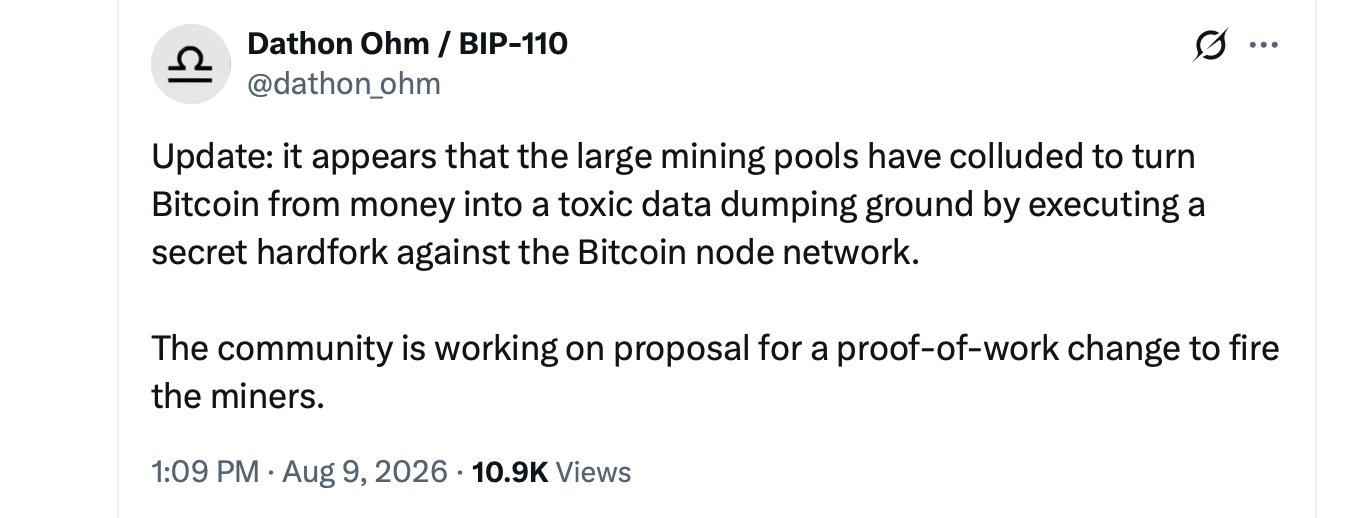
That predicament has pushed some BIP-110 supporters toward a much more consequential contingency: changing the proof-of-work algorithm used by the minority chain. On Aug. 9, pseudonymous BIP-110 author Dathon Ohm accused large mining pools of colluding to turn Bitcoin “from money into a toxic data dumping ground” and said supporters were working on a proof-of-work proposal “to fire the miners.”
The idea would not alter Bitcoin’s dominant chain. Instead, the contemplated change would give the BIP-110 minority chain a different mining algorithm, allowing it to escape dependence on the SHA-256d mining industry that overwhelmingly remained with Bitcoin after the split.
That distinction matters. Existing Bitcoin miners operate ASIC machines specifically engineered for SHA-256d. If the BIP-110 chain adopted another algorithm, those machines could no longer automatically dominate mining on that chain and hurt it in any way.
BIP-110’s Failed Signaling Push Drives the Debate
BIP-110, formally known as the Reduced Data Temporary Softfork, was authored by Ohm with significant input from longtime Bitcoin developer and Bitcoin Knots maintainer Luke Dashjr.
The proposal temporarily restricts several ways non-financial data can be embedded in transactions, including techniques associated with Ordinals, BRC-20 tokens and similar protocols. Supporters argue the restrictions would reduce blockchain data they consider spam while preserving Bitcoin primarily as a monetary settlement network.
BIP-110 was designed around a 55% miner-signaling threshold. If miners did not voluntarily reach that level, enforcing nodes would begin rejecting non-signaling blocks once the mandatory period started at block 961632.
Miner support never came close. Signaling remained roughly between 2% and 2.6% before the split, while major mining pools continued producing Bitcoin blocks without adopting BIP-110. The result was not that Bitcoin stopped. Instead, the enforcing nodes separated onto a minority chain that had almost none of Bitcoin’s total hashpower behind it.
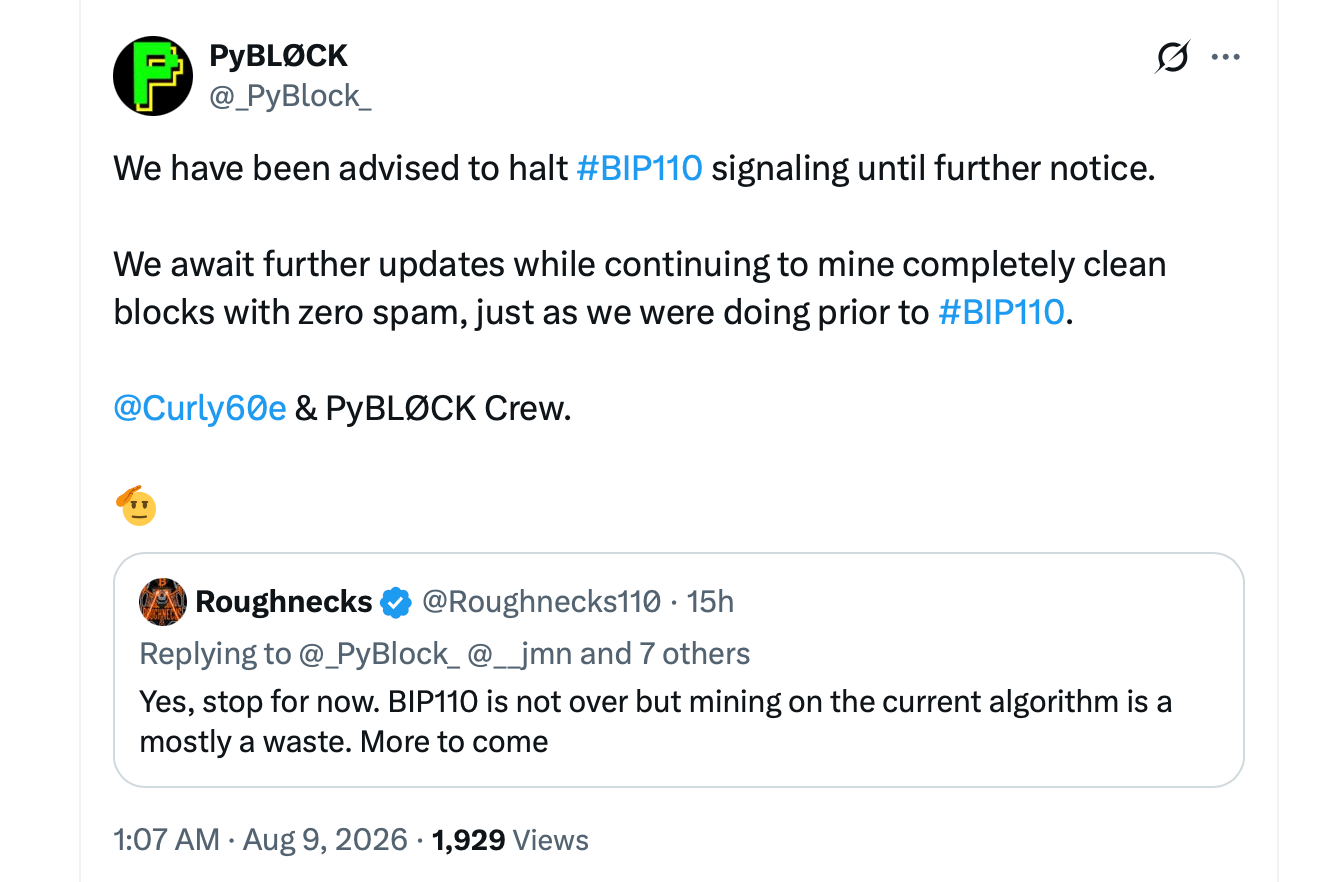
A mining pool connected with Ocean Mining called Roughnecks mined the minority chain’s only two mined block so far and then called it quits. Several other mining pools following the BIP-110 chain also halted but say they are still filtering transactions the best they can. At the time of writing, onchain data shows there’s an extremely small fraction of hashpower trying to discover BIP-110 chain’s block number 961634.
Dashjr Weighs Alternatives to SHA-256d in Knots Discord
Inside the Bitcoin Knots Discord server’s #strategic channel, the discussion has increasingly focused on what kind of proof-of-work system could keep the BIP-110 chain moving without relying on existing Bitcoin miners.

One participant summarized the motivation bluntly: “The reason for ditching SHA256d is to fire the miners, not because it’s broken.” Dashjr responded, “It’s also broken,” and pointed to ASICBoost when asked what he considered wrong with SHA-256d. Discord participants have discussed specific crypto algorithms like RandomX, KT256, BLAKE3, BLAKE2 variants, Scrypt, Autolykos v2, CPU and GPU mining and other approaches.
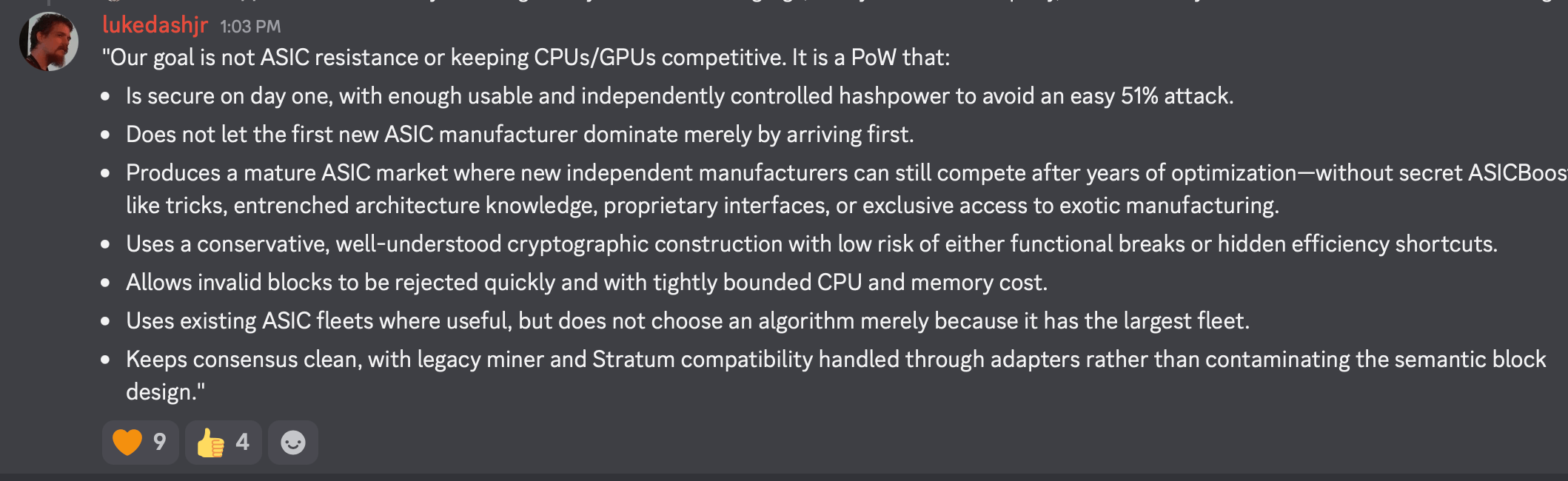
The central question is not simply which algorithm works technically. The group is trying to determine what algorithm could give the minority chain usable mining power without immediately handing control to another established group of specialized miners. Several of the members of the Discord are relying on generated artificial intelligence (AI) summaries for ideas and asking Dashjr what he thinks.
Every Mining Option Creates a New Problem
Scrypt illustrates the problem. Some Knots Discord participants stressed that Litecoin and Dogecoin already have substantial Scrypt ASIC infrastructure, meaning a BIP-110 chain using Scrypt could potentially attract meaningful hashpower quickly.
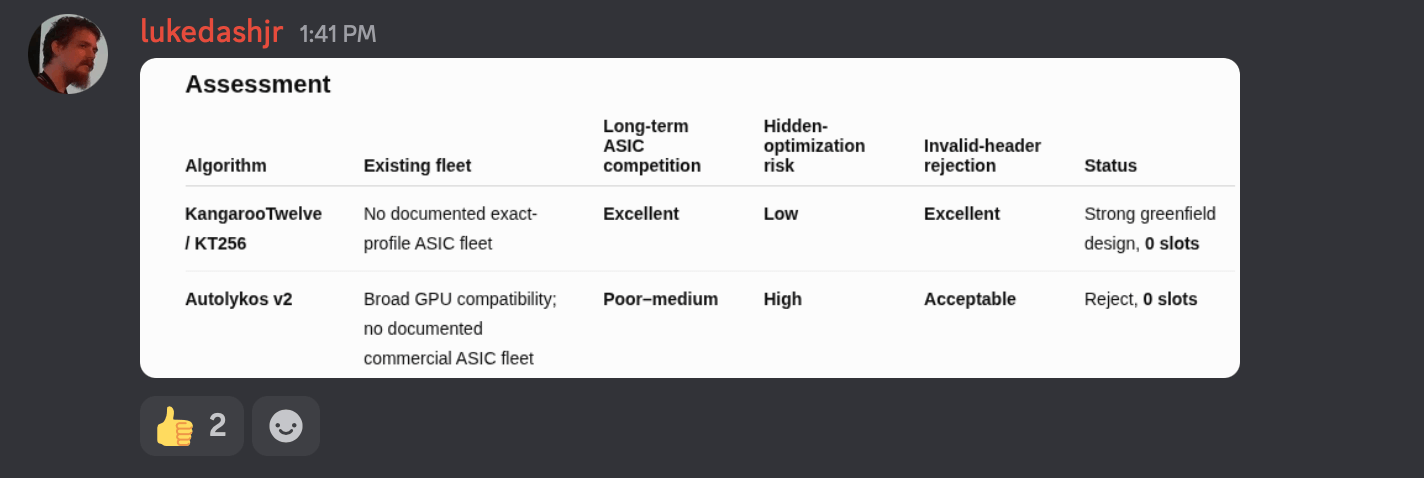
But those same miners would begin with an enormous advantage. The #strategic channel participants raised the possibility that existing Scrypt operators could simply dominate or attack the new chain. A completely new algorithm creates the opposite risk. Nobody begins with an established ASIC fleet, but whoever develops specialized hardware first could eventually gain an outsized advantage.
CPU- or GPU-oriented mining could broaden participation initially, but specialized machines could still emerge later. The discussion therefore centers on how to bootstrap a viable minority chain without recreating the same concentration problem supporters believe exists around SHA-256d mining.
Dashjr Floats a Random Algorithm Selection
Dashjr suggested one possible way to reduce the risk of somebody preparing specialized hardware ahead of everyone else.
Rather than choosing a single algorithm in advance, he proposed assembling a short list of acceptable candidates and allowing a deterministic random process to make the final selection.
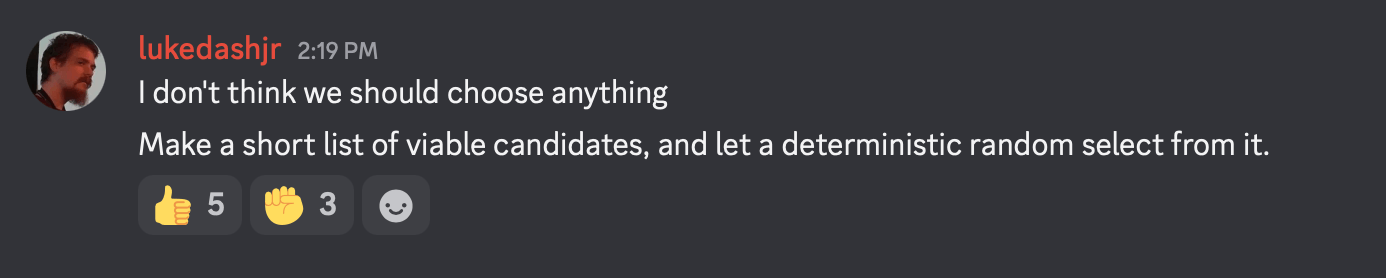
“I don’t think we should choose anything,” Dashjr said. “Make a short list of viable candidates, and let a deterministic random select from it.” He later explained the rationale:
“That way nobody knows before everyone knows.”
The proposal appears designed to prevent miners or hardware manufacturers from secretly gaining a head start by knowing which algorithm the BIP-110 chain will ultimately use.
The Argument Expands Into Bitcoin Governance
The technical debate also exposes a deeper disagreement over the relationship between miners and nodes. One participant compared nodes to a “legislative branch” and miners to an “executive branch,” arguing miners “should have no say.” Another said supporters needed to find a way to stop depending on miners for consensus.

Those comments reflect a lesson some participants appear to have drawn from the BIP-110 split. Their nodes successfully enforced the rules they wanted, but enforcing those rules did not bring Bitcoin’s industrial mining base with them. The resulting question is whether the minority chain should continue competing for SHA-256d hashpower or change its proof-of-work system so existing Bitcoin miners no longer possess the same incumbent advantage.
No Proof-of-Work Change Has Been Activated
Experimental code already exists. Knots developer Chris Guida rebased proof-of-work change code originally written by Dashjr around Bitcoin’s 2017 block-size conflict onto a recent Bitcoin Knots codebase. The branch includes changes involving mining validation, consensus parameters, chain configuration and testing. It also allows alternative algorithms and a dramatically easier initial mining target that could help a minority chain begin producing blocks before normal difficulty adjustment takes over.
At the time of writing, just after 3 p.m. EDT on Sunday, nothing has been activated or approved by the #strategic Bitcoin Knots server participants. No proof-of-work algorithm has been selected, no activation height has been announced and Bitcoin Knots has not committed to a proof-of-work (PoW) change. While Dashjr is actively discussing the PoW change, many well known BIP-110 evangelists are not present in the discussion or are using Discord aliases.
For now, the BIP-110 chain remains a stalled SHA-256d minority fork that produced two blocks before Bitcoin’s massive inherited difficulty caught up with its limited hashpower. The next question is whether supporters can attract enough SHA-256d miners to revive it or decide that keeping the chain alive requires breaking with Bitcoin’s proof-of-work system altogether.
Bitcoin Developers Look to Move Dashjr off the BIP Editors List
Mark Erhardt, widely known in bitcoin circles as “Murch,” a prominent software engineer, researcher and Bitcoin developer, took to X to reveal that a request has been made to remove Dashjr as a BIP editor.
“Since it will likely land here on Twitter soon anyway: I have recommended the removal of Luke Dashjr from the BIP Editors to the mailing list,” Murch wrote on the social media platform. Dashjr then replied to Murch’s X post.
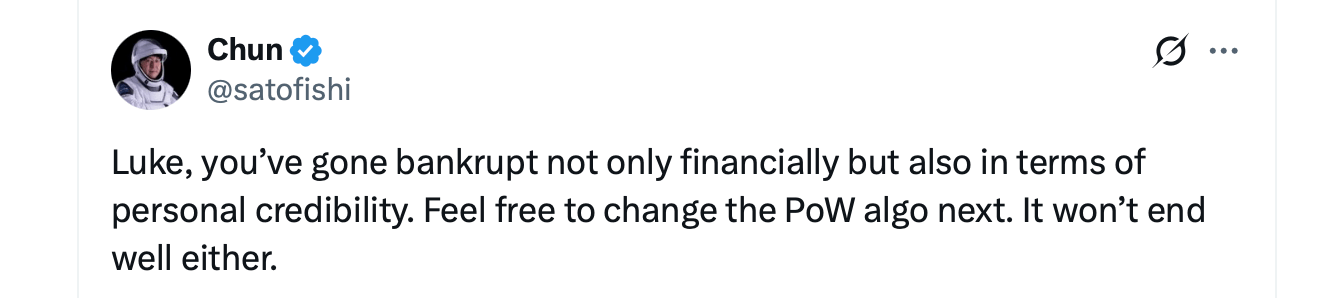
“Since my reply will likely be censored (the mailing list is completely captured and corrupt), here it is: “These are false accusations. I have followed the BIP process consistently for years. Your novice opinions alone do not establish new processes. You are the one who stopped communicating, not I. You are the one who should be removed,” Dashjr stated on X in response to the criticism.