


• About
  • FAQ
  • Earn Bitcoin while Surfing the net
  • Buy & Sell Crypto on Paxful
Newsletter
Approx Foundation
  • Home
    • Home – Layout 1
  • Bitcoin
  • Ethereum
  • Regulation
  • Market
  • Blockchain
  • Business
  • Guide
  • Contact Us
No Result
View All Result
  • Home
    • Home – Layout 1
  • Bitcoin
  • Ethereum
  • Regulation
  • Market
  • Blockchain
  • Business
  • Guide
  • Contact Us
No Result
View All Result
Approx Foundation
No Result
View All Result
Home Regulation

Ethereum abandons its 8-year cryptography bet after proof systems flip the tradeoff

Moussa by Moussa
August 15, 2026
in Regulation
0
Ethereum abandons its 8-year cryptography bet after proof systems flip the tradeoff
189
SHARES
1.5k
VIEWS
Share on FacebookShare on Twitter


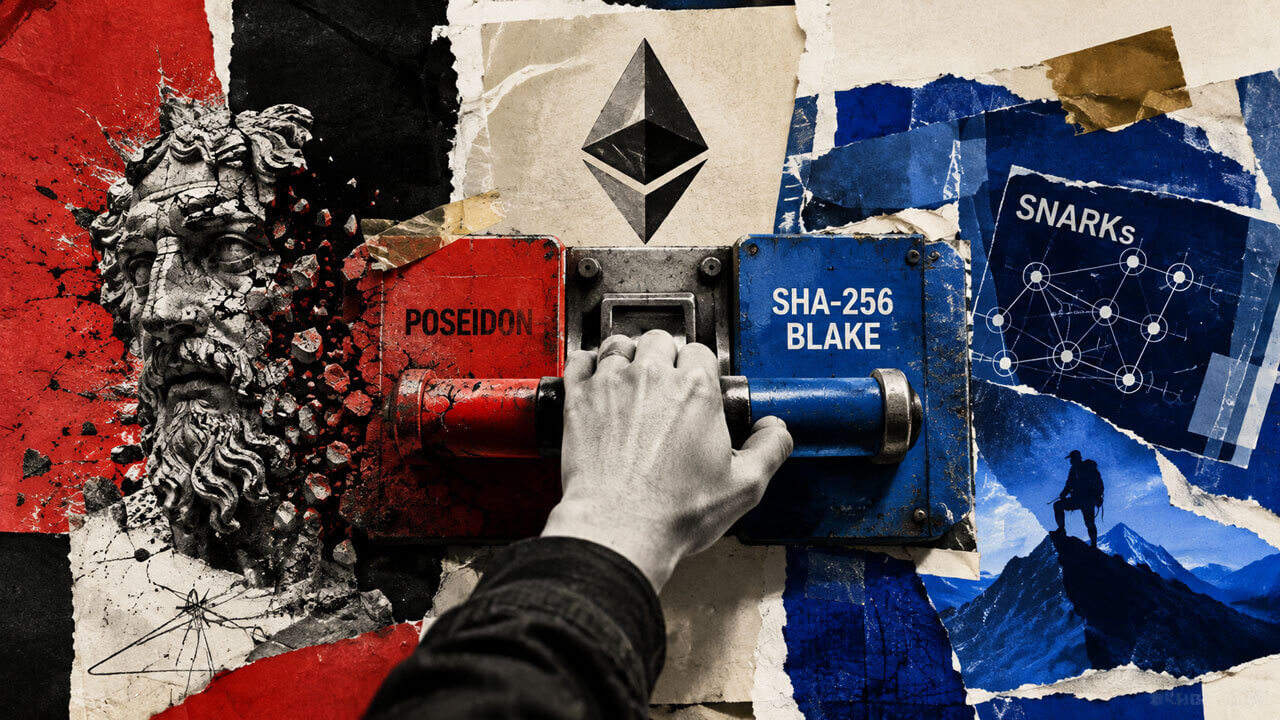
Ethereum researcher Justin Drake said on Aug. 13 that the Ethereum Foundation is abandoning Poseidon for future layer-1 (L1) designs and pivoting toward SHA or BLAKE hashes after eight years of work on specialized, proof-friendly cryptography.

Drake reported no break in Poseidon and issued no migration order, noting that recent gains in proof systems changed the performance tradeoff that had favored the hash.

SNARKs produce compact proofs that a computation was performed correctly. Many use arithmetic over large prime fields, where the bitwise operations behind conventional hashes such as SHA-256 and Keccak historically imposed a high proving cost. Poseidon was designed to lower that cost by fitting the proof system’s preferred math.

Ethereum considers Poseidon hash to boost zero-knowledge proof efficiencyEthereum considers Poseidon hash to boost zero-knowledge proof efficiency
Related Reading

Ethereum considers Poseidon hash to boost zero-knowledge proof efficiency

Poseidon promises reduced computational costs for Ethereum’s rollups but faces skepticism over performance.

Feb 26, 2025 · Oluwapelumi Adejumo

Binary-field proofs raise hash throughput

Binius research binary-field construction works naturally with 0s and 1s, closely matching Keccak’s bitwise operations. The Flock paper, posted July 29, applies newer techniques to large batches of standard hash computations.


Related articles

Bitmine may not need to buy more ETH to reach its 5% Ethereum goal

Bitmine may not need to buy more ETH to reach its 5% Ethereum goal

September 6, 2026
Hayes’ thesis meets dormant Fed plumbing

Hayes’ thesis meets dormant Fed plumbing

September 4, 2026

Flock’s authors report that one M4 Max core can prove about 82,000 BLAKE3 compression evaluations, 42,000 SHA-256 compressions, and 30,000 Keccak permutations per second. Ten cores exceeded 660,000 BLAKE3 compressions per second, and SHA-256 proving ran more than nine times faster than Binius64 in the paper’s comparison.

The proof-of-concept benchmark counts internal hash operations, while Ethereum transaction capacity and production throughput use different measurements.
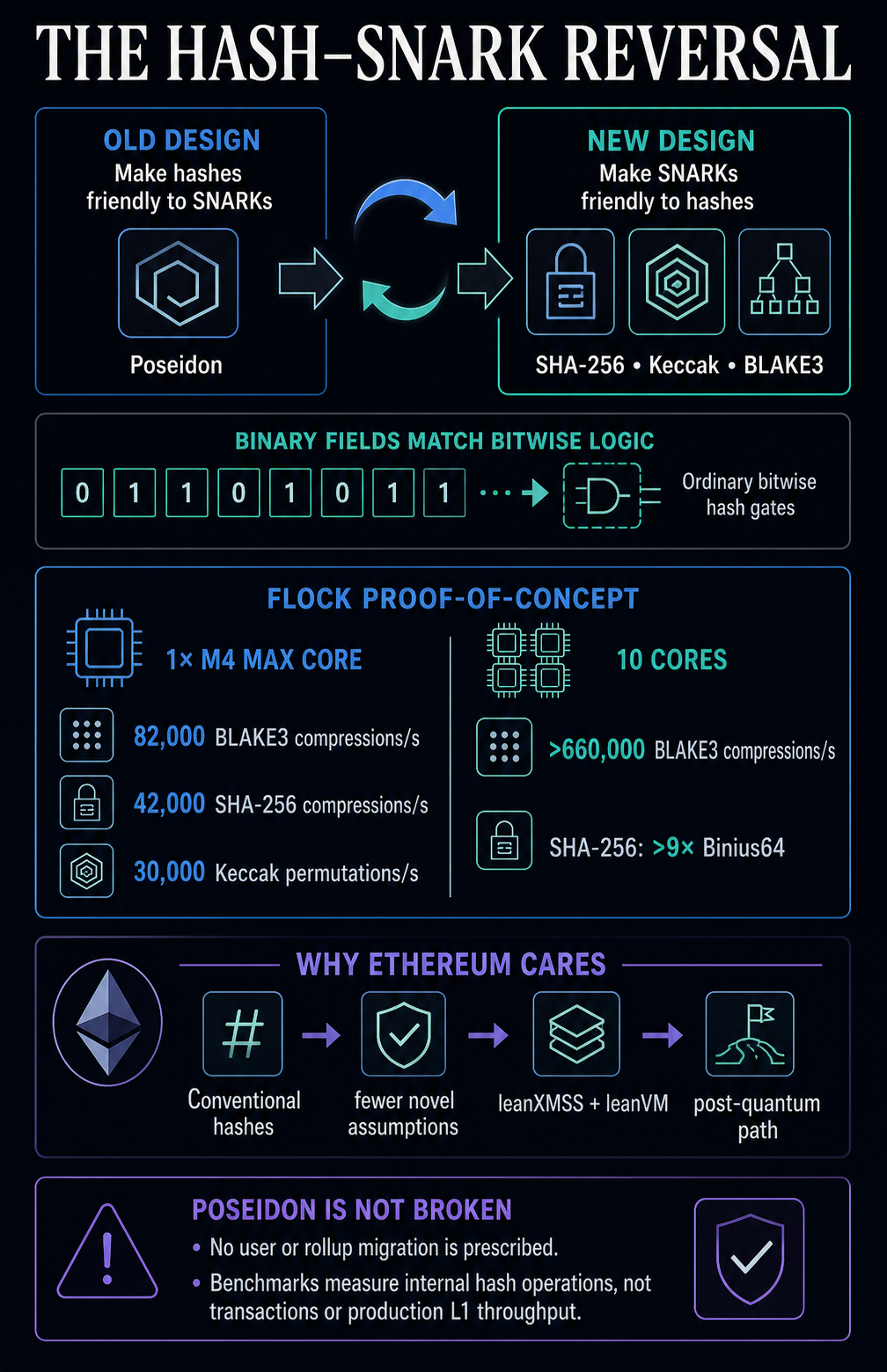
Infographic showing Ethereum's shift from Poseidon-friendly SNARK design to binary-field proofs for SHA-256, Keccak and BLAKE3, with Flock benchmark results and post-quantum implications.Infographic showing Ethereum's shift from Poseidon-friendly SNARK design to binary-field proofs for SHA-256, Keccak and BLAKE3, with Flock benchmark results and post-quantum implications.
Infographic compares Ethereum’s hash-to-SNARK reversal, Flock benchmarks, and post-quantum implications using Poseidon, SHA-256, Keccak, BLAKE3, and leanXMSS.

Drake described the advance as a reversal in cryptographic design: researchers have built hash-friendly SNARKs, reducing the need for SNARK-friendly hashes. Conventional hashes can enter Ethereum’s design process without carrying their former proving penalty.

SHA-256 is part of NIST’s Secure Hash Standard. BLAKE2 has had a public informational specification since 2015, separating it from the newer BLAKE3 implementation benchmarked by Flock.

CryptoSlate Daily Brief

Daily signals, zero noise.

Market-moving headlines and context delivered every morning in one tight read.

5-minute digest 100k+ readers

Free. No spam. Unsubscribe any time.

Whoops, looks like there was a problem. Please try again.

You’re subscribed. Welcome aboard.

Years of public analysis give cryptanalysts more time to test its design, and faster proofs now let Ethereum weigh that history without choosing a younger primitive mainly for proving speed.

Ethereum’s security roadmap separately identifies protocol simplification as a way to shrink the network’s attack surface.
Justin Drake reveals 10-year ‘Lean Ethereum' roadmap to achieve 10k TPS on mainnetJustin Drake reveals 10-year ‘Lean Ethereum' roadmap to achieve 10k TPS on mainnet
Related Reading

Justin Drake reveals 10-year ‘Lean Ethereum’ roadmap to achieve 10k TPS on mainnet

Ethereum researcher Justin Drake sketched a post-quantum, high-throughput roadmap for the next decade a day after Ethereum’s 10th anniversary.

Jul 31, 2025 · Gino Matos

Ethereum plans to replace validator BLS signatures with hash-based leanXMSS signatures, then use leanVM to aggregate their much larger data into compact proofs. Cheap proofs of conventional hashes would remove one obstacle from that architecture.

Drake’s personal strawmap places production-grade leanVM around 2027 and deployments across the consensus, data and execution layers in 2028. Ethereum’s official post-quantum roadmap gives a nonbinding target of about 2029 for core infrastructure and extends full execution-layer migration beyond that point.


As quantum ‘Q-Day' jumps to 2029, Ethereum faces a new fight over what to do with coins left in old walletsAs quantum ‘Q-Day' jumps to 2029, Ethereum faces a new fight over what to do with coins left in old wallets
Related Reading

As quantum ‘Q-Day’ jumps to 2029, Ethereum faces a new fight over what to do with coins left in old wallets

The Ethereum Foundation’s post-quantum roadmap argues that the real danger is a years-long struggle over how to move user wallets.

Mar 26, 2026 · Gino Matos

Ethereum’s roadmap tells users to leave their wallets unchanged for now, while Drake’s announcement calls for no changes to existing rollups or zkVMs and describes no deployed fork. The decision concerns which hash foundations Ethereum may use in a future proof-driven L1.




Source link

Share76Tweet47

Related Posts

Bitmine may not need to buy more ETH to reach its 5% Ethereum goal

Bitmine may not need to buy more ETH to reach its 5% Ethereum goal

by Moussa
September 6, 2026
0

Bitmine is still buying Ethereum, even as staking may make further purchases unnecessary to reach its 5% ownership target.The Nasdaq-listed...

Hayes’ thesis meets dormant Fed plumbing

Hayes’ thesis meets dormant Fed plumbing

by Moussa
September 4, 2026
0

Arthur Hayes has a new market alarm for crypto traders: EUR/JPY. The pair has started to fall, yet the Federal...

Ethereum L2 Silicon shuts down with nearly $10 million still onchain

Ethereum L2 Silicon shuts down with nearly $10 million still onchain

by Moussa
September 3, 2026
0

Silicon Network is shutting down with nearly $10 million still on-chain, giving users until year-end to exit.The Ethereum layer 2...

Ethereum has a $5 billion staking traffic jam

Ethereum has a $5 billion staking traffic jam

by Moussa
August 31, 2026
0

More than 2 million ETH is waiting to enter Ethereum staking as the amount already staked reaches a record high.Ethereum’s...

Ledger patched critical signing bugs months after writing the fixes

Ledger patched critical signing bugs months after writing the fixes

by Moussa
August 28, 2026
0

Crypto wallet maker Ledger is urging its Ethereum app users to update again after two signing flaws remained in its...

Load More

youssufi.com

sephina.com

[vc_row full_width="stretch_row" parallax="content-moving" vc_row_background="" background_repeat="no-repeat" background_position="center center" footer_scheme="dark" css=".vc_custom_1517813231908{padding-top: 60px !important;padding-bottom: 30px !important;background-color: #191818 !important;background-position: center;background-repeat: no-repeat !important;background-size: cover !important;}" footer_widget_title_color="#fcbf46" footer_button_bg="#fcb11e"][vc_column width="1/4"]

We bring you the latest in Crypto News

[/vc_column][vc_column width="1/4"][vc_wp_categories]
[/vc_column][vc_column width="1/4"][vc_wp_tagcloud taxonomy="post_tag"][/vc_column][vc_column width="1/4"]

Newsletter

[vc_raw_html]JTNDcCUzRSUzQ2RpdiUyMGNsYXNzJTNEJTIydG5wJTIwdG5wLXN1YnNjcmlwdGlvbiUyMiUzRSUwQSUzQ2Zvcm0lMjBtZXRob2QlM0QlMjJwb3N0JTIyJTIwYWN0aW9uJTNEJTIyaHR0cHMlM0ElMkYlMkZhcHByb3gub3JnJTJGJTNGbmElM0RzJTIyJTNFJTBBJTBBJTNDaW5wdXQlMjB0eXBlJTNEJTIyaGlkZGVuJTIyJTIwbmFtZSUzRCUyMm5sYW5nJTIyJTIwdmFsdWUlM0QlMjIlMjIlM0UlM0NkaXYlMjBjbGFzcyUzRCUyMnRucC1maWVsZCUyMHRucC1maWVsZC1maXJzdG5hbWUlMjIlM0UlM0NsYWJlbCUyMGZvciUzRCUyMnRucC0xJTIyJTNFRmlyc3QlMjBuYW1lJTIwb3IlMjBmdWxsJTIwbmFtZSUzQyUyRmxhYmVsJTNFJTBBJTNDaW5wdXQlMjBjbGFzcyUzRCUyMnRucC1uYW1lJTIyJTIwdHlwZSUzRCUyMnRleHQlMjIlMjBuYW1lJTNEJTIybm4lMjIlMjBpZCUzRCUyMnRucC0xJTIyJTIwdmFsdWUlM0QlMjIlMjIlM0UlM0MlMkZkaXYlM0UlMEElM0NkaXYlMjBjbGFzcyUzRCUyMnRucC1maWVsZCUyMHRucC1maWVsZC1lbWFpbCUyMiUzRSUzQ2xhYmVsJTIwZm9yJTNEJTIydG5wLTIlMjIlM0VFbWFpbCUzQyUyRmxhYmVsJTNFJTBBJTNDaW5wdXQlMjBjbGFzcyUzRCUyMnRucC1lbWFpbCUyMiUyMHR5cGUlM0QlMjJlbWFpbCUyMiUyMG5hbWUlM0QlMjJuZSUyMiUyMGlkJTNEJTIydG5wLTIlMjIlMjB2YWx1ZSUzRCUyMiUyMiUyMHJlcXVpcmVkJTNFJTNDJTJGZGl2JTNFJTBBJTNDZGl2JTIwY2xhc3MlM0QlMjJ0bnAtZmllbGQlMjB0bnAtcHJpdmFjeS1maWVsZCUyMiUzRSUzQ2xhYmVsJTNFJTNDaW5wdXQlMjB0eXBlJTNEJTIyY2hlY2tib3glMjIlMjBuYW1lJTNEJTIybnklMjIlMjByZXF1aXJlZCUyMGNsYXNzJTNEJTIydG5wLXByaXZhY3klMjIlM0UlQzIlQTBCeSUyMGNvbnRpbnVpbmclMkMlMjB5b3UlMjBhY2NlcHQlMjB0aGUlMjBwcml2YWN5JTIwcG9saWN5JTNDJTJGbGFiZWwlM0UlM0MlMkZkaXYlM0UlM0NkaXYlMjBjbGFzcyUzRCUyMnRucC1maWVsZCUyMHRucC1maWVsZC1idXR0b24lMjIlM0UlM0NpbnB1dCUyMGNsYXNzJTNEJTIydG5wLXN1Ym1pdCUyMiUyMHR5cGUlM0QlMjJzdWJtaXQlMjIlMjB2YWx1ZSUzRCUyMlN1YnNjcmliZSUyMiUyMCUzRSUwQSUzQyUyRmRpdiUzRSUwQSUzQyUyRmZvcm0lM0UlMEElM0MlMkZkaXYlM0UlM0NiciUyRiUzRSUzQyUyRnAlM0U=[/vc_raw_html][/vc_column][/vc_row]
No Result
View All Result
  • Contact Us
  • Homepages
  • Business
  • Guide

© 2024 APPROX FOUNDATION - The Crypto Currency News