





• About
  • FAQ
  • Earn Bitcoin while Surfing the net
  • Buy & Sell Crypto on Paxful
Newsletter
Approx Foundation
  • Home
    • Home – Layout 1
  • Bitcoin
  • Ethereum
  • Regulation
  • Market
  • Blockchain
  • Business
  • Guide
  • Contact Us
No Result
View All Result
  • Home
    • Home – Layout 1
  • Bitcoin
  • Ethereum
  • Regulation
  • Market
  • Blockchain
  • Business
  • Guide
  • Contact Us
No Result
View All Result
Approx Foundation
No Result
View All Result
Home Regulation

Ethereum developers move to close the loophole sandwich bots exploit

Moussa by Moussa
August 18, 2026
in Regulation
0
Ethereum developers move to close the loophole sandwich bots exploit
189
SHARES
1.5k
VIEWS
Share on FacebookShare on Twitter

Related articles

Half of Aave’s debt sits in just 9% of positions built around one Ethereum correlation trade

Half of Aave’s debt sits in just 9% of positions built around one Ethereum correlation trade

August 18, 2026
Allocation Update – Q4 2023

Allocation Update – Q2 2026

August 18, 2026


Ethereum developers are weighing a new defense against predatory trading bots that exploit pending transactions before they reach the blockchain.

The problem stems from Ethereum’s public mempool, a transparent waiting room where transactions can be inspected before execution. That visibility lets automated traders spot profitable orders and place their own transactions around them, extracting value from users before a trade settles.

The practice has become most closely associated with sandwich attacks. A bot spots a pending swap, buys the same asset first to move the price against the user, then sells immediately after the victim’s trade executes at the worse price.

While estimates suggest losses from such attacks have declined from earlier peaks, the problem has not disappeared. In April, Ethereum co-founder Vitalik Buterin was himself targeted when the notorious Jaredfromsubway.eth bot front-ran and back-ran a small swap from one of his addresses.

Crypto privacy has turned into an economic crisis as MEV bots siphon millions and most users still leak everythingCrypto privacy has turned into an economic crisis as MEV bots siphon millions and most users still leak everything
Related Reading

Crypto privacy has turned into an economic crisis as MEV bots siphon millions and most users still leak everything

Confidential execution, encrypted mempools, and selective disclosure are rising, but the winners will be whoever makes privacy boring by default.

Feb 17, 2026 · Gino Matos

Developers are now exploring whether encryption can remove the informational advantage that makes those attacks possible.

Protocol researchers are scheduled to discuss the issue during an Aug. 19 “Encrypt the Mempool” call, where they will examine proposals designed to conceal transaction contents until their position in a block has already been committed.

The effort targets a long-running tradeoff for Ethereum users. Traders can already bypass the public mempool by routing transactions through private relays, reducing their exposure to front-running. But that protection comes with dependence on intermediaries that control transaction inclusion and availability.

An encrypted public mempool would attempt to preserve permissionless access to blockspace while preventing builders and bots from seeing the underlying trade before its ordering is fixed.

One leading proposal is EIP-8184, known as LUCID. The draft would require block builders to commit to sealed transactions containing a chargeable ticket and encrypted payload without knowing what the transaction does. Only after the commitment is made would the sender, or an off-protocol key publisher, release the information needed to decrypt it.

While that design closes one avenue for exploitation, it also creates another problem Ethereum developers have yet to solve.

The decryption dilemma

A fully enshrined encryption scheme would need to satisfy a difficult set of constraints at Ethereum’s scale.

EIP-8184’s authors list small public keys, non-interactive decryption, no trusted setup, practical ciphertext sizes, strong chosen-ciphertext security and a credible route to quantum safety among the requirements.

They say no known cryptographic construction currently satisfies the entire set at Ethereum’s scale.
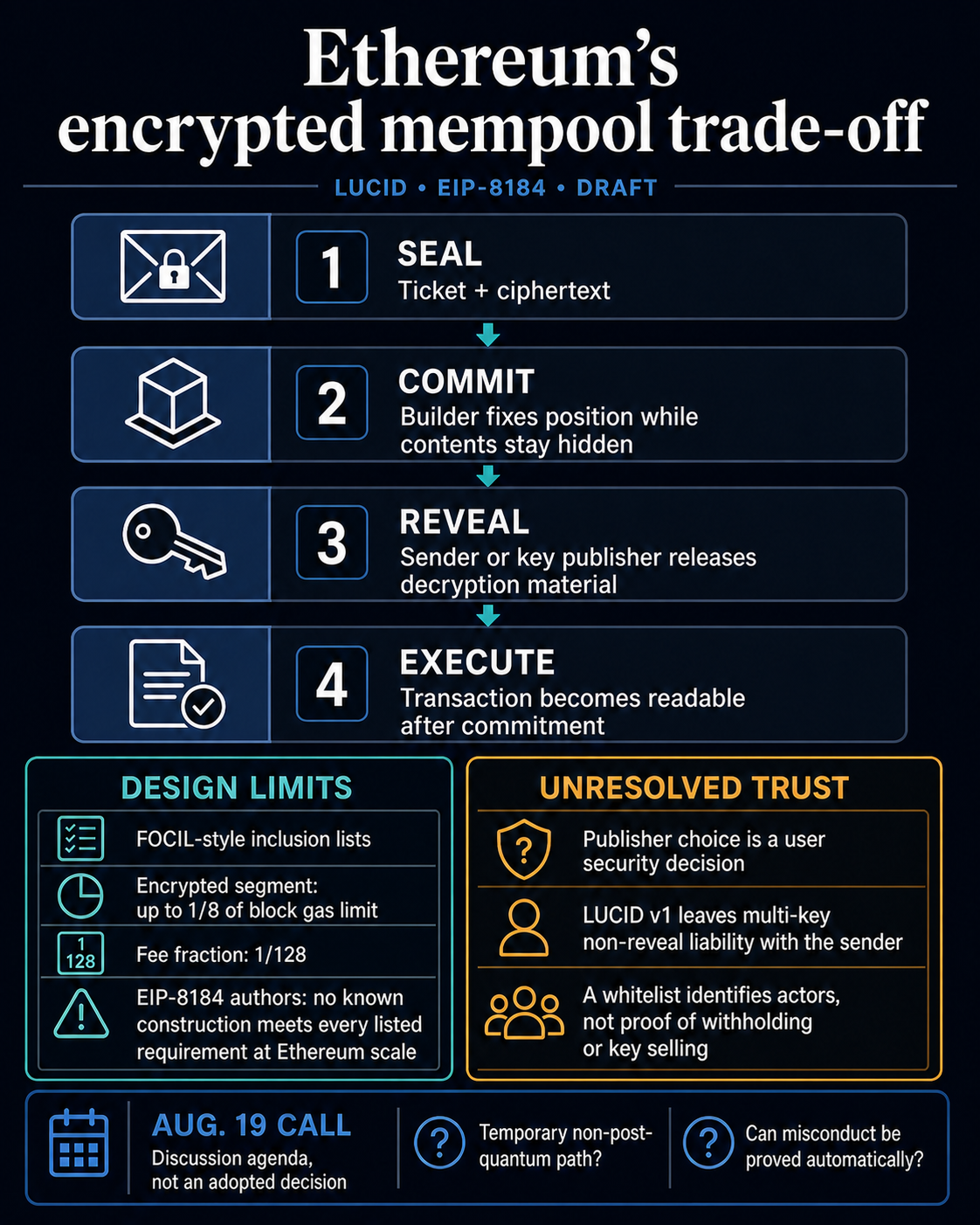
Flow diagram showing LUCID sealing, committing, revealing and executing encrypted Ethereum transactions, with design limits and unresolved key-publisher trust risks.Flow diagram showing LUCID sealing, committing, revealing and executing encrypted Ethereum transactions, with design limits and unresolved key-publisher trust risks.

LUCID therefore leaves the decryption construction outside the core protocol, allowing senders to manage their own key release or follow instructions from a key publisher. That preserves flexibility for stronger cryptography later, but EIP-8184’s security considerations explicitly make publisher selection part of the user’s security model.

The design also creates financial liabilities.

If a key is withheld or fails to arrive on schedule, LUCID’s initial draft leaves the protocol-level penalty for a failed multi-key reveal with the transaction sender rather than automatically transferring it to the third-party key provider.

CryptoSlate Daily Brief

Daily signals, zero noise.

Market-moving headlines and context delivered every morning in one tight read.

5-minute digest 100k+ readers

Free. No spam. Unsubscribe any time.

Whoops, looks like there was a problem. Please try again.

You’re subscribed. Welcome aboard.

To put an economic cost on failed reveals, LUCID caps its encrypted top-of-block segment at one-eighth of the block gas limit and uses a reservation fee. Most of that amount can be returned after successful decryption, while the full reservation can be lost when the reveal fails.

That makes failed or selective releases expensive, but it cannot establish why a key failed to arrive or determine whether a publisher deliberately leaked it early.

The authors have described an off-protocol sponsorship arrangement where a publisher funds a transaction inside the bundle and absorbs the loss if it remains sealed. Ethereum itself would not enforce that pledge.

Trading intermediaries and network scaling

Wednesday’s agenda will ask developers whether a temporary, non-post-quantum cryptographic solution is acceptable.

It also targets the deeper enforcement problem: how withholding or early key selling by members of a validator whitelist could be proved and whether those proofs could be automated.

A whitelist can establish who is authorized to publish keys. It cannot by itself distinguish deliberate misconduct from software failure, network latency, or a missed deadline.

An alternative proposal, EIP-8105, uses a directed trust graph where registered providers identify other providers they trust. Providers can establish their own withholding conditions, leaving incentives, reliability systems, and potential punishment mechanisms outside Ethereum’s consensus rules.

Other approaches introduce their own costs. Threshold decryption distributes control among multiple participants but adds timing pressure. Trusted hardware can shorten the path to a key while introducing new hardware and operator dependencies.

Any production deployment would also need to coordinate with Ethereum’s broader roadmap. LUCID is designed to extend the inclusion-list pipeline associated with FOCIL, or EIP-7805, which gives multiple validators a role in identifying transactions a builder must include.

Ethereum’s security roadmap currently targets FOCIL as a consensus-layer priority for the Hegotá upgrade in 2027, while broader post-quantum infrastructure milestones sit further out.


As quantum ‘Q-Day' jumps to 2029, Ethereum faces a new fight over what to do with coins left in old walletsAs quantum ‘Q-Day' jumps to 2029, Ethereum faces a new fight over what to do with coins left in old wallets
Related Reading

As quantum ‘Q-Day’ jumps to 2029, Ethereum faces a new fight over what to do with coins left in old wallets

The Ethereum Foundation’s post-quantum roadmap argues that the real danger is a years-long struggle over how to move user wallets.


Mar 26, 2026 · Gino Matos


Source link

Share76Tweet47

Related Posts

Half of Aave’s debt sits in just 9% of positions built around one Ethereum correlation trade

Half of Aave’s debt sits in just 9% of positions built around one Ethereum correlation trade

by Moussa
August 18, 2026
0

Galaxy's Aug. 7 snapshot of Aave V3 Core found 19,073 loans on the protocol after applying standard filters. Fewer than...

Allocation Update – Q4 2023

Allocation Update – Q2 2026

by Moussa
August 18, 2026
0

DAOs/GovernanceResearchFaculty Research Fellowship: Ethereum Studies (AY 2025–2026)Enables Prof. Strnad to dedicate substantial research time to Ethereum-focused problems, including DAO governance,...

Ethereum has only 2 Weeks to cut 66 Hegotá proposals

Ethereum has only 2 Weeks to cut 66 Hegotá proposals

by Moussa
August 17, 2026
0

Ethereum developers are eyeing 2027 for Hegotá as they open a new public testnet for Glamsterdam, the network's next major...

Announcing the Platåberget Testnet | Ethereum Foundation Blog

Announcing the Platåberget Testnet | Ethereum Foundation Blog

by Moussa
August 17, 2026
0

tl;dr: Meet Platåberget: Glamsterdam's (Gloas + Amsterdam) early testing ground open to public participation. This upgrade comes with breaking changes...

Cboe pushes for 3x Bitcoin and Ethereum ETFs after 2x crypto funds suffer losses of up to 96%

Cboe pushes for 3x Bitcoin and Ethereum ETFs after 2x crypto funds suffer losses of up to 96%

by Moussa
August 16, 2026
0

Cboe BZX is asking the Securities and Exchange Commission (SEC) for an exception to its own generic listing rules so...

Load More

youssufi.com

sephina.com

[vc_row full_width="stretch_row" parallax="content-moving" vc_row_background="" background_repeat="no-repeat" background_position="center center" footer_scheme="dark" css=".vc_custom_1517813231908{padding-top: 60px !important;padding-bottom: 30px !important;background-color: #191818 !important;background-position: center;background-repeat: no-repeat !important;background-size: cover !important;}" footer_widget_title_color="#fcbf46" footer_button_bg="#fcb11e"][vc_column width="1/4"]

We bring you the latest in Crypto News

[/vc_column][vc_column width="1/4"][vc_wp_categories]
[/vc_column][vc_column width="1/4"][vc_wp_tagcloud taxonomy="post_tag"][/vc_column][vc_column width="1/4"]

Newsletter

[vc_raw_html]JTNDcCUzRSUzQ2RpdiUyMGNsYXNzJTNEJTIydG5wJTIwdG5wLXN1YnNjcmlwdGlvbiUyMiUzRSUwQSUzQ2Zvcm0lMjBtZXRob2QlM0QlMjJwb3N0JTIyJTIwYWN0aW9uJTNEJTIyaHR0cHMlM0ElMkYlMkZhcHByb3gub3JnJTJGJTNGbmElM0RzJTIyJTNFJTBBJTBBJTNDaW5wdXQlMjB0eXBlJTNEJTIyaGlkZGVuJTIyJTIwbmFtZSUzRCUyMm5sYW5nJTIyJTIwdmFsdWUlM0QlMjIlMjIlM0UlM0NkaXYlMjBjbGFzcyUzRCUyMnRucC1maWVsZCUyMHRucC1maWVsZC1maXJzdG5hbWUlMjIlM0UlM0NsYWJlbCUyMGZvciUzRCUyMnRucC0xJTIyJTNFRmlyc3QlMjBuYW1lJTIwb3IlMjBmdWxsJTIwbmFtZSUzQyUyRmxhYmVsJTNFJTBBJTNDaW5wdXQlMjBjbGFzcyUzRCUyMnRucC1uYW1lJTIyJTIwdHlwZSUzRCUyMnRleHQlMjIlMjBuYW1lJTNEJTIybm4lMjIlMjBpZCUzRCUyMnRucC0xJTIyJTIwdmFsdWUlM0QlMjIlMjIlM0UlM0MlMkZkaXYlM0UlMEElM0NkaXYlMjBjbGFzcyUzRCUyMnRucC1maWVsZCUyMHRucC1maWVsZC1lbWFpbCUyMiUzRSUzQ2xhYmVsJTIwZm9yJTNEJTIydG5wLTIlMjIlM0VFbWFpbCUzQyUyRmxhYmVsJTNFJTBBJTNDaW5wdXQlMjBjbGFzcyUzRCUyMnRucC1lbWFpbCUyMiUyMHR5cGUlM0QlMjJlbWFpbCUyMiUyMG5hbWUlM0QlMjJuZSUyMiUyMGlkJTNEJTIydG5wLTIlMjIlMjB2YWx1ZSUzRCUyMiUyMiUyMHJlcXVpcmVkJTNFJTNDJTJGZGl2JTNFJTBBJTNDZGl2JTIwY2xhc3MlM0QlMjJ0bnAtZmllbGQlMjB0bnAtcHJpdmFjeS1maWVsZCUyMiUzRSUzQ2xhYmVsJTNFJTNDaW5wdXQlMjB0eXBlJTNEJTIyY2hlY2tib3glMjIlMjBuYW1lJTNEJTIybnklMjIlMjByZXF1aXJlZCUyMGNsYXNzJTNEJTIydG5wLXByaXZhY3klMjIlM0UlQzIlQTBCeSUyMGNvbnRpbnVpbmclMkMlMjB5b3UlMjBhY2NlcHQlMjB0aGUlMjBwcml2YWN5JTIwcG9saWN5JTNDJTJGbGFiZWwlM0UlM0MlMkZkaXYlM0UlM0NkaXYlMjBjbGFzcyUzRCUyMnRucC1maWVsZCUyMHRucC1maWVsZC1idXR0b24lMjIlM0UlM0NpbnB1dCUyMGNsYXNzJTNEJTIydG5wLXN1Ym1pdCUyMiUyMHR5cGUlM0QlMjJzdWJtaXQlMjIlMjB2YWx1ZSUzRCUyMlN1YnNjcmliZSUyMiUyMCUzRSUwQSUzQyUyRmRpdiUzRSUwQSUzQyUyRmZvcm0lM0UlMEElM0MlMkZkaXYlM0UlM0NiciUyRiUzRSUzQyUyRnAlM0U=[/vc_raw_html][/vc_column][/vc_row]
No Result
View All Result
  • Contact Us
  • Homepages
  • Business
  • Guide

© 2024 APPROX FOUNDATION - The Crypto Currency News