




• About
  • FAQ
  • Earn Bitcoin while Surfing the net
  • Buy & Sell Crypto on Paxful
Newsletter
Approx Foundation
  • Home
    • Home – Layout 1
  • Bitcoin
  • Ethereum
  • Regulation
  • Market
  • Blockchain
  • Business
  • Guide
  • Contact Us
No Result
View All Result
  • Home
    • Home – Layout 1
  • Bitcoin
  • Ethereum
  • Regulation
  • Market
  • Blockchain
  • Business
  • Guide
  • Contact Us
No Result
View All Result
Approx Foundation
No Result
View All Result
Home Regulation

Ethereum proposal would cut 33,800 ETH issuance and break every deployed Altair light client

Moussa by Moussa
August 25, 2026
in Regulation
0
Ethereum proposal would cut 33,800 ETH issuance and break every deployed Altair light client
189
SHARES
1.5k
VIEWS
Share on FacebookShare on Twitter

Related articles

Bitcoin wallets react within 15 minutes as Ethereum stays muted

Bitcoin wallets react within 15 minutes as Ethereum stays muted

September 11, 2026
Crypto exchange recovery rules split NES holders into winners and losers after $286M exploit fallout

Crypto exchange recovery rules split NES holders into winners and losers after $286M exploit fallout

September 11, 2026


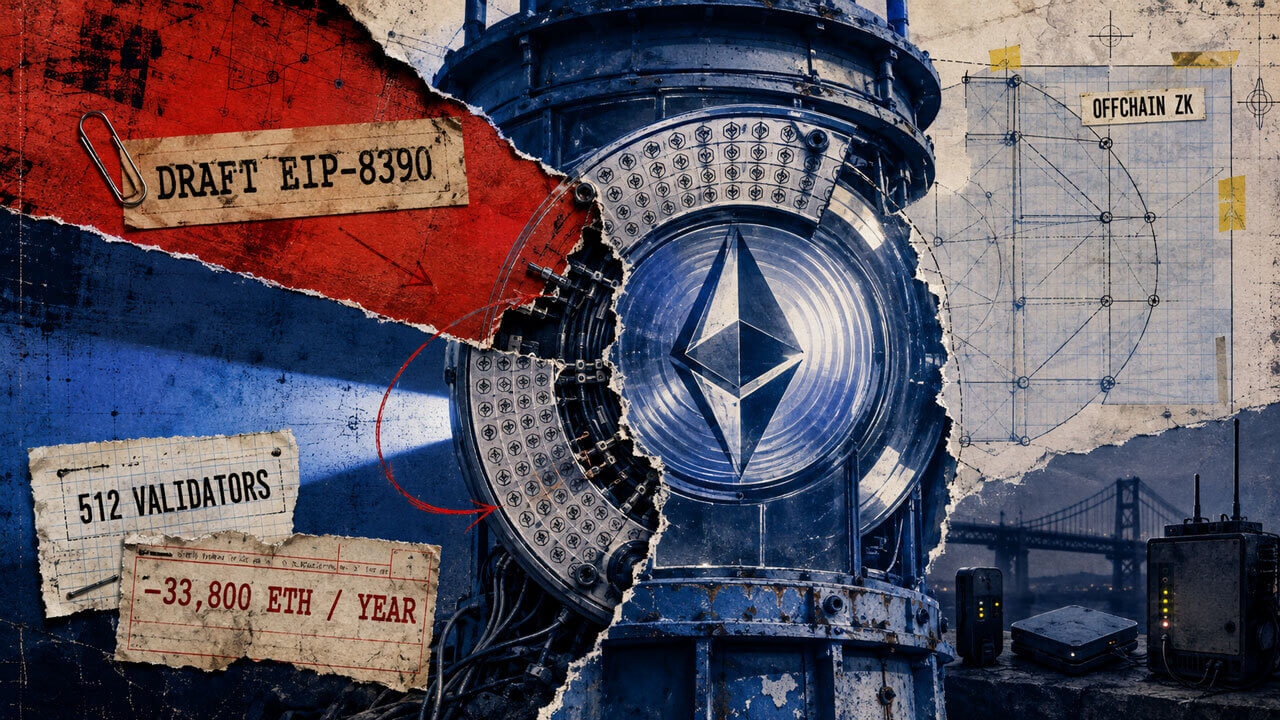
A newly merged Ethereum proposal would retire the network’s 512-validator sync committee, remove its rewards, and make the current Altair light-client interface obsolete by replacing it with offchain zero-knowledge proofs.

The Draft EIP-8390 estimates that deleting the committee’s reward weight would reduce annual consensus issuance by roughly 33,800 ETH.

Ethereum would give up an in-protocol mechanism that lets lightweight clients follow the beacon chain before the proposed replacement proving service, migration interface, and economic support have been specified.

A sync committee is a 512-validator sample whose messages give light clients a compact way to track Ethereum without processing the full validator set.

The proposal entered the official EIPs repository at 02:04 UTC on Aug. 24, but its Draft status makes it a design for discussion, not an adopted upgrade. It has no activation epoch or Ethereum roadmap commitment, and the document leaves scheduling to client teams.

The author’s discussion thread listed no external reviews in its initial-draft update.

Issuance falls, but the security trade changes

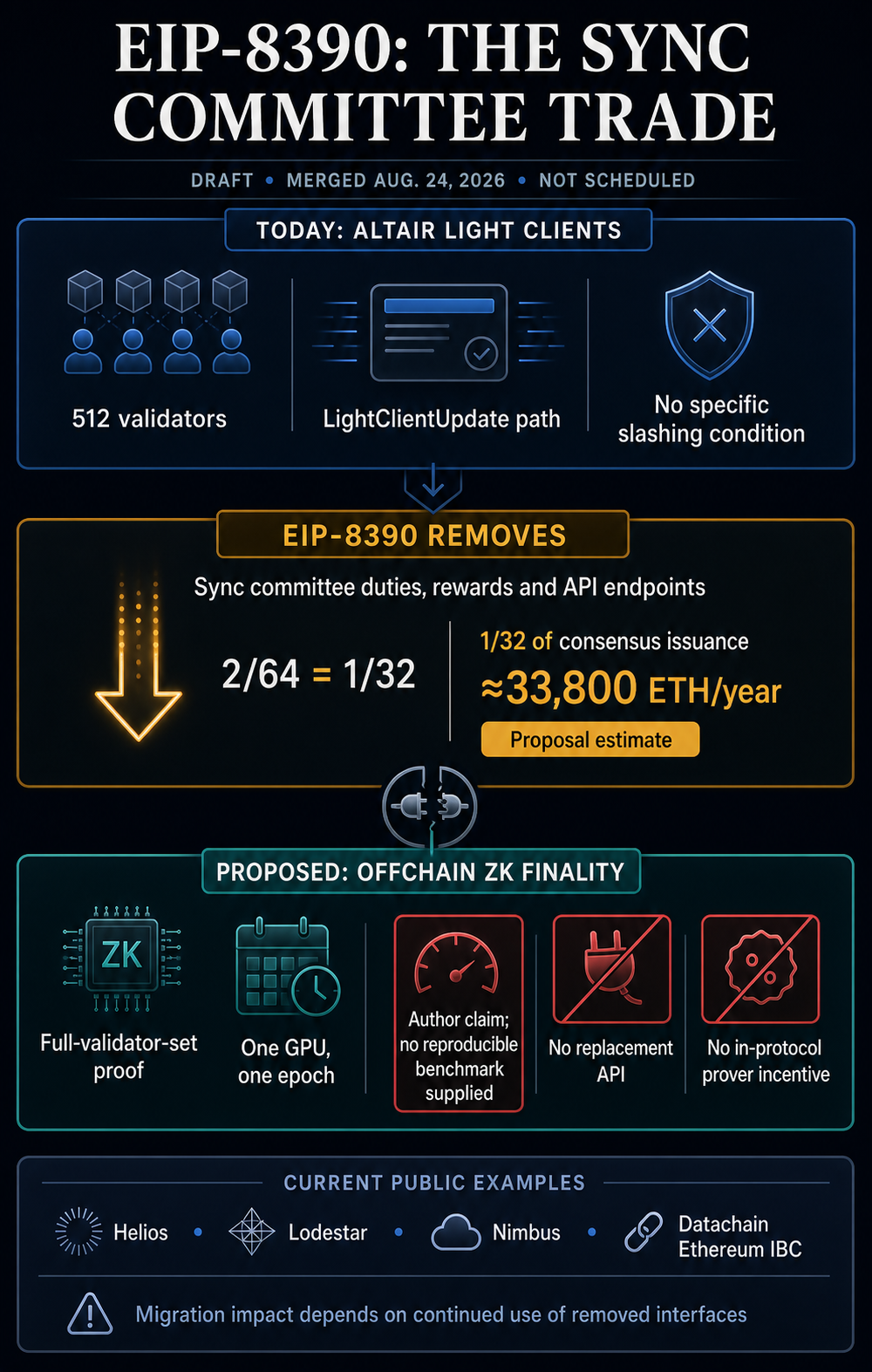
Ethereum’s consensus reward formula assigns the sync committee a weight of 2 within a denominator of 64. EIP-8390 would remove that weight without redistributing it, producing a 2/64, or 1/32, reduction in consensus issuance.

The draft reports a snapshot of 901,505 validators and 42,328,615 ETH staked. Against its estimate of about 1.082 million ETH in annual consensus issuance, the removed share works out to approximately 33,800 ETH per year.

The 1/32 calculation does not translate into a 3.125% cut to every validator’s total realized yield. It applies to consensus issuance allocated to sync-committee rewards, while realized returns can include other consensus rewards and execution-layer income.

Altair defines no slashing condition specifically for a validator that signs a malicious sync-committee message. EIP-7657, a separate proposal that sought to add such a penalty, is now marked Stagnant. It warned that applications securing more than 512 times 32 ETH, or 16,384 ETH, should combine the light-client protocol with other protections.

That figure was a design warning under a 32 ETH maximum effective balance, but it nevertheless captures the concern behind EIP-8390: the sampled signatures help light clients follow Ethereum, yet malicious sync-committee messages do not carry their own protocol slashing condition.

Removing the sample would exchange that accountability problem for a different dependency. Light clients would be expected to verify a zero-knowledge proof of Casper FFG finality across the full validator set.

That proof would become the finality signal for clients that do not process the full validator set.
The Daily Brief

The signal, before the noise.

Start your day with the crypto stories moving markets, decoded by CryptoSlate’s editors.

One email. Everything that matters.

Free to join. Unsubscribe any time.

Whoops, looks like there was a problem. Please try again.

You’re on the list. Your next Daily Brief is on its way.

Infographic comparing Ethereum’s current 512-validator Altair sync committee with EIP-8390’s proposed offchain ZK finality replacement, including the estimated 33,800 ETH annual issuance reduction and unresolved API, benchmark and prover incentive gaps.Infographic comparing Ethereum’s current 512-validator Altair sync committee with EIP-8390’s proposed offchain ZK finality replacement, including the estimated 33,800 ETH annual issuance reduction and unresolved API, benchmark and prover incentive gaps.
Diagram showing EIP-8390’s proposal to remove Ethereum’s sync committee and shift finality toward offchain zero-knowledge proofs.

Ethereum light clients would need an unbuilt replacement

EIP-8390 would remove its validator duties, network messages, light-client data containers, and several Beacon API endpoints. The proposal says deployed Altair light clients that sync through LightClientUpdate would stop working at the fork.

The affected category includes software that uses the standard Altair update flow. Helios, which can be embedded in wallets and decentralized applications, relies on a consensus endpoint supporting Ethereum’s light-client Beacon API. Lodestar provides a consumer-side light-client package built around that path.

Nimbus exposes a light-client interface for the same update objects, while Datachain’s Ethereum IBC client constructs headers from LightClientUpdate and FinalityUpdate data obtained through Beacon RPC.

These projects are confirmed examples, and their actual fork impact would depend on whether they still use the removed interfaces and what migrations their maintainers release.

The current Altair specification defines the update flow those implementations consume. EIP-8390 removes that flow without supplying a replacement Beacon API contract or client migration specification.

EIP-8390 asserts that Casper FFG finality could be proved within one epoch on one GPU and verified in milliseconds, but the draft cites no reproducible implementation, circuit, hardware profile, or benchmark to support that claim.

One comparable public full-set design reports sub-minute preprocessing on a 64-core CPU without GPU acceleration and describes parts of the final proof composition as future or unbuilt work. The work shows progress under a different hardware setup.

The EIP does not define the proving service, its client interface, reliability model, operators, or funding. The draft also explicitly adds no in-protocol incentive to produce finality proofs and proposes none, although offchain or public-goods funding could still emerge outside the protocol.

Ethereum would be swapping one imperfect trust mechanism for infrastructure that is not yet part of the specification. The issuance savings are concrete in the proposal’s own numbers, while the replacement’s availability, migration path, and economics remain open.

Moving EIP-8390 toward activation would require a tested interface for light clients, working migrations for current Altair consumers, and public proof production that remains available when users depend on it.




Source link

Share76Tweet47

Related Posts

Bitcoin wallets react within 15 minutes as Ethereum stays muted

Bitcoin wallets react within 15 minutes as Ethereum stays muted

by Moussa
September 11, 2026
0

A Federal Reserve Bank of Philadelphia working paper published this month found that public notifications of large crypto transfers were...

Crypto exchange recovery rules split NES holders into winners and losers after $286M exploit fallout

Crypto exchange recovery rules split NES holders into winners and losers after $286M exploit fallout

by Moussa
September 11, 2026
0

Nesa’s NES token returned to trading on Binance Alpha and regained Ethereum funding on Kraken on Sept. 10 after venue-specific...

BitMine’s staked ETH equals nearly 12% of Ethereum’s active stake, but who controls it?

BitMine’s staked ETH equals nearly 12% of Ethereum’s active stake, but who controls it?

by Moussa
September 11, 2026
0

BitMine Immersion Technologies has amassed a staked ETH position equivalent to almost 12% of Ethereum’s active stake, without disclosing who...

MetaMask and Consensys split exposes the gap between Ethereum adoption and ETH demand

MetaMask and Consensys split exposes the gap between Ethereum adoption and ETH demand

by Moussa
September 10, 2026
0

Consensys announced plans on Sept. 9 to operate MetaMask separately from its Ethereum infrastructure business, giving the consumer wallet and...

Wall Street’s altcoin ETF rotation is not producing an altseason, and the old playbook may be breaking

Wall Street’s altcoin ETF rotation is not producing an altseason, and the old playbook may be breaking

by Moussa
September 10, 2026
0

US exchange-traded funds tied to Ethereum, XRP, and Solana attracted almost $59 million on Sept. 9 as Bitcoin products lost...

Load More

youssufi.com

sephina.com

[vc_row full_width="stretch_row" parallax="content-moving" vc_row_background="" background_repeat="no-repeat" background_position="center center" footer_scheme="dark" css=".vc_custom_1517813231908{padding-top: 60px !important;padding-bottom: 30px !important;background-color: #191818 !important;background-position: center;background-repeat: no-repeat !important;background-size: cover !important;}" footer_widget_title_color="#fcbf46" footer_button_bg="#fcb11e"][vc_column width="1/4"]

We bring you the latest in Crypto News

[/vc_column][vc_column width="1/4"][vc_wp_categories]
[/vc_column][vc_column width="1/4"][vc_wp_tagcloud taxonomy="post_tag"][/vc_column][vc_column width="1/4"]

Newsletter

[vc_raw_html]JTNDcCUzRSUzQ2RpdiUyMGNsYXNzJTNEJTIydG5wJTIwdG5wLXN1YnNjcmlwdGlvbiUyMiUzRSUwQSUzQ2Zvcm0lMjBtZXRob2QlM0QlMjJwb3N0JTIyJTIwYWN0aW9uJTNEJTIyaHR0cHMlM0ElMkYlMkZhcHByb3gub3JnJTJGJTNGbmElM0RzJTIyJTNFJTBBJTBBJTNDaW5wdXQlMjB0eXBlJTNEJTIyaGlkZGVuJTIyJTIwbmFtZSUzRCUyMm5sYW5nJTIyJTIwdmFsdWUlM0QlMjIlMjIlM0UlM0NkaXYlMjBjbGFzcyUzRCUyMnRucC1maWVsZCUyMHRucC1maWVsZC1maXJzdG5hbWUlMjIlM0UlM0NsYWJlbCUyMGZvciUzRCUyMnRucC0xJTIyJTNFRmlyc3QlMjBuYW1lJTIwb3IlMjBmdWxsJTIwbmFtZSUzQyUyRmxhYmVsJTNFJTBBJTNDaW5wdXQlMjBjbGFzcyUzRCUyMnRucC1uYW1lJTIyJTIwdHlwZSUzRCUyMnRleHQlMjIlMjBuYW1lJTNEJTIybm4lMjIlMjBpZCUzRCUyMnRucC0xJTIyJTIwdmFsdWUlM0QlMjIlMjIlM0UlM0MlMkZkaXYlM0UlMEElM0NkaXYlMjBjbGFzcyUzRCUyMnRucC1maWVsZCUyMHRucC1maWVsZC1lbWFpbCUyMiUzRSUzQ2xhYmVsJTIwZm9yJTNEJTIydG5wLTIlMjIlM0VFbWFpbCUzQyUyRmxhYmVsJTNFJTBBJTNDaW5wdXQlMjBjbGFzcyUzRCUyMnRucC1lbWFpbCUyMiUyMHR5cGUlM0QlMjJlbWFpbCUyMiUyMG5hbWUlM0QlMjJuZSUyMiUyMGlkJTNEJTIydG5wLTIlMjIlMjB2YWx1ZSUzRCUyMiUyMiUyMHJlcXVpcmVkJTNFJTNDJTJGZGl2JTNFJTBBJTNDZGl2JTIwY2xhc3MlM0QlMjJ0bnAtZmllbGQlMjB0bnAtcHJpdmFjeS1maWVsZCUyMiUzRSUzQ2xhYmVsJTNFJTNDaW5wdXQlMjB0eXBlJTNEJTIyY2hlY2tib3glMjIlMjBuYW1lJTNEJTIybnklMjIlMjByZXF1aXJlZCUyMGNsYXNzJTNEJTIydG5wLXByaXZhY3klMjIlM0UlQzIlQTBCeSUyMGNvbnRpbnVpbmclMkMlMjB5b3UlMjBhY2NlcHQlMjB0aGUlMjBwcml2YWN5JTIwcG9saWN5JTNDJTJGbGFiZWwlM0UlM0MlMkZkaXYlM0UlM0NkaXYlMjBjbGFzcyUzRCUyMnRucC1maWVsZCUyMHRucC1maWVsZC1idXR0b24lMjIlM0UlM0NpbnB1dCUyMGNsYXNzJTNEJTIydG5wLXN1Ym1pdCUyMiUyMHR5cGUlM0QlMjJzdWJtaXQlMjIlMjB2YWx1ZSUzRCUyMlN1YnNjcmliZSUyMiUyMCUzRSUwQSUzQyUyRmRpdiUzRSUwQSUzQyUyRmZvcm0lM0UlMEElM0MlMkZkaXYlM0UlM0NiciUyRiUzRSUzQyUyRnAlM0U=[/vc_raw_html][/vc_column][/vc_row]
No Result
View All Result
  • Contact Us
  • Homepages
  • Business
  • Guide

© 2024 APPROX FOUNDATION - The Crypto Currency News