




Strategy’s Bitcoin treasury may be less vulnerable to a crypto market crash than to a prolonged loss of capital-market access, a risk that could threaten its ability to fund roughly $1.76 billion in annual obligations without selling Bitcoin, according to a recent analysis from Regime Intelligence.
According to the report, Strategy’s 840,447 BTC stash sits behind roughly $22 billion in debt and preferred claims, meaning the company’s Bitcoin accumulation model depends on its ability to continually raise fresh capital to meet obligations.
Contrary to popular belief, Strategy’s (MSTR) biggest vulnerability isn’t a Bitcoin-driven price drop or liquidity event, but its continued dependence on access to capital markets. The report noted that Strategy’s debt does not function like a conventional Bitcoin-backed margin loan, with no BTC-linked margin call that would force the company to liquidate its holdings as prices fall.
Regime Intelligence’s stress test found that Bitcoin would need to fall roughly 96% before Strategy’s Bitcoin holdings and reserves would no longer cover its convertible notes. However, that shifts the risk to the other side of the balance sheet, as Strategy must continue servicing roughly $1.76 billion in annual preferred dividends and interest regardless of Bitcoin’s price.
“In my opinion, MSTR’s principal challenge is to keep the flywheel running in order to cover the annual debt and preferred charges,” the report’s author, Sherif Saad, told Cointelegraph.
He said investors should watch Strategy’s preferred share price and cash reserves, which currently cover about 2.6 times its annualized charges.
If financing conditions deteriorate, its Bitcoin accumulation strategy could reverse, forcing greater reliance on reserves and Bitcoin sales to meet its obligations.
“During a prolonged BTC decline, the problem becomes more serious if MSTR’s share price and mNAV decline at the same time,” he said, adding that raising capital would then become “progressively more difficult or expensive.”
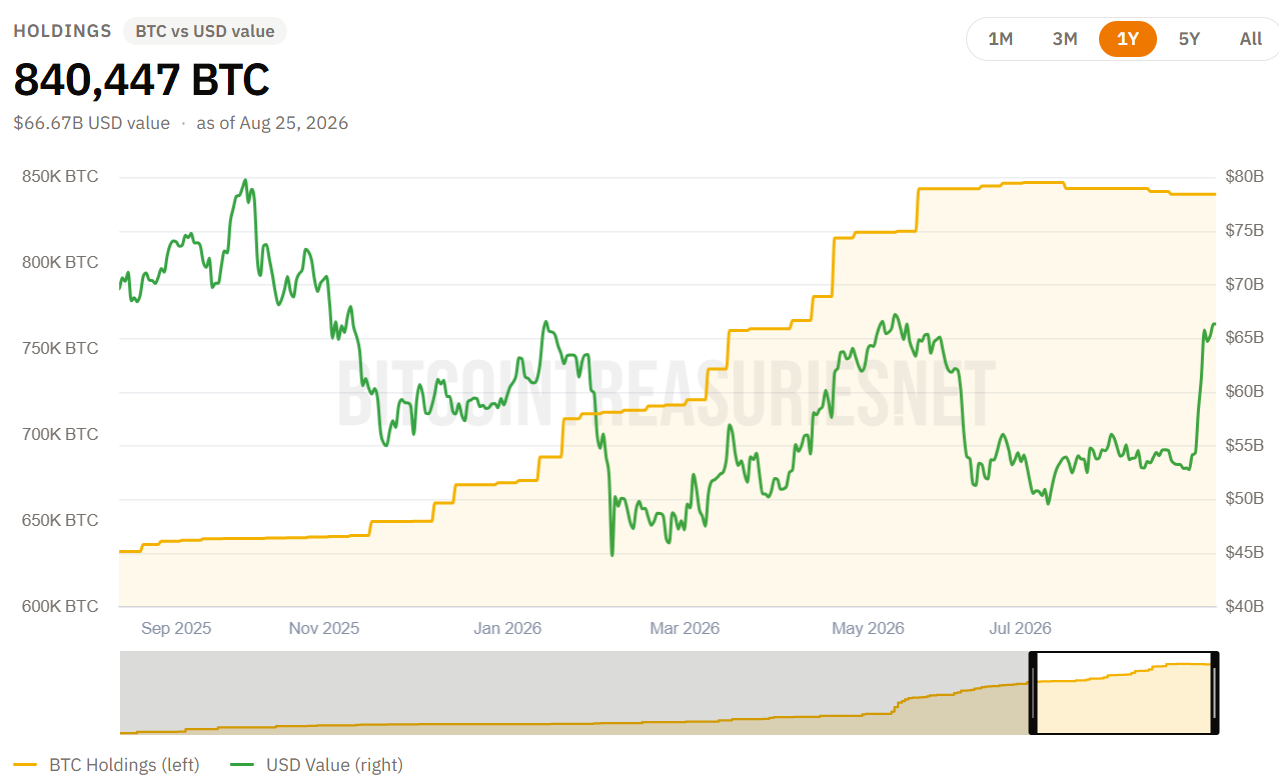
Following Bitcoin’s recent recovery, Strategy’s BTC stash is now worth $66.7 billion, higher than the company’s $63.36 billion cost basis. Source: BitcoinTreasuries.NET
Related: Standard Chartered analyst eyes $100K BTC as US Treasury doubles long-end buybacks
Michael Saylor’s juggling act
Much of the perceived risk surrounding Strategy centers on its willingness to tap the Bitcoin on its balance sheet, especially after executive chairman Michael Saylor spent years promoting a “never-sell” approach. So, it came as a surprise to some Bitcoiners when Strategy began selling BTC this year to meet its other business obligations.
The company has sold Bitcoin four times since May, including a recent sale of 1,690 BTC, with proceeds from recent sales used to fund preferred stock dividends, share repurchases and its growing US dollar reserve.
Despite the sales, Strategy CEO Phong Le reminded investors that the company has accumulated “about 25 times more” Bitcoin than it has sold this year. He told CNBC earlier this month that the company plans to resume Bitcoin purchases later this year.
Related: Crypto Biz: Bitcoin’s $116M self-custody wake-up call