



Bitcoin embraces post quantum future
Despite considerable skepticism among Bitcoiners about how close the quantum threat to Bitcoin actually is, two stories this week highlighted the progress being made toward upgrading the blockchain and protecting outputs from attack.
StarkWare researcher Avihu Levy tested an experimental quantum-resistant transaction on the Bitcoin mainnet that protects it during the brief period when public keys are exposed in the mempool.
Onchain data shows that StarkWSare spent a 10,000-satoshi output protected by Levy’s Quantum Safe Bitcoin (QSB) scheme. It combines hash-based one-time signatures with computational searches that bind an authorization to a specific transaction. While it works, it’s more of a last resort than a practical measure, as each transaction takes hours and costs between $150 to $200.
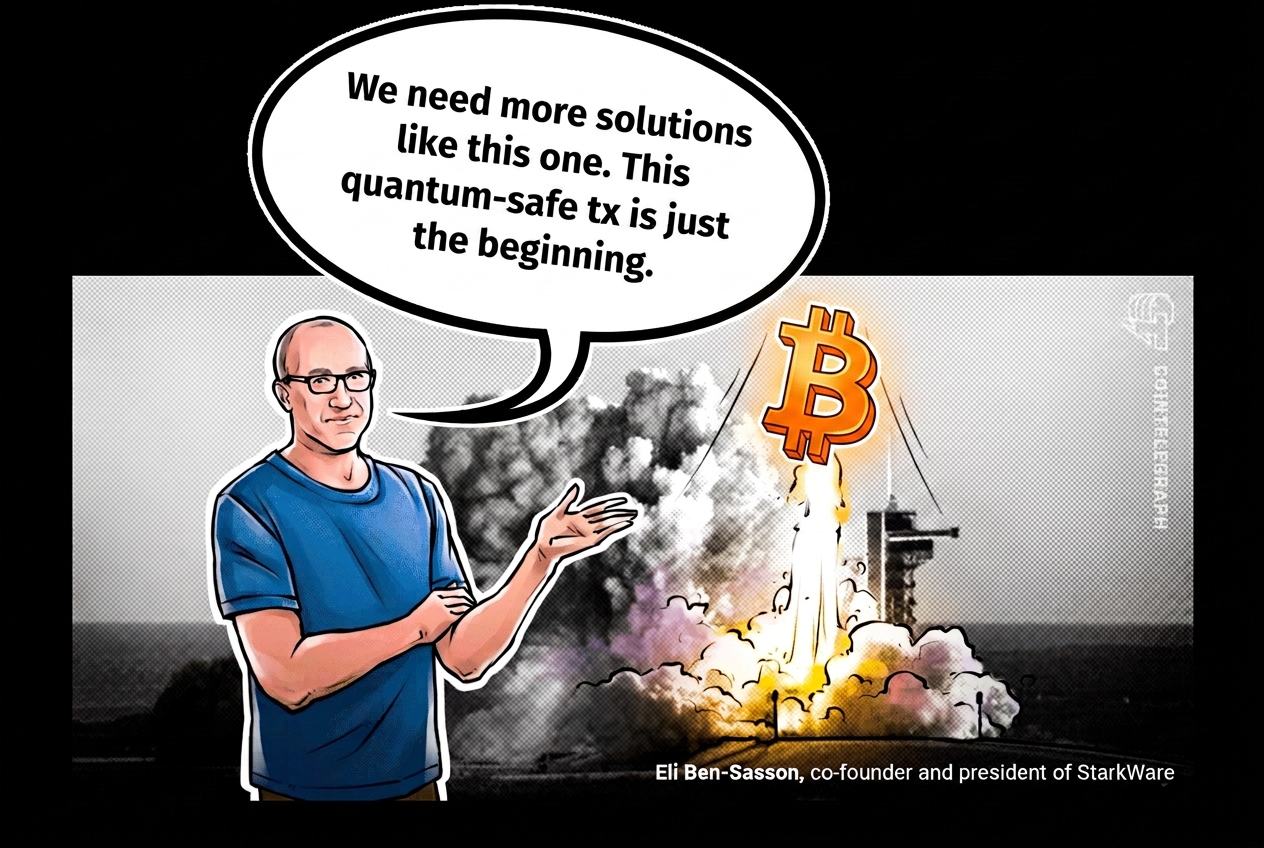
There’s also been progress on long term upgrades to protect every transaction. On August 27, Blockstream researchers published a Bitcoin Improvement Proposal to upgrade Bitcoin with the SHRINCS signature scheme. The researchers slimmed down a huge, hash based post quantum signature by about 13.23 times — an impressive effort, but the SHRINCS signature is still at least nine times larger than Bitcoin’s existing signatures and comes with a bunch of trade offs.
Blockstream Research’s Jonas Nick called it “the first concrete proposal for a post-quantum signature scheme designed specifically for Bitcoin.” He conceeded it was “not optimal along every axis” but added:
”I do think it is a very good trade-off among the options we have now,” he said.
Solana validators vote to cut inflation to 1.5% in 2.8 years
Solana validators have approved a proposal to double the network’s annual disinflation rate. This will reduce issuance by 18.9 million SOL over the next six years.
Overall participation reached 60.7% of eligible stake and the proposal received 67% support, with 25.16% voting against and 7.84% abstaining.
Known as SGP-0002 or Double Disinflation, the measure will increase Solana’s annual disinflation rate from 15% to 30%.
Under the new schedule, Solana is expected to reach its 1.5% terminal inflation rate in about 2.8 years, compared with roughly 5.7 years under the previous schedule.
Onchain data presented by The Kobeissi Letter showed that Solana processed a record 4.2 billion transactions during July, up 13.5% from the month before. Transaction counts have risen by roughly 2 billion since December, representing a 91% increase.
Trump cost investors $4.7B through crypto ‘schemes’
Nonprofit consumer advocacy organization Public Citizen claims that US President Donald Trump “left investors at least an estimated $4.7 billion underwater” since 2022 through his and his family’s digital asset ventures.
A new report states that investors lost $3.2 billion via his Official Trump (TRUMP) memecoin, at least $1 billion on the World Liberty Financial governance token, $450 million on Trump Media’s digital asset treasury, and at least $9.3 million on the president’s nonfungible token (NFT) trading cards launched in 2022.
Holders of the USD1 stablecoin however were sitting pretty on $0 losses.

Trump’s crypto profits are one of the key factors holding up passage of the CLARITY Act, with Democrats digging in on stronger protections to prevent elected officials from issuing cryptocurrencies.
Bitcoin rally only just getting started
BlocksBridge Consulting reported this week that that Bitcoin’s 23% rally over the past week had outpaced most AI-linked infrastructure stocks.
Three beaten-down Bitcoin mining companies — Canaan, American Bitcoin and Cango — gained between 41% and 67%. By comparison, CoreWeave rose about 21%, Nebius gained 17% and IREN advanced 15%.
The Bitcoin ETFs have also minted more than $3.3 billion in August, for the strongest month since October 2025’s all time high. Outflows on Friday ended a nine day hot streak however.
Wall Street analysts from Bernstein predict we are at the start of a new four year cycle. Bernstein’s forecast suggests Bitcoin will reclaim $125,000 under both its base case and bull case scenario, and will peak at $300,000 in 2029 under the base case, or top $500,000 that year under its bullish scenario.
Revolut rolls out euro stablecoin in 3 European markets
Revolut has begun rolling out its first stablecoin, a euro-pegged token called EURR to around 2 million customers in Denmark, Poland and Portugal.
The phased rollout is expected to expand to other European Economic Area (EEA) markets later this year.
EURR is issued by Bridge Building S.A., the Luxembourg-based entity of Stripe-owned stablecoin infrastructure company Bridge. Revolut said EURR will be integrated into its retail app, with plans to support multiple blockchain networks and transfers to external wallets. It’s launching initially on the Ethereum network.

Winners and Losers
At the end of the week, Bitcoin (BTC) is up 1.1% to trade at $78,420, Ethereum (ETH) is up 0.6% to trade at $2,469 and XRP (XRP) is down 8.7% to $1.38. The total market cap is at $2.64 trillion according to CoinMarketCap.
Among the biggest 100 cryptocurrencies, the top three altcoin winners of the week are VeChain (VET) with an 18.5% gain, SPX6900 (SPX) on 17.3%, and Uniswap (UNI) on 15.2%.
The top three altcoin losers of the week are Aptos (APT) which was down 16.4%, Stable (STABLE) down 14.7% and Morpho (MORPHO) down 13.6%.
Prediction of the Week
Bitcoin bear market ‘over’ as price metric copies 2023 recovery: CryptoQuant CEO
CryptoQuant CEO Ki Young Ju has flagged the first positive reading on CryptoQuant’s Bull/Bear Market Cycle Indicator since early October.
“The Bitcoin bear cycle is over,” he wrote.
The indicator measures onchain profitability metrics in comparison to a 365 day moving average, including the market value to realized value (MVRV) ratio, net unrealized profit/loss (NUPL) and the spent output profit ratio (SOPR). Values above zero for the Bull/Bear indicator point to bullish phases in the BTC price cycle as profitability improves.
Current cycle lows came on Feb. 5 as BTC/USD fell to $60,000, with a reading of -1.244 corresponding to “extreme bear” conditions. As of Aug. 26, the Bull/Bear indicator displayed a positive reading of 0.042, placing it in its “bull” bracket.
FUD of the Week
77% of Americans see crypto in retirement plans as risky: Survey
More than three-quarters of Americans view cryptocurrency in workplace retirement plans as risky, according to a new survey from The National Institute on Retirement Security.
The survey found that 77% of Americans consider crypto in workplace retirement plans risky, including 46% who view it as very risky, while 53% oppose employers offering crypto as an investment option.
The survey was conducted by Greenwald Research between Oct. 24 and Nov. 14, 2025, and included 1,203 Americans aged 25 and older, with results weighted by age, gender and income.
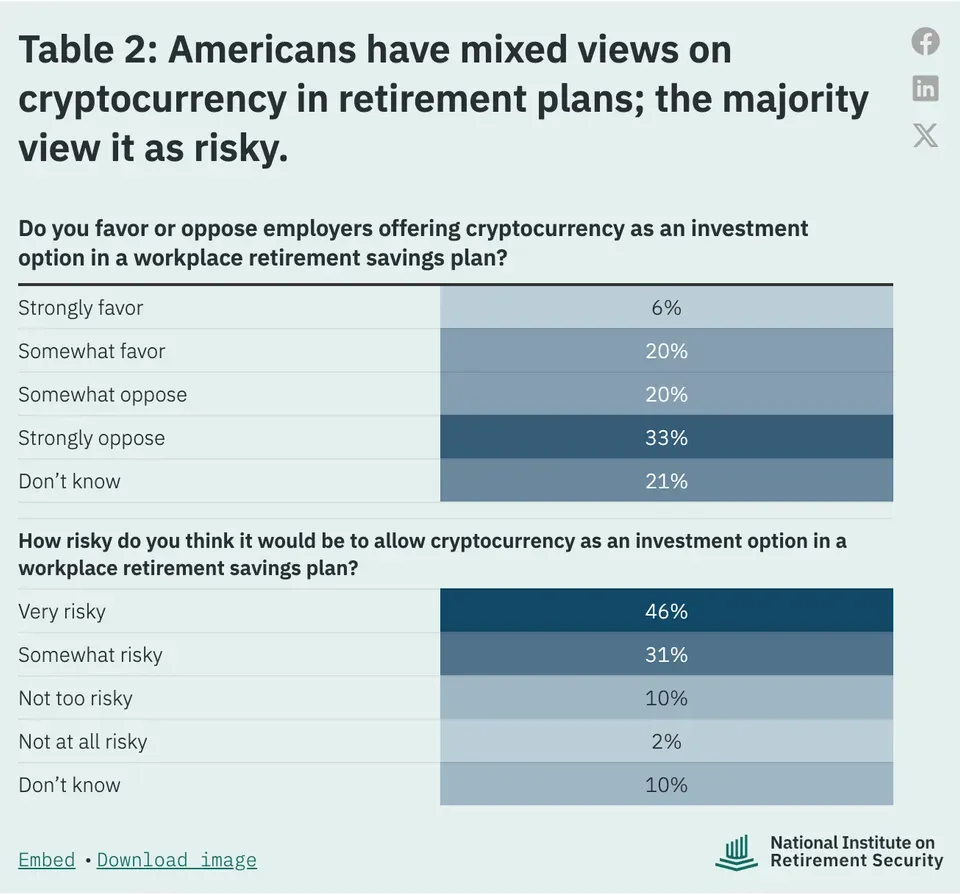
Americans view of crypto in retirement plans. Source: National Institute of Retirement Security
Real Trump Coins denies launching GOLD token, blames ‘bad actors’
Real Trump Coins has denied launching, promoting or authorizing the Trump Digital GOLD token that briefly appeared across its online presence before collapsing, blaming the promotion on “third-party bad actors.”
The denial came after the Real Trump Coins X account promoted the Solana-based token on Saturday and directed users to RealTrumpCoins.com, where GOLD was also advertised. The X posts were later deleted, while the account now links to a separate domain, TrumpCoins.com.
“Trump Coins has not authorized and will not launch, promote, or authorize any digital token,” Real Trump Coins said in an X post on Saturday, adding that it was working with authorities to investigate the matter.
Polygon discloses security flaws fixed in recent hard forks
Polygon has disclosed several previously private security vulnerabilities that could have disrupted its proof-of-stake network, after deploying fixes through two recent hard forks.
The vulnerabilities affected Polygon’s Bor and Heimdall clients and included denial-of-service risks, validator resource exhaustion and flaws affecting checkpoint and milestone processing, according to a Thursday disclosure from Polygon Labs’ Validators Support Team.
Polygon said the flaws were fixed through the Austin and Kyoto hard forks, which were deployed privately and tested before being activated on mainnet and publicly disclosed.
Top Magazine Stories of the Week
A new Bitcoin Improvement Proposal for the SHRINCS signature scheme has just been published to upgrade Bitcoin to quantum secure. Here’s everything you need to know.
Hugging Face relies on open weight Chinese models to defend itself from rogue AI agents. But a lack of safety guardrails makes those models potentially dangerous too.
If your personal AI agent goes rogue and causes harm or financial damage in the real world, can you be held liable?
Cointelegraph publishes long-form journalism, analysis and narrative reporting produced by Cointelegraph’s in-house editorial team with subject-matter expertise. All articles are edited and reviewed by Cointelegraph editors in line with our editorial standards. Some articles contain affiliate links, from which Cointelegraph may earn a commission. These relationships do not influence which products we review or our editorial conclusions. Content published in here does not constitute financial, legal or investment advice. Readers should conduct their own research and consult qualified professionals where appropriate. Cointelegraph maintains full editorial independence.