


• About
  • FAQ
  • Earn Bitcoin while Surfing the net
  • Buy & Sell Crypto on Paxful
Newsletter
Approx Foundation
  • Home
    • Home – Layout 1
  • Bitcoin
  • Ethereum
  • Regulation
  • Market
  • Blockchain
  • Business
  • Guide
  • Contact Us
No Result
View All Result
  • Home
    • Home – Layout 1
  • Bitcoin
  • Ethereum
  • Regulation
  • Market
  • Blockchain
  • Business
  • Guide
  • Contact Us
No Result
View All Result
Approx Foundation
No Result
View All Result
Home Regulation

Builder receipts versus ETH burn

Moussa by Moussa
September 7, 2026
in Regulation
0
Builder receipts versus ETH burn
189
SHARES
1.5k
VIEWS
Share on FacebookShare on Twitter


Ethereum arbitrage generated about $5.24 in builder receipts for every $1 burned in a 30-day sample reported by blockchain data provider Bitquery. Its allocation puts 49.3% of measured surplus toward block assembly, 9.4% toward burned fees and 41.3% with trading operators.

For ETH holders, the finding shows why trading activity and the investment case for holding the token require different measures. Payments reward participants executing and ordering trades; fee burning changes ETH supply. Builders also pay validators to propose blocks, so the largest receipt bucket does not identify the largest final profit.

The investigation marks its figures verified Aug. 31, 2026. Its allocation table specifies 30 days without exact endpoints; a separate monthly trade-distribution table ends Aug. 29. The five-to-one comparison is calculated from the rounded shares and describes sampled arbitrage surplus, not Ethereum-wide revenue.
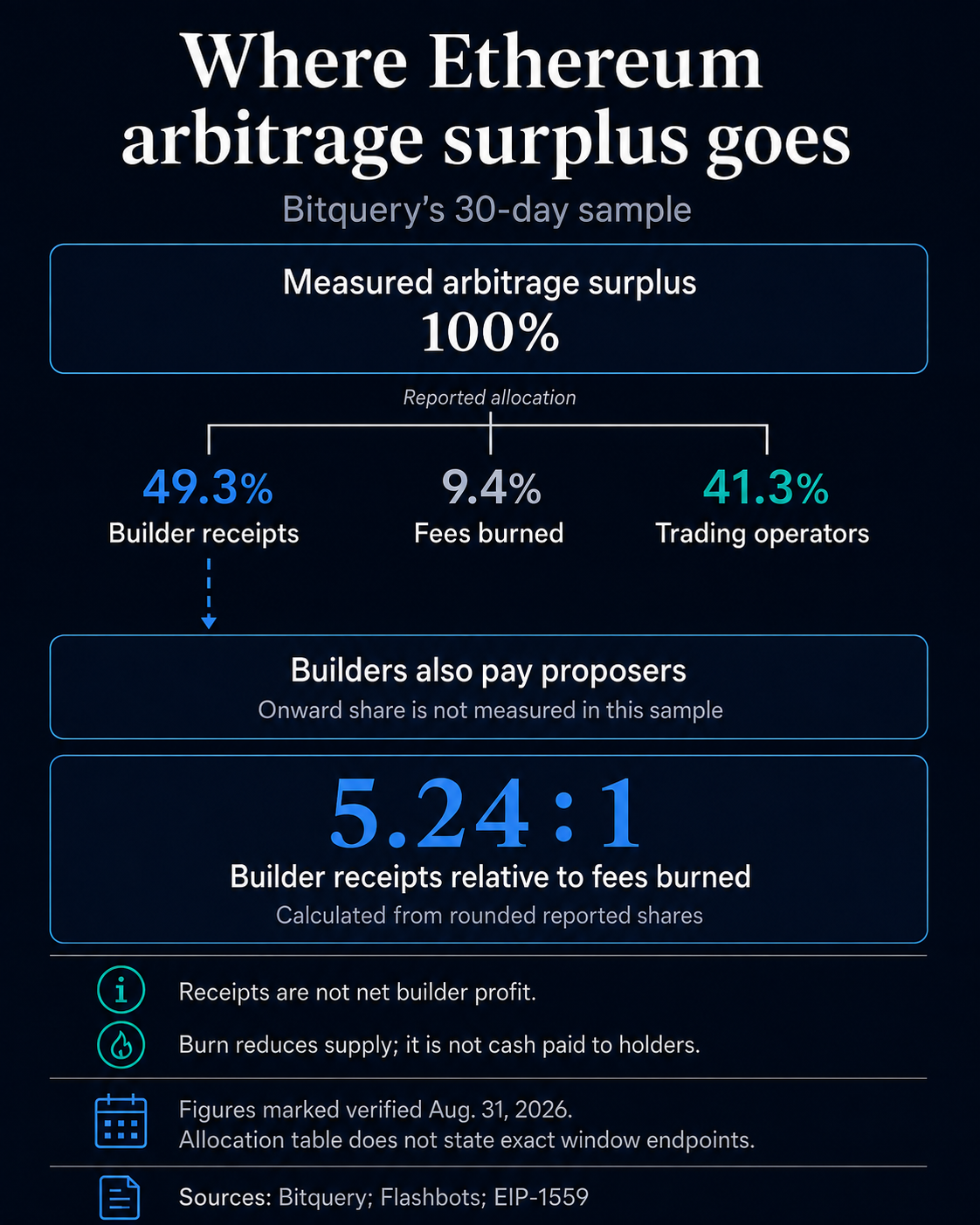
Bitquery's 30-day Ethereum arbitrage allocation: 49.3% builder receipts, 9.4% fees burned and 41.3% trading operators. Builder receipts are 5.24 times burn; builders also pay proposers, but the onward share is unmeasured.Bitquery's 30-day Ethereum arbitrage allocation: 49.3% builder receipts, 9.4% fees burned and 41.3% trading operators. Builder receipts are 5.24 times burn; builders also pay proposers, but the onward share is unmeasured.

A payment to builders has another destination

Arbitrage software looks for a token available at different prices, buys at the cheaper price and sells at the higher one. Ethereum’s MEV documentation describes the specialized participants finding these opportunities as searchers. When several searchers pursue the same trade, getting a transaction included in the right position has economic value.

An operator must secure execution while the price difference still exists. Competition for that opportunity can turn part of a trading gain into a payment for inclusion, reducing what remains with the operator.

In the block-building arrangement documented by Flashbots, builders gather transactions and bundles, construct blocks, then bid for validators’ blockspace through relays. The validator acting as proposer is paid to propose the builder’s block.

The payment design makes the distinction visible. A builder sets its own address as the block’s fee recipient, then includes a transaction at the end of the block paying ETH to the proposer’s designated recipient. Money can reach the builder address and subsequently leave for the validator within that same block.

Related Reading

Ethereum’s next upgrade turns a 2-second block bottleneck into a roughly 9-second window

Counting only the incoming payment stops the accounting too early. To compare participants, the relevant builder figure is what remains after the proposer payment, with business costs a further consideration. The proposer receipt is a separate flow, not an additional arbitrage gain to add on top of the original surplus.

New York Fed Staff Report 1102 uses this distinction in its historical research: builder profit is direct payments plus priority fees, minus the payment to the proposer. It measures retained block revenue, rather than a complete business profit after operating costs.

The Daily Brief

The signal, before the noise.

Start your day with the crypto stories moving markets, decoded by CryptoSlate’s editors.

One email. Everything that matters.

Free to join. Unsubscribe any time.

Whoops, looks like there was a problem. Please try again.

You’re on the list. Your next Daily Brief is on its way.

Bitquery’s allocation does not measure the fraction of its builder receipts passed onward to proposers. Assigning that money between builders and validators would require matching the sampled trading payments to the relevant onward transfers. The protocol describes the route; it does not supply the missing percentage.

What fee burn means for ETH holders

Ethereum’s EIP-1559 specification separates the base fee from the priority fee. The base fee is destroyed by the protocol. The priority fee is a payment associated with transaction inclusion.

Base fee per gas adjusts according to gas used relative to the block target. That is a different mechanism from a searcher’s willingness to pay for a profitable trading position. Both can feature in the same transaction, but they answer different economic questions.

This is why the comparison cannot be read as though every payment made on Ethereum contributes equally to reducing ETH supply. A larger inclusion payment can change what a participant receives without representing an equivalent increase in burned ETH. Likewise, a transaction count does not disclose either the gas consumed or the base fee paid.

Related Reading

Ethereum’s next major upgrade just slipped to late 2026, forcing a two-week scramble to save its 2027 roadmap

For a holder assessing the supply effect, the useful measurement is ETH destroyed over a defined period, compared with ETH created over that same period. Ethereum’s issuance documentation explains that the balance of issuance and burn determines whether supply expands or contracts.

Burn consequently reduces supply relative to a world without that destruction, but it does not by itself establish that total supply fell. Nor does it transfer cash to a passive holder. Those distinctions remain relevant even when the underlying activity creates a profitable trade for somebody else.


Related articles

SEC staff’s staking-token split spotlights the exit risks behind staked ETH tokens

SEC staff’s staking-token split spotlights the exit risks behind staked ETH tokens

September 27, 2026
Ethereum isn’t instant, but collateral could make it feel that way

Ethereum isn’t instant, but collateral could make it feel that way

September 27, 2026

The study filters for surplus no greater than the capital committed in each transaction. Wallet reconciliation can reduce apparent earnings further, and incomplete Ethereum venue decoding misses activity. The separate annual comparison covers Ethereum, BNB Chain, Base, Arbitrum and Polygon for 12 months through Aug. 29, 2026; Optimism and Solana are excluded. Its fixed reference prices differ from the monthly prices used in the historical series.

These boundaries leave a useful allocation finding without establishing a trend in anyone’s profits. A later comparison would need consistent coverage, periods and accounting, including builder payments onward to proposers. Otherwise, a change in the reported share could reflect a change in what was counted.

The investment-thesis test therefore has distinct parts. Operators need retained trading surplus sufficient to cover their business costs. Builders need receipts considered alongside proposer payments. Validators receive compensation through their own role. Passive holders face a supply outcome that depends on issuance as well as destruction.

Related Reading

A 36-day staking bottleneck is costing Ethereum depositors over $350,000 in lost rewards daily

More transactions cannot answer all four questions. Evidence that activity strengthens ETH’s supply-reduction case would be comparable burn and issuance measurements; evidence of higher retained block revenue would be comparable receipts and onward payments. The distinction determines whether a busy network is producing more income for its participants, reducing its token supply, or doing both.




Source link

Share76Tweet47

Related Posts

SEC staff’s staking-token split spotlights the exit risks behind staked ETH tokens

SEC staff’s staking-token split spotlights the exit risks behind staked ETH tokens

by Moussa
September 27, 2026
0

An ETH holder can sell a liquid-staking token while the ETH behind it remains staked. A Sept. 25 SEC staff...

Ethereum isn’t instant, but collateral could make it feel that way

Ethereum isn’t instant, but collateral could make it feel that way

by Moussa
September 27, 2026
0

When a payment app tells you a transfer is complete, you start making decisions. You hand over whatever you've sold,...

The NFT party is over and everybody now owes storage rent

The NFT party is over and everybody now owes storage rent

by Moussa
September 26, 2026
0

In 2021, Christie's sold a Beeple NFT for $69.35 million, and Sotheby's took another $24.40 million for 101 Bored Ape...

ARK partners with Securitize to put a venture fund on Ethereum, but leaves exit doors locked

ARK partners with Securitize to put a venture fund on Ethereum, but leaves exit doors locked

by Moussa
September 26, 2026
0

ARK Invest and Securitize announced on Sept. 24 that eligible investors would be able to hold tokenized interests in the...

Payy bridge exploit freezes crypto cards, and no balances remain safe

Payy bridge exploit freezes crypto cards, and no balances remain safe

by Moussa
September 25, 2026
0

Payy has frozen its stablecoin payment network, including card transactions, after saying its Ethereum bridge contract was exploited and drained...

Load More

youssufi.com

sephina.com

[vc_row full_width="stretch_row" parallax="content-moving" vc_row_background="" background_repeat="no-repeat" background_position="center center" footer_scheme="dark" css=".vc_custom_1517813231908{padding-top: 60px !important;padding-bottom: 30px !important;background-color: #191818 !important;background-position: center;background-repeat: no-repeat !important;background-size: cover !important;}" footer_widget_title_color="#fcbf46" footer_button_bg="#fcb11e"][vc_column width="1/4"]

We bring you the latest in Crypto News

[/vc_column][vc_column width="1/4"][vc_wp_categories]
[/vc_column][vc_column width="1/4"][vc_wp_tagcloud taxonomy="post_tag"][/vc_column][vc_column width="1/4"]

Newsletter

[vc_raw_html]JTNDcCUzRSUzQ2RpdiUyMGNsYXNzJTNEJTIydG5wJTIwdG5wLXN1YnNjcmlwdGlvbiUyMiUzRSUwQSUzQ2Zvcm0lMjBtZXRob2QlM0QlMjJwb3N0JTIyJTIwYWN0aW9uJTNEJTIyaHR0cHMlM0ElMkYlMkZhcHByb3gub3JnJTJGJTNGbmElM0RzJTIyJTNFJTBBJTBBJTNDaW5wdXQlMjB0eXBlJTNEJTIyaGlkZGVuJTIyJTIwbmFtZSUzRCUyMm5sYW5nJTIyJTIwdmFsdWUlM0QlMjIlMjIlM0UlM0NkaXYlMjBjbGFzcyUzRCUyMnRucC1maWVsZCUyMHRucC1maWVsZC1maXJzdG5hbWUlMjIlM0UlM0NsYWJlbCUyMGZvciUzRCUyMnRucC0xJTIyJTNFRmlyc3QlMjBuYW1lJTIwb3IlMjBmdWxsJTIwbmFtZSUzQyUyRmxhYmVsJTNFJTBBJTNDaW5wdXQlMjBjbGFzcyUzRCUyMnRucC1uYW1lJTIyJTIwdHlwZSUzRCUyMnRleHQlMjIlMjBuYW1lJTNEJTIybm4lMjIlMjBpZCUzRCUyMnRucC0xJTIyJTIwdmFsdWUlM0QlMjIlMjIlM0UlM0MlMkZkaXYlM0UlMEElM0NkaXYlMjBjbGFzcyUzRCUyMnRucC1maWVsZCUyMHRucC1maWVsZC1lbWFpbCUyMiUzRSUzQ2xhYmVsJTIwZm9yJTNEJTIydG5wLTIlMjIlM0VFbWFpbCUzQyUyRmxhYmVsJTNFJTBBJTNDaW5wdXQlMjBjbGFzcyUzRCUyMnRucC1lbWFpbCUyMiUyMHR5cGUlM0QlMjJlbWFpbCUyMiUyMG5hbWUlM0QlMjJuZSUyMiUyMGlkJTNEJTIydG5wLTIlMjIlMjB2YWx1ZSUzRCUyMiUyMiUyMHJlcXVpcmVkJTNFJTNDJTJGZGl2JTNFJTBBJTNDZGl2JTIwY2xhc3MlM0QlMjJ0bnAtZmllbGQlMjB0bnAtcHJpdmFjeS1maWVsZCUyMiUzRSUzQ2xhYmVsJTNFJTNDaW5wdXQlMjB0eXBlJTNEJTIyY2hlY2tib3glMjIlMjBuYW1lJTNEJTIybnklMjIlMjByZXF1aXJlZCUyMGNsYXNzJTNEJTIydG5wLXByaXZhY3klMjIlM0UlQzIlQTBCeSUyMGNvbnRpbnVpbmclMkMlMjB5b3UlMjBhY2NlcHQlMjB0aGUlMjBwcml2YWN5JTIwcG9saWN5JTNDJTJGbGFiZWwlM0UlM0MlMkZkaXYlM0UlM0NkaXYlMjBjbGFzcyUzRCUyMnRucC1maWVsZCUyMHRucC1maWVsZC1idXR0b24lMjIlM0UlM0NpbnB1dCUyMGNsYXNzJTNEJTIydG5wLXN1Ym1pdCUyMiUyMHR5cGUlM0QlMjJzdWJtaXQlMjIlMjB2YWx1ZSUzRCUyMlN1YnNjcmliZSUyMiUyMCUzRSUwQSUzQyUyRmRpdiUzRSUwQSUzQyUyRmZvcm0lM0UlMEElM0MlMkZkaXYlM0UlM0NiciUyRiUzRSUzQyUyRnAlM0U=[/vc_raw_html][/vc_column][/vc_row]
No Result
View All Result
  • Contact Us
  • Homepages
  • Business
  • Guide

© 2024 APPROX FOUNDATION - The Crypto Currency News