



• About
  • FAQ
  • Earn Bitcoin while Surfing the net
  • Buy & Sell Crypto on Paxful
Newsletter
Approx Foundation
  • Home
    • Home – Layout 1
  • Bitcoin
  • Ethereum
  • Regulation
  • Market
  • Blockchain
  • Business
  • Guide
  • Contact Us
No Result
View All Result
  • Home
    • Home – Layout 1
  • Bitcoin
  • Ethereum
  • Regulation
  • Market
  • Blockchain
  • Business
  • Guide
  • Contact Us
No Result
View All Result
Approx Foundation
No Result
View All Result
Home Regulation

RowDAS prototype cuts CPU work

Moussa by Moussa
September 7, 2026
in Regulation
0
RowDAS prototype cuts CPU work
189
SHARES
1.5k
VIEWS
Share on FacebookShare on Twitter


An Ethereum prototype that divides blob-recovery duties among nodes reported an 11–18× reduction in estimated reconstruction computing work across 1,000-node simulations. The results suggest operators could reduce duplicated work through a smaller change than the full RowDAS networking proposal.

Researcher Csaba Kiraly’s Sept. 3 report describes the reduced design as a possible first step toward RowDAS. It assigns recovery duties without introducing the new row-networking channels in the full proposal.

Blobs carry data used by layer-2 rollups. PeerDAS, Ethereum’s system for checking that blob data is available, lets nodes download only part of it. High-custody nodes hold at least 64 of the 128 data columns, enough to rebuild missing blob data; supernodes hold all 128.

Related Reading

Ethereum’s data bloat threatens home staking amid surge toward 1.2TB need

Many high-custody nodes can repeat the same reconstruction. The reduced design assigns particular blobs to them first, allowing others to receive the recovered data instead of immediately rebuilding it themselves.

What the Ethereum blob-recovery simulations show

In one configuration with four blobs, 10% supernodes and no columns withheld, the estimated network-wide reconstruction cost fell from 48.6 CPU-seconds under the PeerDAS model to 2.75 CPU-seconds under the reduced design. At a 20% supernode share, the corresponding figures were 91 and 6.6 CPU-seconds.

Those totals describe accumulated computing work across the simulated network, rather than elapsed recovery time. The accounting applies a measured 162-millisecond cost per blob recovery on a Ryzen 9 8945HS processor. Transaction speeds and fee savings were outside the reported measurements.
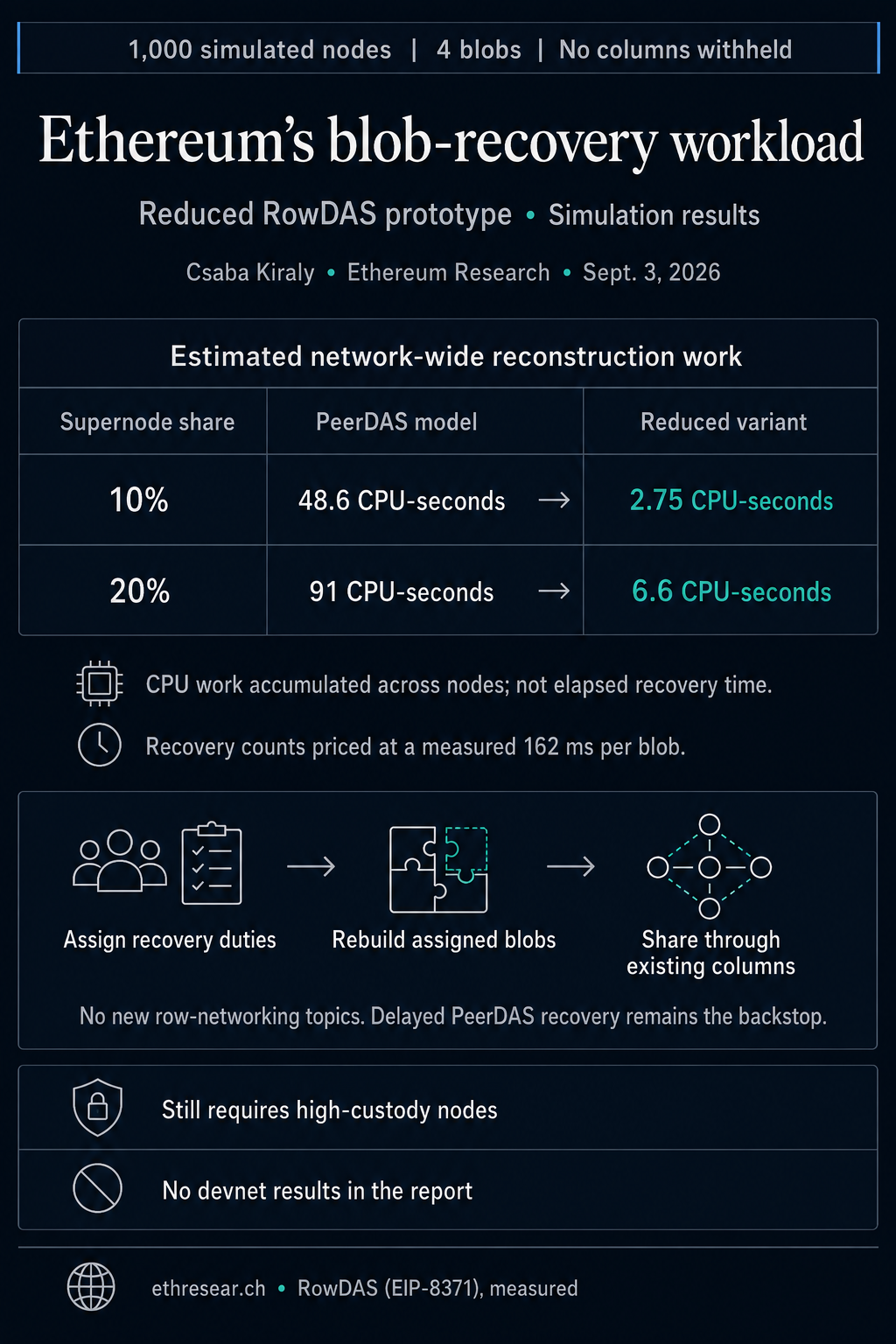
Reported simulation CPU work for 1,000 nodes and four blobs with no columns withheld: 48.6 versus 2.75 CPU-seconds at 10% supernodes and 91 versus 6.6 at 20%, comparing PeerDAS with the reduced RowDAS variant. CPU work is not elapsed time; high-custody nodes are still required and the report had no devnet results.Reported simulation CPU work for 1,000 nodes and four blobs with no columns withheld: 48.6 versus 2.75 CPU-seconds at 10% supernodes and 91 versus 6.6 at 20%, comparing PeerDAS with the reduced RowDAS variant. CPU work is not elapsed time; high-custody nodes are still required and the report had no devnet results.

The PeerDAS baseline already includes randomized waiting and checks that suppress duplicate reconstruction. The comparison therefore gives existing client behavior credit for the work those delays save.

The Daily Brief

The signal, before the noise.

Start your day with the crypto stories moving markets, decoded by CryptoSlate’s editors.

One email. Everything that matters.

Free to join. Unsubscribe any time.

Whoops, looks like there was a problem. Please try again.

You’re on the list. Your next Daily Brief is on its way.

Under the reduced variant, assigned nodes share recovered cells through existing column-distribution channels. High-custody nodes retain a delayed recovery role for anything still missing, preserving a PeerDAS-style backstop.

Related Reading

Ethereum’s surprising usage drop suggests the network solved the wrong problem with Fusaka upgrade

Full RowDAS, specified in draft EIP-8371, would add another recovery route: row channels let smaller nodes pool their data and reconstruct collectively when their combined holdings clear the recovery threshold. The reduced design retains today’s dependence on high-custody nodes and cannot provide that additional resilience.

The measurements remain limited to simulated, in-process networks using real cryptography. Kiraly reported no devnet results, and the full design’s 128-row-subnet configuration remains an extrapolation from smaller subnet counts. Larger simulations and real-network tests are still ahead.


Related articles

SEC staff’s staking-token split spotlights the exit risks behind staked ETH tokens

SEC staff’s staking-token split spotlights the exit risks behind staked ETH tokens

September 27, 2026
Ethereum isn’t instant, but collateral could make it feel that way

Ethereum isn’t instant, but collateral could make it feel that way

September 27, 2026

EIP-8371 leaves blob limits unchanged, and the proposed split between duty assignment and row networking has yet to be incorporated into its draft text. The immediate opportunity is narrower: reducing the processor work needed for recovery, with the broader resilience benefits dependent on a later row layer.

Related Reading

Ethereum’s next major upgrade just slipped to late 2026, forcing a two-week scramble to save its 2027 roadmap




Source link

Share76Tweet47

Related Posts

SEC staff’s staking-token split spotlights the exit risks behind staked ETH tokens

SEC staff’s staking-token split spotlights the exit risks behind staked ETH tokens

by Moussa
September 27, 2026
0

An ETH holder can sell a liquid-staking token while the ETH behind it remains staked. A Sept. 25 SEC staff...

Ethereum isn’t instant, but collateral could make it feel that way

Ethereum isn’t instant, but collateral could make it feel that way

by Moussa
September 27, 2026
0

When a payment app tells you a transfer is complete, you start making decisions. You hand over whatever you've sold,...

The NFT party is over and everybody now owes storage rent

The NFT party is over and everybody now owes storage rent

by Moussa
September 26, 2026
0

In 2021, Christie's sold a Beeple NFT for $69.35 million, and Sotheby's took another $24.40 million for 101 Bored Ape...

ARK partners with Securitize to put a venture fund on Ethereum, but leaves exit doors locked

ARK partners with Securitize to put a venture fund on Ethereum, but leaves exit doors locked

by Moussa
September 26, 2026
0

ARK Invest and Securitize announced on Sept. 24 that eligible investors would be able to hold tokenized interests in the...

Payy bridge exploit freezes crypto cards, and no balances remain safe

Payy bridge exploit freezes crypto cards, and no balances remain safe

by Moussa
September 25, 2026
0

Payy has frozen its stablecoin payment network, including card transactions, after saying its Ethereum bridge contract was exploited and drained...

Load More

youssufi.com

sephina.com

[vc_row full_width="stretch_row" parallax="content-moving" vc_row_background="" background_repeat="no-repeat" background_position="center center" footer_scheme="dark" css=".vc_custom_1517813231908{padding-top: 60px !important;padding-bottom: 30px !important;background-color: #191818 !important;background-position: center;background-repeat: no-repeat !important;background-size: cover !important;}" footer_widget_title_color="#fcbf46" footer_button_bg="#fcb11e"][vc_column width="1/4"]

We bring you the latest in Crypto News

[/vc_column][vc_column width="1/4"][vc_wp_categories]
[/vc_column][vc_column width="1/4"][vc_wp_tagcloud taxonomy="post_tag"][/vc_column][vc_column width="1/4"]

Newsletter

[vc_raw_html]JTNDcCUzRSUzQ2RpdiUyMGNsYXNzJTNEJTIydG5wJTIwdG5wLXN1YnNjcmlwdGlvbiUyMiUzRSUwQSUzQ2Zvcm0lMjBtZXRob2QlM0QlMjJwb3N0JTIyJTIwYWN0aW9uJTNEJTIyaHR0cHMlM0ElMkYlMkZhcHByb3gub3JnJTJGJTNGbmElM0RzJTIyJTNFJTBBJTBBJTNDaW5wdXQlMjB0eXBlJTNEJTIyaGlkZGVuJTIyJTIwbmFtZSUzRCUyMm5sYW5nJTIyJTIwdmFsdWUlM0QlMjIlMjIlM0UlM0NkaXYlMjBjbGFzcyUzRCUyMnRucC1maWVsZCUyMHRucC1maWVsZC1maXJzdG5hbWUlMjIlM0UlM0NsYWJlbCUyMGZvciUzRCUyMnRucC0xJTIyJTNFRmlyc3QlMjBuYW1lJTIwb3IlMjBmdWxsJTIwbmFtZSUzQyUyRmxhYmVsJTNFJTBBJTNDaW5wdXQlMjBjbGFzcyUzRCUyMnRucC1uYW1lJTIyJTIwdHlwZSUzRCUyMnRleHQlMjIlMjBuYW1lJTNEJTIybm4lMjIlMjBpZCUzRCUyMnRucC0xJTIyJTIwdmFsdWUlM0QlMjIlMjIlM0UlM0MlMkZkaXYlM0UlMEElM0NkaXYlMjBjbGFzcyUzRCUyMnRucC1maWVsZCUyMHRucC1maWVsZC1lbWFpbCUyMiUzRSUzQ2xhYmVsJTIwZm9yJTNEJTIydG5wLTIlMjIlM0VFbWFpbCUzQyUyRmxhYmVsJTNFJTBBJTNDaW5wdXQlMjBjbGFzcyUzRCUyMnRucC1lbWFpbCUyMiUyMHR5cGUlM0QlMjJlbWFpbCUyMiUyMG5hbWUlM0QlMjJuZSUyMiUyMGlkJTNEJTIydG5wLTIlMjIlMjB2YWx1ZSUzRCUyMiUyMiUyMHJlcXVpcmVkJTNFJTNDJTJGZGl2JTNFJTBBJTNDZGl2JTIwY2xhc3MlM0QlMjJ0bnAtZmllbGQlMjB0bnAtcHJpdmFjeS1maWVsZCUyMiUzRSUzQ2xhYmVsJTNFJTNDaW5wdXQlMjB0eXBlJTNEJTIyY2hlY2tib3glMjIlMjBuYW1lJTNEJTIybnklMjIlMjByZXF1aXJlZCUyMGNsYXNzJTNEJTIydG5wLXByaXZhY3klMjIlM0UlQzIlQTBCeSUyMGNvbnRpbnVpbmclMkMlMjB5b3UlMjBhY2NlcHQlMjB0aGUlMjBwcml2YWN5JTIwcG9saWN5JTNDJTJGbGFiZWwlM0UlM0MlMkZkaXYlM0UlM0NkaXYlMjBjbGFzcyUzRCUyMnRucC1maWVsZCUyMHRucC1maWVsZC1idXR0b24lMjIlM0UlM0NpbnB1dCUyMGNsYXNzJTNEJTIydG5wLXN1Ym1pdCUyMiUyMHR5cGUlM0QlMjJzdWJtaXQlMjIlMjB2YWx1ZSUzRCUyMlN1YnNjcmliZSUyMiUyMCUzRSUwQSUzQyUyRmRpdiUzRSUwQSUzQyUyRmZvcm0lM0UlMEElM0MlMkZkaXYlM0UlM0NiciUyRiUzRSUzQyUyRnAlM0U=[/vc_raw_html][/vc_column][/vc_row]
No Result
View All Result
  • Contact Us
  • Homepages
  • Business
  • Guide

© 2024 APPROX FOUNDATION - The Crypto Currency News