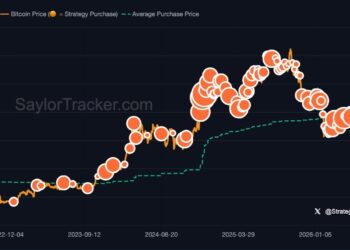




Bitcoin is finally showing signs of fatigue after its multi-month ascent from the $60k level to nearly $88k. As of Friday morning, BTC is settling in around $80,800 after what will likely be its biggest weekly downmove since June.
Despite the correction, BTC looks technically solid on longer timeframes, and both the S&P 500 and the Nasdaq touched new all-time highs this week, fueling general optimism in risk assets.
And bitcoin’s resilience remains one of the more interesting stories. Jeff Dorman argued that crypto is becoming an actual capital market, with investors rotating between themes based on data. He calls its behavior “strangely rational.” That would help explain why crypto is holding up despite a macroeconomic backdrop that should, in theory, be making life difficult.
Glassnode highlighted $90,000 as its largest liquidation cluster, giving a nice psychological breakout level for bulls.
Forward Guidance’s Felix is more excited about this cycle because there are simply better coins and better companies. Jamie Coutts supplied a complementary analysis: new token supply among the top 200 has been trending down since 2021, while prices have finally started rising. He calls it a “disinflationary regime.” Less dilution and more businesses worth owning would certainly improve the experience. Rekt Diomedes’s midweek recap is also worth reading.
Adding to the optimism on the timeline, Citrini dropped a new thesis on the intersection between crypto and agentic AI, arguing that blockchain will be the beneficiary of the clunky traditional financial rails succumbing to AI.
“Either our existing consumer-facing financial institutions rebuild themselves around more open, programmable standards, or they are eventually disrupted by a new system that does.
This brings us back to an industry that, for most of the last decade, has looked like a solution in search of a problem:
Crypto.”
The man also blessed us with some of the tokens and equities he’s bullish on, which include: Derive (DRV), Lighter (LIT), Securitize (SECZ), Circle (CRCL), and about 20 more.
It should be noted that Citrini was acquired by Semianalysis this month. It is speculated that the firm may have been using the platform to pump their bags.
In the macroeconomic sphere, the usual questions linger. After the bond-ETF inflows discussed last week, the search for a bottom in bonds continues. Tracy Alloway highlighted how unpleasant the experience has been for bond investors. At some point, sufficiently attractive yields should bring buyers back. The question is what happens to the economy before they do. A bond rally driven by easing inflation would probably be more welcome than one driven by a collapse in demand.
France supplied another reminder that sovereign debt is a comparative game. A Japanese fund’s reported selling helped widen the French-German bond spread, prompting some rather apocalyptic commentary. Bob Elliott pushed back on comparisons with the eurozone crisis: the broad capital flight that characterized that episode has not appeared. U.S. debt may look unappetizing, but that doesn’t make the alternatives better. Cleanest dirty shirt and all that.
Private credit deserves attention too. Michael Howell warned about a worsening debt-maturity wall through 2030. Borrowers eventually have to repay or refinance, whether the available rate suits them or not. A refinancing problem can remain invisible while the old borrowing terms are still in place.
Meanwhile, Elliott thinks AI is what is holding up U.S. stocks against higher yields, widening corporate spreads and expensive oil. Last week’s question about whether AI can keep the economy afloat remains relevant. A16z estimates that only about 2% of U.S. households pay for AI, although that share is growing quickly. Depending on your disposition, that’s either a lot of room for growth or a rather small paying customer base beneath enormous expectations.
In regulation, there was a genuine win for self-custody. Treasury’s proposed unhosted-wallet rule has been withdrawn, removing a threat of additional reporting and verification requirements around transfers involving self-custodied wallets. Holding your own keys should not itself be treated as suspicious. While addressing a conference at the United Nations headquarters in New York, Charles Hoskinson explained directly why he doesn’t trust the digital euro. Financial privacy remains an awkward subject for institutions that would prefer to collect everything.
The SEC’s approval of leveraged crypto funds was less reassuring. Its October 2 order permits Cboe to list 3x bitcoin and ether products. These target three times a daily futures benchmark’s return, not three times bitcoin’s or ether’s return over whatever period someone happens to hold them. Compounding makes that distinction important. These assets already supply quite enough volatility without a multiplier. I suspect this will look slightly less like progress later in the bull market.
The debate over what bitcoin’s real investment thesis continued. In an op-ed for the Wall Street Journal, Bitwise CIO Matt Hougan made the case for BTC to be the world’s digital store of value. Luke Gromen warned that pursuing the “digital credit” narrative could prevent it from ever reaching $1 million. More financial products built around bitcoin do not necessarily serve the same thesis.
Looking at the tokenization trend, Ethereum has an important question to answer. Lorenzo Valente highlighted how little tokenized-stock activity is happening on mainnet, while Solana appears to be heating up. Is Ethereum short of commercial effort, or is there something about the trading experience that makes other chains more attractive? Dankrad Feist joined the debate. The opportunity discussed here for several weeks is real, but Ethereum does not automatically inherit it.
Gabriel Shapiro expects tokenized stocks to settle at two extremes: credibly neutral, decentralized chains such as Ethereum, or fully controlled environments such as Robinhood Chain. That leaves the chains somewhere in between with a less obvious pitch: neither the neutrality of the first option nor the issuer’s control over the second.
Ethereum creator Vitalik Buterin offered another interesting perspective in his Singapore remarks. Falling fees and AI integration could mean on-chain applications in their current form disappear, with agents interacting directly instead. The competition may not just be over which chain hosts an app, but whether users need to open one at all.
The AI-token pitches remain ambitious. Following Bitwise’s NEAR ETF launch last week, Hougan is making the case for NEAR as the blockchain for AI. Stillcore, the Bittensor-focused fund associated with Jason Calacanis, lays out a case for a $1 trillion-plus Bittensor ecosystem by 2030. The ambition is enormous, although an ecosystem valuation is not the same thing as a return forecast for TAO alone. At the other end of the enthusiasm spectrum, Algod is shorting VVV based on his criticisms of tokenomics discussed last week.
On to the business of crypto. OKX raised capital from Circle, Ripple, SC Ventures and QRT at a $25 billion pre-money valuation. Robinhood added $25 million in bitcoin to its balance sheet. Tom Lee says Bitmine will stop accumulating ETH once it reaches 5% of the supply, with about 100,000 ETH left to buy. The target is impressive, but reaching it would also remove a substantial recurring buyer.
CME’s retreat from its 24/7 crude-oil futures plan offered a less flattering tradfi comparison. The exchange withdrew its proposed 10-barrel contract after industry participants raised concerns about around-the-clock energy trading. Hyperliquid doesn’t seem to have the same difficulty with weekends.
Not every crypto business is thriving either. Blast is shutting down, saying operating costs exceed the chain’s revenue. In media, Cointelegraph denied claims that it is seeking a new owner.
And not every coin has joined the recovery, especially memecoins. Fabiano revisited Murad’s “SSSS Tier” list from two years ago. Every single coin is down nearly 100%. Apparently “SSSS Tier” needed a more precise definition.
Finally, security. Justin Drake called for calmly preparing for “bunker mode”, which includes controlled migration to fresh addresses ahead of a possible break in wallet cryptography. Drake’s concern is broader than quantum computers alone: he worries that AI-assisted mathematical advances could bring the threat forward. Mert Mumtaz rejected the advice, while Taylor Monahan pointed out how much wider the implications would be if an ordinary hacker acquired capabilities beyond governments. Drake’s warning is legitimate contingency planning, but not evidence that everyone’s wallets are about to be drained.
There was better news from Bitget. CryptoQuant credited quick communication and phased withdrawal reopening with preventing a run after the hack covered in previous weeks. ZachXBT described infiltrating a Chinese laundering syndicate that he says processed more than $1 billion linked to Lazarus Group, gathering intelligence that helped freeze funds. The man continues to do extraordinary work.
THORChain, meanwhile, drew criticism from Monahan over its new ZEC pool and the possibility of earning fees from North Korea-linked stolen funds. After last week’s argument about which transactions the protocol will and won’t stop, this hardly improves the optics.
The more immediate threats remain depressingly familiar. Telegram and carrier voicemail were flagged as another attack surface. An attendee at the Singapore conference reported losing $4 million to a hack. And in a wrench attack in Thailand, robbers took cash and Rolexes and forced the victims to transfer about $820,000 in crypto. There is plenty to worry about before anyone breaks the mathematics.
Stay safe out there.
-David Sencil