

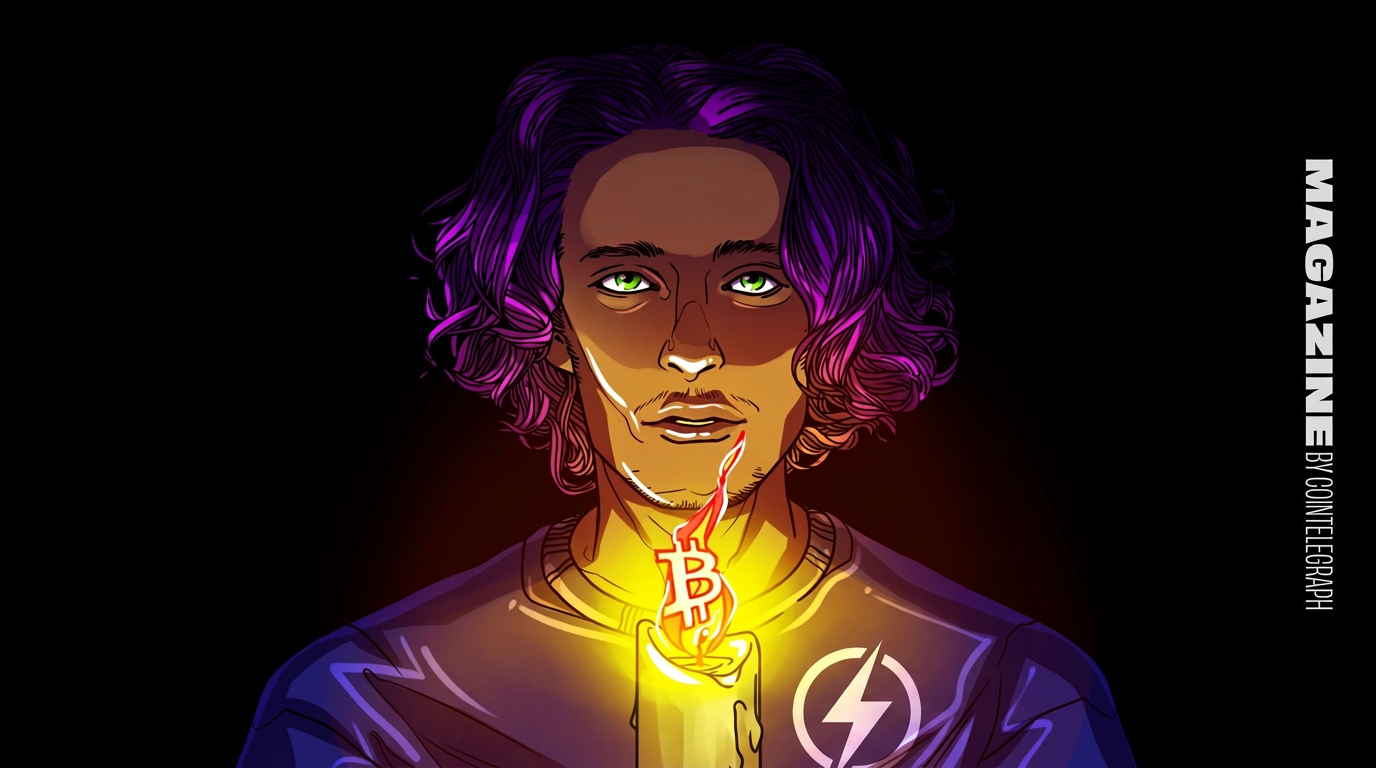

Bitcoin developer Paul Sztorc ruffled a few feathers this month with a brutally blunt assessment of the Lightning Network: Bitcoiners are lying to themselves about how well it works.
“Most people don’t realize how bad the Lightning Network is,” Sztorc said in an October 4 post on X, “because there has been a vast, years long conspiracy to ***lie*** about the LN user experience.”
He argued that custodial Lightning services account for more than 80% of payments, and described their promotion as a “vast campaign of fraud on par with Elizabeth Holmes’ Theranos,” he said, referring to fake blood-testing device company whose founder was convicted of fraud.
Lightning payments are private by design, making it impossible to establish the custodial share from public network data alone. Sztorc did not respond to Magazine’s requests for comment.
But his scathing criticism resurfaces a topic Bitcoin developers have wrestled with for years: Has Lightning made Bitcoin easier to use, or has the community become so invested in Layer 2 protocol that it overlooks its shortcomings?
Lightning has a usability problem
Lightning was designed to enable faster, cheaper Bitcoin transactions without every payment having to be individually recorded on the blockchain, but its underlying mechanics have often created friction for users and businesses alike.

Sztorc says people don’t realize how bad the Lightning Network is. Source: Paul Sztorc
In a one-click world where users of TradFi rails can tap a card or click a mouse to complete a transaction, Lightning’s clunky payment channels rely on liquidity being available in the right places at the right times. Routing payments through the network can fail, especially larger payments requiring several hops through different nodes.
Related: Big Questions: Does Satoshi actually own 1.1 million Bitcoin?
Even Lightning’s head of liquidity, Alex Bosworth, said this month, “the painful truth is that in a setup with privacy and p2p etc it’s extremely slow compared to tap to pay.”
Added to that, running a node and managing channels is simply way too technical for the average user, who just wants to pay for stuff and get on with their day. That’s the reason for high estimates of custodial use — it’s easier and works better at the expense of using a trusted intermediary.
Everyday payments have a 99.7% success rate
Jesse Shrader, co-founder and chief executive of Lightning infrastructure provider Amboss, acknowledges that liquidity requirements are “challenging” to understand at first, but he says they are “trivial to solve” with current tools or automation services.
He tells Magazine, “For everyday payments of around $100, most users can achieve 99% reliability in the core network,” adding that Amboss’ simulations put the success rate for $100 payments at 99.66%.
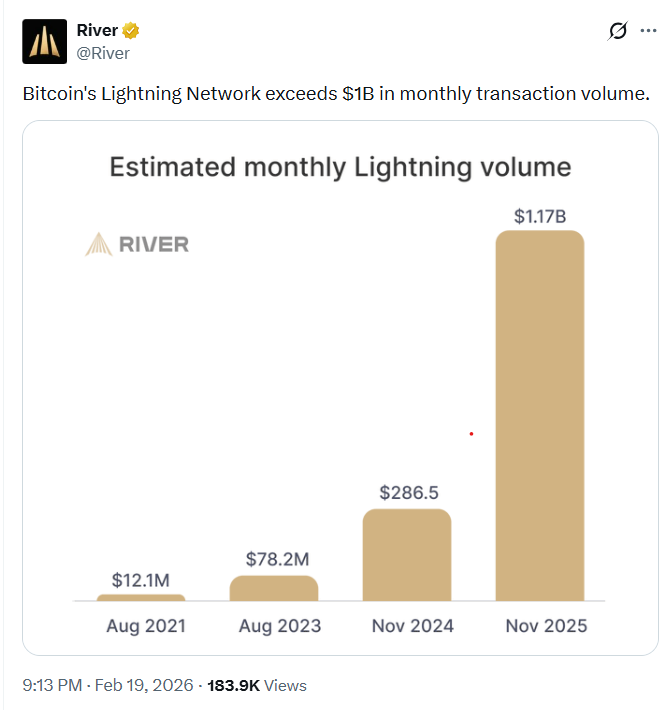
Lightning exceeded $1 billion in transaction volume in November 2025. Source: River
While that’s an encouraging benchmark, it’s not a verified, network-wide measure of everyone’s experience in practice. As they say in the fine print of advertisements: Your results may vary.
In an April 2026 Reddit discussion, one user said he was “genuinely impressed” by where the network had gotten technically, but still questioned how useful it was for everyday spending. “There is still a gap in practice,” he said:
“Every coffee shop, grocery store and gas station I walk into runs on Visa or Mastercard terminals. NFC tap to pay is the standard. Nobody is running a Lightning node at the point of sale and nobody is going to.”
Have developers solved the problem?
Danny Stagg, marketing lead at Bitcoin payments infrastructure provider Breez, says much of the criticism of Lightning’s user experience is now outdated.
“The criticism is not fair in 2026,” he tells Magazine, “but historically it was. For years, both developers and users were asked to understand the complexities of Lightning, like channels and inbound liquidity, just to get paid.”
He says the network has greatly improved over the past two years, with newer infrastructure abstracting much of that complexity away. “Non-custodial UX is now comparable with custodial,” he says.
Users no longer need to manage channels or run their own nodes for a wallet or application to offer Lightning payments, as developers and service providers can handle much of the work underneath the hood.
Related: Lightning Network hits record capacity on crypto exchange adoption
Breez chief executive Roy Sheinfeld says that AI coding tools are making it easier for developers to build Bitcoin-enabled applications, and inquiries from prospective partners have rapidly increased.
“That’s why we’re seeing more partners add Bitcoin every quarter,” Stagg says.
But growing developer interest does not necessarily mean more people are using Lightning for everyday payments.
The numbers show activity, not necessarily success
According to its 2026 Bitcoin adoption report, financial services company River estimated that Lightning processed $1.17 billion in transaction volume across 5.22 million transactions in November 2025 alone.
While that seems like an impressive number, it remains below Lightning’s August 2023 peak of 6.6 million transactions, suggesting transaction counts have not kept pace with the value moving through the network.
Crypto payment processor CoinGate reported 782,403 paid crypto orders across its own customer base in the first half of 2026, up 21.4% year over year, with Lightning accounting for 9.6% of Bitcoin payments processed through its service.
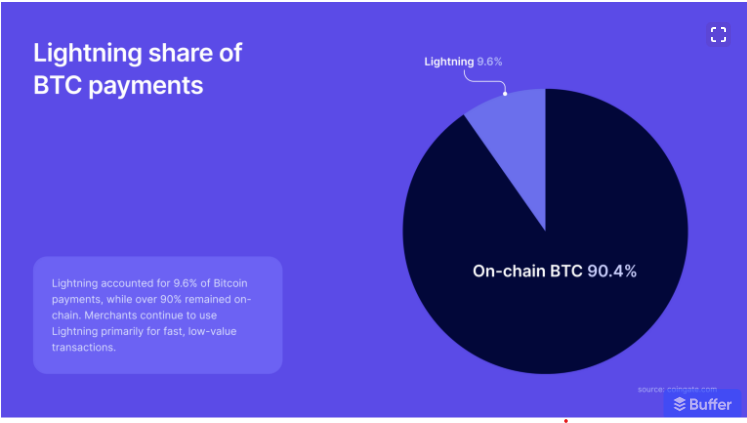
Lightning accounted for 9.6% of Bitcoin payments. Source: CoinGate
What would count as success?
Shrader says that since network-level payment statistics are “impossible to produce unless you are party to the transactions themselves,” he isn’t buying Sztorc’s claim that more than 80% of Lightning payments are custodial.
“I distrust anyone who claims they can prove an 80% custodial share either way from public data alone.”
Stagg says the claim “describes yesterday’s Lightning,” when custodial services offered an easier experience and non-custodial services hadn’t “caught up” yet. (Back in 2023, River estimated one self custodial user for every eight custodial users). But without hard data that’s up to date, the custody question can’t be settled.
And the same caution should apply to claims about Lightning adoption measured in metrics like payment volume, network capacity or developer interest; each measures something different, and none alone can establish how easy Lightning is to use.
Businesses are processing payments and developers are finding ways to abstract technical complexity, but technical progress is not the same as mainstream usability.
The real criticism may not be that Lightning has failed, but whether its supporters conflate evidence of what the network can do with what people are actually doing on the network.
Related: Bitcoin treasury firms can outperform BTC… but is the risk worth taking?
Cointelegraph publishes long-form journalism, analysis and narrative reporting produced by Cointelegraph’s in-house editorial team with subject-matter expertise. All articles are edited and reviewed by Cointelegraph editors in line with our editorial standards. Some articles contain affiliate links, from which Cointelegraph may earn a commission. These relationships do not influence which products we review or our editorial conclusions. Content published in here does not constitute financial, legal or investment advice. Readers should conduct their own research and consult qualified professionals where appropriate. Cointelegraph maintains full editorial independence.