




Lido Lend, a proposed lending protocol from Lido contributors, could let ETH lenders shrink borrowers’ positions before liquidation if its final rules make healthy loans eligible for collateral withdrawals. Its Fallback Exits design would cover a lender’s withdrawal shortfall with borrower collateral while reducing the affected debt.
In the ETH/wstETH example in the October 16 disclosure, lenders supply ETH and borrowers pledge wstETH to borrow it. An exit into that collateral would leave the lender exposed to a staking token before obtaining ETH. Exact borrower eligibility and the token-versus-claim delivery interface remain unsettled.
Lido contributors introduced the lending project on October 7 as a modified fork of Morpho Blue built around isolated markets. In the October 16 post, contributor Izzy said technical specifications and market parameters would follow within two weeks, with governance processes and public audits still ahead of mainnet launch.
Fallback Exits would put borrowers nearest the liquidation loan-to-value ratio, or LLTV, first. Much healthier positions would be less likely to supply collateral. That language suggests a possible unwind below the liquidation threshold; final eligibility rules will determine whether those positions qualify.
The disclosure leaves the eligibility cutoff, settlement valuation, debt-offset formula, fees and limits unspecified. The choice between direct collateral tokens and an intermediate claim also remains open. Those details are consequential: eligibility determines whose position can shrink, while pricing determines the value exchanged.
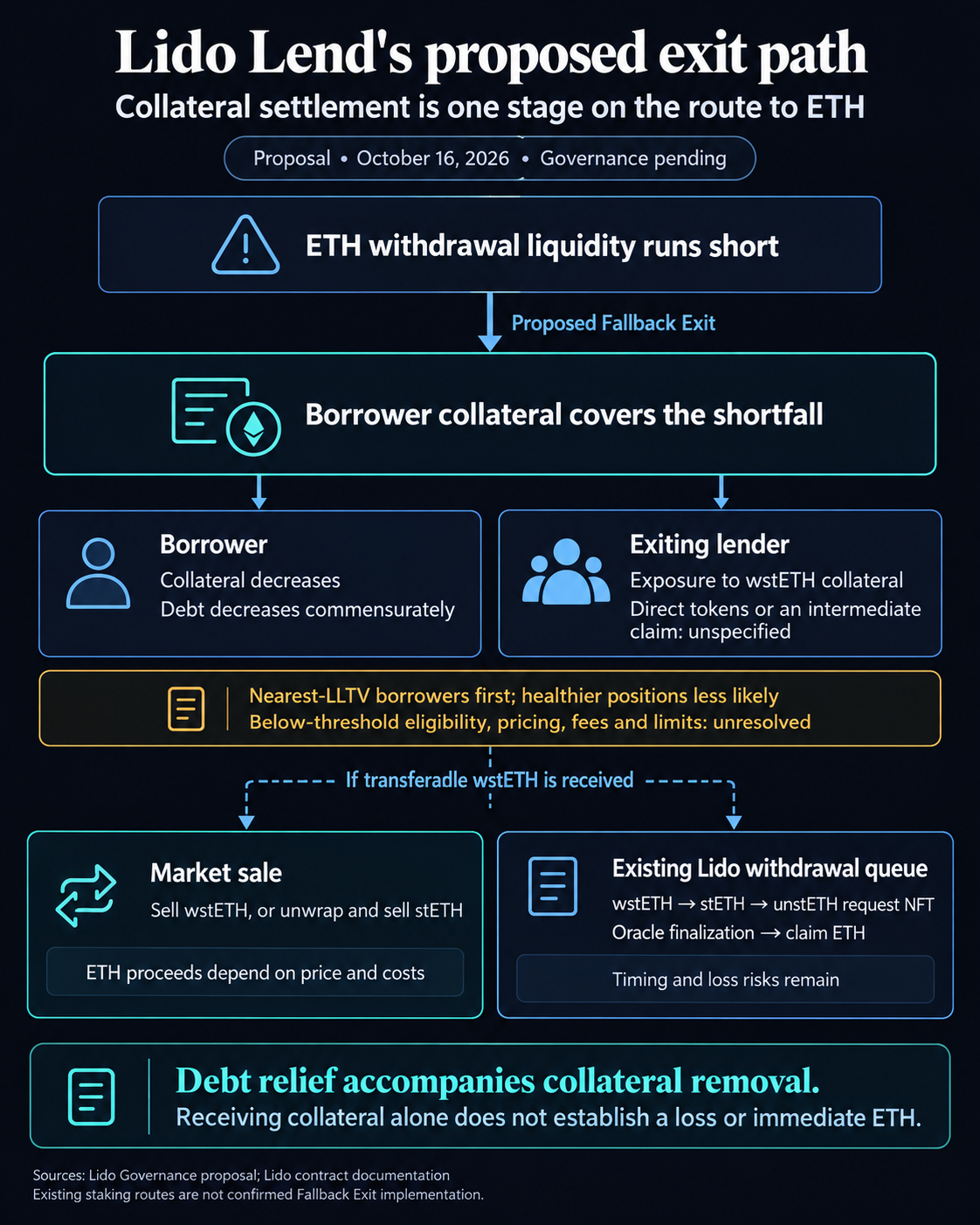
For a borrower, collateral leaving the position must be considered alongside the debt removed. A borrower’s equity change and any penalty depend on the collateral valuation and corresponding debt relief.
The proposed recall risk concerns control over a position’s size as well as its solvency. If below-threshold positions qualify, staying within the borrowing limit might protect against ordinary liquidation while leaving a borrower exposed to a lender-driven reduction.
Fallback Exits and Morpho’s withdrawal rules
Morpho Blue’s core contract illustrates the difference. Its withdrawal function accrues interest and reduces the lender’s supplied balance. It then checks that the remaining supplied assets cover total borrowed assets. If that coverage is insufficient, the transaction reverts; a successful withdrawal transfers the loan token.
This is a market-liquidity test. Borrower collateral stays outside that withdrawal path, so a loan-token shortfall causes the withdrawal to revert. Repayment follows a separate path, bringing loan tokens into the contract while reducing debt balances.
Liquidation applies another test altogether. The contract compares debt with the collateral’s oracle value multiplied by the market’s LLTV, including its integer rounding. A position that remains within that limit is healthy, including equality in the contract’s check, and the liquidation function rejects it. A liquidator supplies loan tokens in exchange for seized collateral.
The core code reserves liquidation for unhealthy positions, regardless of a lender’s withdrawal needs. Lido’s proposed collateral settlement would introduce a different route to reducing a position.
Morpho lenders also have a potential alternative to waiting for repayments. Its Public Allocator V2 liquidity documentation describes moving loan assets from participating vaults into a target market to support a larger withdrawal.
That route depends on the vaults’ settings, permissions, caps and available assets. A move may carry a penalty paid by the caller. Both liquidity already in a market and liquidity available for reallocation are unreserved, so the displayed amount can change before execution.
Morpho recommends combining reallocation and withdrawal in an atomic transaction, refreshing the plan and simulating it before submission. The comparison is therefore between conditional routes: Morpho can bring eligible loan liquidity into a market; Lido proposes letting an exiting lender accept exposure to borrower collateral.
From wstETH collateral to usable ETH
wstETH and ETH balances measure different assets. Lido’s wrapper documentation describes a token whose balance stays fixed through oracle reports while its stETH entitlement changes. Unwrapping delivers stETH.
The wrapper’s conversion rate measures a stETH entitlement. A market quote measures how much ETH a buyer would pay.


If fallback settlement ultimately gives a lender transferable wstETH, a sale would depend on the executable price and transaction costs. The accounting value used to cancel debt and the actual ETH sale proceeds can differ. The same distinction applies if the lender unwraps first and then sells stETH.
Lido’s existing withdrawal queue offers another route once a holder has transferable collateral. It accepts wstETH, unwraps it into stETH and issues an unstETH NFT representing the request. Finalization through an oracle report comes before the holder can claim reserved ETH.
The existing queue caps a stETH request at 1,000 stETH and checks wstETH requests by their stETH equivalent. Larger amounts can be split into separate requests. These limits belong to existing staking withdrawals; the proposed lending exit’s limits remain unspecified.
Finalization depends on available ETH, elapsed time and share-rate conditions. Tokens stop earning rewards while queued and remain exposed to losses, which can reduce redemption value. The lender’s route from a fallback settlement into that queue remains an implementation question.
CryptoSlate’s September 27 staking-token analysis examined the distinction between selling a token and redeeming for ETH. Its September 14 coverage of lending withdrawals also explained how Morpho vault redemptions can leave a holder with underlying positions that remain illiquid.
Lido’s proposal adds the borrower’s side of that exchange: debt and collateral could be reduced to support someone else’s withdrawal.
For an ETH lender, the useful comparison is therefore the asset received, the cost of converting it and the time until ETH can be used. For a borrower, it is the eligibility rule and the amount of debt removed for the collateral taken.