




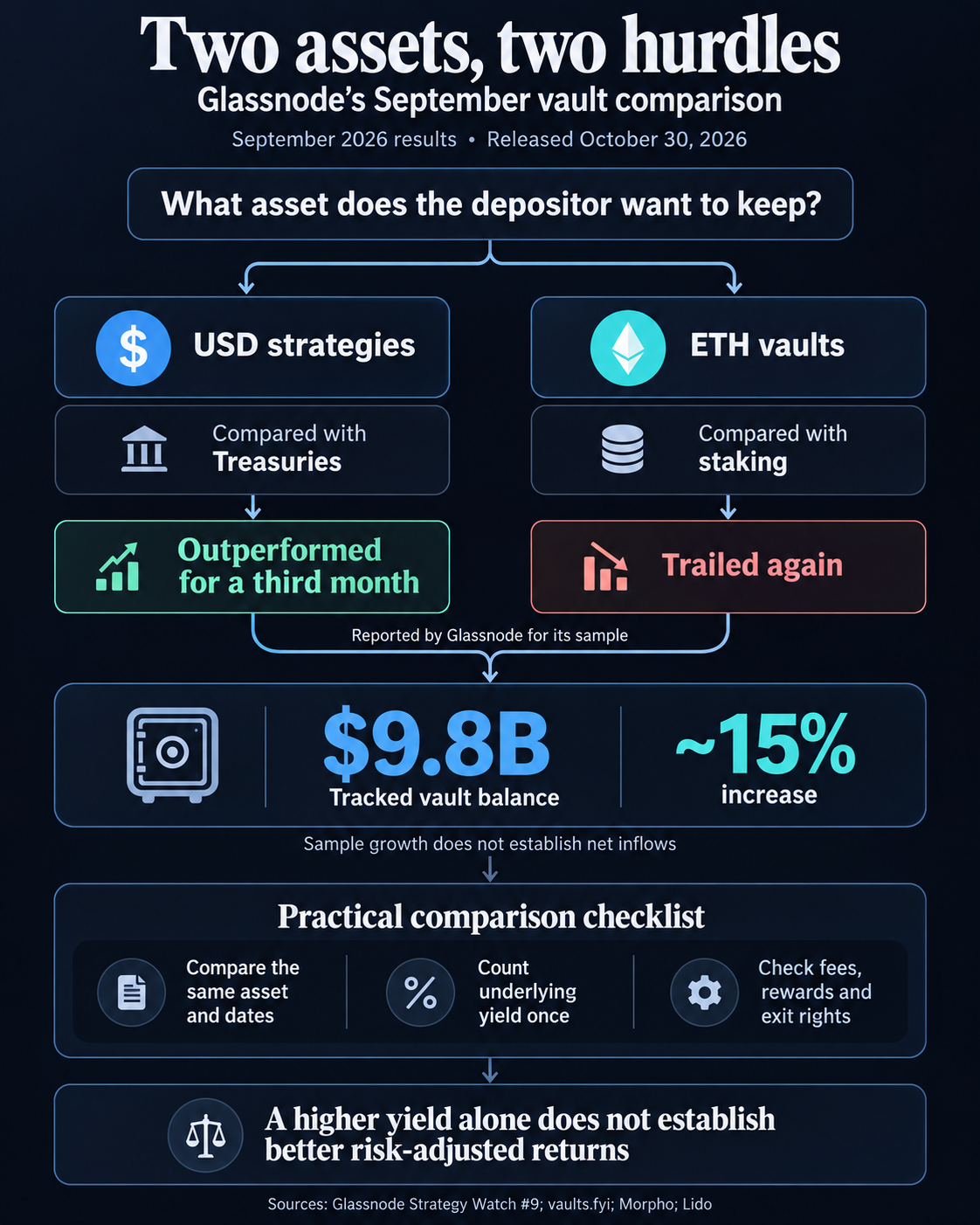
ETH vaults in Glassnode’s September comparison trailed staking even as the balance in its wider vault sample rose about 15% to $10 billion. Curators managing dollar-denominated vault strategies beat Treasuries for a third consecutive month, according to the research firm’s October 30 performance review.
Vaults pool deposits into yield strategies overseen by curators, or managers. The split puts a practical question ahead of the advertised yield: what could the depositor have earned while keeping the asset they already wanted to own? For an ETH holder, earning more tokens through a managed strategy is useful only in relation to alternatives such as staking. A dollar saver faces a different comparison.
Glassnode’s balance figure, its highest since November 2025, describes the vaults represented in its data. It does not establish whole-market growth or isolate how much came from new deposits, changing asset values or changes in coverage. A growing pool of assets and a strategy that beats its benchmark are separate findings.
The benchmark depends on the asset you hold
A depositor who intends to retain ETH exposure is choosing how to put that holding to work. Comparing an ETH vault with staking preserves that starting decision. Comparing it with a dollar interest rate also introduces a decision about whether to hold ETH at all.
CryptoSlate’s October 24 staking analysis made that distinction between accumulating tokens on an existing holding and shopping for cash income. Glassnode’s new September comparison brings the question inside managed DeFi: did the additional strategy deliver more than staking?
The ETH vaults in Glassnode’s comparison did not clear staking’s return hurdle. That makes the relevant test the return above staking, after allowing for the vault’s additional risks.
The dollar result carries a different implication. Beating Treasuries shows a return premium against that comparator, but says nothing on its own about whether the premium adequately paid for the vault’s additional risks. The next question is what generated the income and what could interrupt access to the money.
The yield-data provider vaults.fyi’s benchmark explainer separates USD and ETH yields by network. Its current methodology weights up to five of the largest qualifying vaults by their total value locked, with a $1 million minimum for each. Its legacy Ethereum mainnet ETH benchmark instead uses four fixed liquid-staking tokens.
The construction matters: those series cannot be assumed to be Glassnode’s staking comparator. Currency and return dates must match before any return gap can be measured.
Count staking yield once, and fees once
The accounting is particularly consequential for strategies built on liquid-staking assets. Part of the total return can come from the underlying staking position and part from what the vault does with it. Treating the strategy’s extra yield as the entire ETH return can understate performance; adding staking again to an inclusive total can overstate it.
Vaults.fyi’s APY methodology distinguishes fully compounded total yield, including underlying protocol yield, from intrinsic yield earned by the underlying asset alone. Its March product update described that separation as a way to distinguish the asset’s earnings from the strategy’s contribution.
The same discipline applies to costs. Vaults.fyi derives trailing annualized yields from onchain share-price changes and accounts for fees already reflected in share prices or accrual. Subtracting those fees again would understate the reported return. Separately valued reward-token emissions can add to the total, so the base return and incentives also need to be distinguished.
Even that split can require looking beneath a wrapper. In its separate census using data as of August 20, vaults.fyi identified cases where wrapper-level base yield contained downstream rewards. An apparently incentive-free return at the first layer can therefore still depend on incentives further along the allocation chain.
Later yield tables cannot settle the September comparison. Vaults.fyi’s October 26 ETH snapshot listed Lido stETH at a 2.34% seven-day average APY. That is an annualized rate from a later trailing window, not September’s realized staking return or a matched test of Glassnode’s vault cohort.
Morpho’s October 8 ecosystem report said more than $11 billion sat in curated vaults. That broader category is separate from Glassnode’s tracked sample.
A vault’s terms can change the value of its yield
For individual depositors, the contract and allocation matter more than a platform total. Morpho’s Vault V2 documentation describes adapters that route funds into underlying strategies and caps that can constrain collateral, oracle or protocol exposures. The enabled adapters, actual allocations and configured limits determine which exposures a user takes.
V2 permits performance fees up to 50% of yield and management fees up to 5% of assets, while distribution wrappers can add another fee layer. Those are configuration ceilings, not actual charges for Glassnode’s sample. The V2 framework illustrates why the version, fee schedule and allocation of each chosen vault matter.


Exit rights add another dimension. Morpho V2’s in-kind mechanisms can exchange vault exposure for an underlying protocol position that may still be illiquid. A penalty of up to 2% may apply, and optional gates can restrict withdrawal rights. Leaving a vault is therefore not always the same as receiving immediately spendable ETH or dollars.
Staking, the ETH comparator, has constraints too. Liquid-staking protocol Lido’s withdrawal process uses a first-in, first-out queue, with waits depending on available ETH, queue demand and validator exits. Users remain exposed to slashing while queued. Selling stETH on a secondary market provides another route, but the execution price can differ from ETH.
That makes the September split a starting point for judging managed DeFi. Dollar curators cleared their reported Treasury hurdle while the ETH vault comparison failed to clear staking’s. For a depositor, the remaining test is whether the return above the relevant alternative survives the actual fee and incentive accounting and compensates for the specific collateral, contract and exit risks taken to earn it.