




Key takeaways
- Microsoft has reportedly declared a “Code Red” to overhaul its engineering and crisis response after a global outage on November 12-13 that lasted about 24 hours.
- Coinbase’s May outage was traced to a cooling failure in an AWS data center: all five matching engine nodes were in the same building, and three went offline, disrupting trading, deposits and withdrawals for about eight hours.
- Moving assets off exchanges does not remove the reliance on centralized infrastructure, because wallets often depend on third-party RPC providers rather than the user’s own node.
- The issue is not that crypto firms use the cloud but whether they have credible alternatives when it fails, as more assets move onto blockchains.
Microsoft has reportedly declared a “Code Red” initiative to overhaul its engineering and crisis response following a global service outage that lasted approximately 24 hours. For an industry built around the idea of decentralization, crypto has good reason to pay attention.
According to internal memos reviewed by Reuters, the technology giant is reconsidering how it prevents and responds to major infrastructure failures after its November 12-13 outage disrupted businesses, government operations and financial firms.
Crypto likes to position itself as an alternative to centralized infrastructure. Yet some of its largest businesses depend on the same handful of cloud computing companies, and the consequences of that reliance have already been felt by traders.
How A Cooling Failure Brought Coinbase Trading To A Halt
In May, Coinbase experienced an infrastructure failure that demonstrated how surprisingly fragile access to cryptocurrency markets can be.
The exchange’s official incident report, published on June 1, traced the disruption to a cooling equipment failure inside an Amazon Web Services (AWS) data center.
Coinbase had five matching engine nodes located within the same building. Three went offline during the incident, leaving the system without enough functioning nodes to operate normally.
The exchange had not implemented an automated mechanism to switch its matching engine to another availability zone.
A separate failure involving AWS’s managed event-streaming infrastructure complicated the recovery further.
For approximately eight hours, customers experienced severe disruptions affecting trading, deposits and withdrawals. Restoring the remaining systems took roughly another 12 hours.
“
“The duration of the outage is unacceptable to us,” Coinbase acknowledged in its subsequent investigation.
Coinbase · June 1 incident report
This was not the first time the exchange had encountered such problems. An AWS outage in October 2025 resulted in three hours and 17 minutes of degraded performance for Coinbase customers.
Despite these incidents, the relationship between cryptocurrency businesses and cloud providers continues to deepen. More recently, Coinbase and AWS partnered to bring x402 payments to CloudFront publishers, bringing blockchain-based payments into existing web infrastructure.
The uncomfortable part is that the blockchains themselves did not need to fail for customers to lose access to exchange services.
A decentralized settlement network is of limited immediate use to someone whose assets are sitting inside an exchange they cannot access.
Your Crypto Wallet May Be Less Decentralized Than You Think
Moving assets away from centralized exchanges does reduce some of these risks. However, it does not necessarily eliminate reliance on centralized infrastructure.
Consider an Ethereum wallet.
When a user opens the application to check their balance or send a transaction, the wallet generally communicates with an Ethereum node through a remote procedure call, commonly known as an RPC.
That connection allows the application to retrieve blockchain information and submit signed transactions.
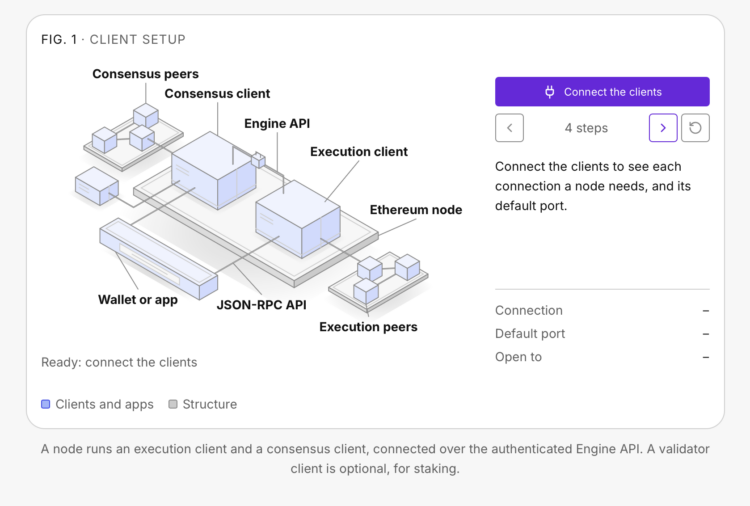
How a wallet app connects to Ethereum through an RPC connection.
Many users rely on infrastructure operated by third-party providers rather than running their own nodes. If the provider becomes unavailable, the wallet may struggle to display balances or broadcast transactions, even while Ethereum continues producing blocks.
In an RPC service outage, the assets can remain intact on the blockchain even when the wallet’s usual connection to the network stops working.
Ethereum’s own node documentation acknowledges that widespread reliance on cloud hosting could introduce a common point of failure.
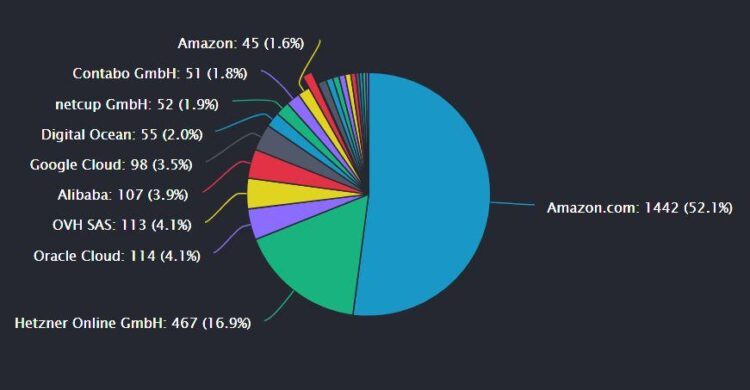
Distribution of Ethereum nodes.
The distribution of Ethereum nodes also raises questions about infrastructure concentration. Having thousands of independently operated nodes does not necessarily eliminate shared dependencies if many rely on the same hosting providers.
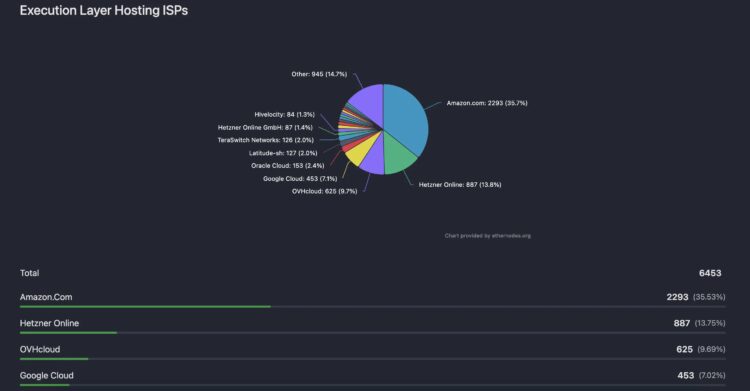
Hosting of Ethereum nodes across providers.
Shared infrastructure can create security risks as well as availability problems. NewsBTC previously covered the debate over verifier and RPC security following the KelpDAO exploit. That incident was an exploit, not a routine cloud outage.
There are alternatives. Users can connect compatible wallets to another RPC provider or operate their own Ethereum nodes. Developers can also design applications to switch between independently operated infrastructure providers when one becomes unavailable.
But these options are not always obvious to the average person opening a wallet on their phone.
The industry has spent years making crypto easier to use, often by hiding much of its technical complexity. In doing so, it has sometimes reintroduced the dependencies that blockchain technology was intended to reduce.
Centralization Is Sometimes A Deliberate Engineering Choice
It would be easy to criticize every cryptocurrency company that uses Amazon, Google or Microsoft infrastructure. The reality is more complicated.
Coinbase explained that keeping its matching engine nodes physically close together was a deliberate decision intended to meet the speed and capacity requirements of its markets.
Separating those systems introduces communication delays. Running redundant infrastructure also costs money, particularly when companies must synchronize large amounts of financial information across multiple locations.
Cloud computing providers offer considerable engineering resources and operational capabilities that smaller crypto companies would struggle to reproduce independently.
The problem is not simply that crypto businesses use centralized services. It is whether they have credible alternatives when those services fail.
Coinbase subsequently outlined plans to improve recovery across availability zones and conduct regular failover exercises in production environments.
Those are useful commitments, although publishing a recovery plan and successfully executing one during an unexpected outage are two different things.
What Microsoft’s Code Red Means For Crypto
There is no established evidence that Microsoft’s latest initiative was prompted by a failure of cryptocurrency networks. The relevance lies elsewhere.
As financial institutions bring more assets onto blockchains, the reliability of the infrastructure connecting investors to those networks becomes increasingly important.
A tokenized investment fund may exist on a distributed ledger, but investors can still depend on centralized custody providers, banking services, identity verification systems and applications to manage their holdings.
A decentralized exchange may execute trades through smart contracts, but its website and the infrastructure connecting users to those contracts can introduce separate vulnerabilities.
Crypto companies should be demonstrating how their products behave when their preferred infrastructure provider goes offline. Can users still submit transactions? Can traders cancel orders? Can another operator take over without waiting for an engineering team to intervene?
Microsoft’s reported response to its November outage is a reminder that even companies with enormous technical resources can discover weaknesses in systems they previously considered reliable.
Crypto does not need to abandon cloud computing. It needs to stop treating decentralization at the blockchain level as proof that everything built around it is equally resilient.