


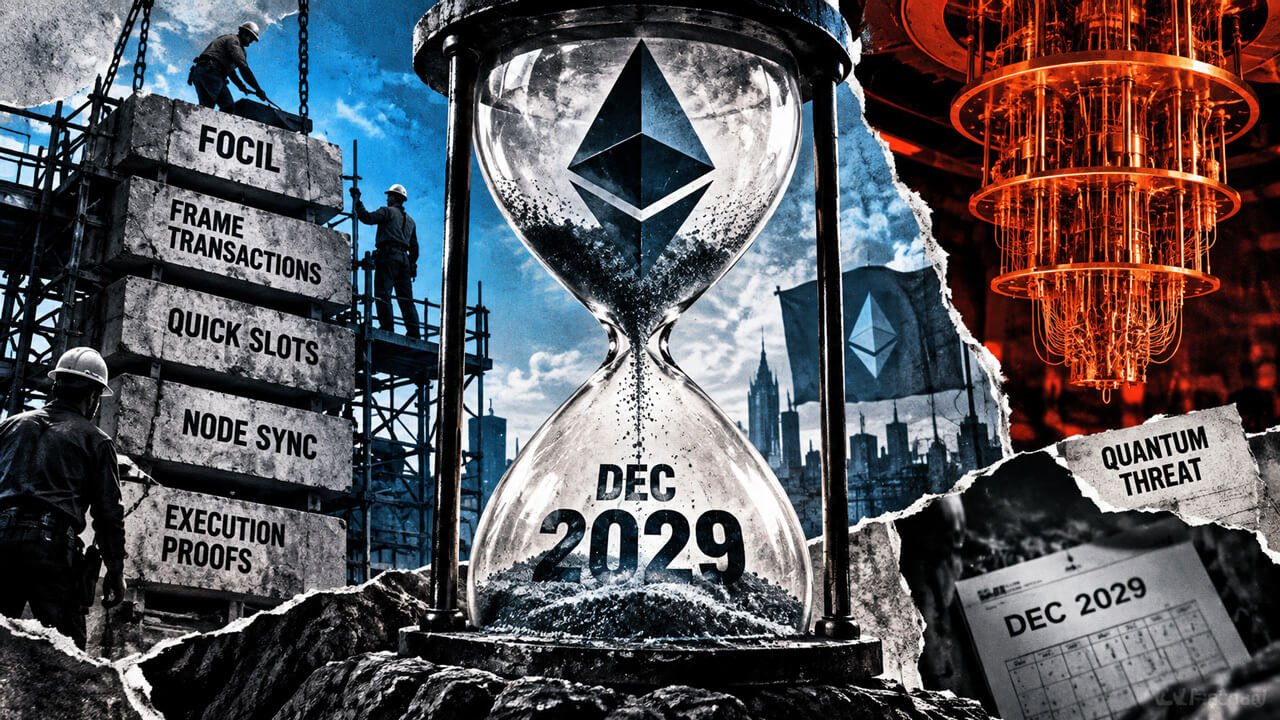



Ethereum is beginning to constrain what it can add to upcoming upgrades as developers race to make the network quantum-resistant by December 2029.
On Sept. 7, the Ethereum Foundation’s Protocol cluster said that the deadline will remain non-negotiable at least until a review with outside experts in January, putting optional features into increasingly direct competition with the engineering work needed to harden Ethereum’s execution, consensus, and data layers.
The trade-off is already emerging in Hegotá, the upgrade being scoped after Glamsterdam. Its two protected headliners are FOCIL, a system designed to strengthen transaction-inclusion guarantees, and Frame Transactions, which introduces a new account transaction model and gives Ethereum a path toward replacing cryptography vulnerable to future quantum attacks.
The Foundation said its appetite for additional consensus-layer work beyond FOCIL is “close to zero” unless it supports the post-quantum roadmap.
A larger trade-off could come next. Developers are considering moving post-quantum attestations forward from the L* upgrade to K* while pushing mandatory execution proofs from K* to L*, accelerating one of Ethereum’s largest remaining quantum-security changes at the expense of the zkEVM timeline.
The swap has not been approved. Its consideration nevertheless shows how a threat still regarded as years away is starting to determine which Ethereum upgrades can make the cut today.
A 2029 deadline leaves little room for missed forks
Ethereum’s target is deliberately aggressive, but it is not being set in isolation.
The Protocol cluster wants Ethereum’s base layer to be quantum-resistant across execution, consensus, and data by December 2029, a date that broadly lines up with post-quantum cryptography migration targets independently set by technology giants like Google, Cloudflare, and Microsoft.
The Foundation is not predicting that a cryptographically relevant quantum computer will arrive in 2030. It instead wants Ethereum to plan around Q-day, the point at which quantum computers could break widely used public-key cryptography, occurring as early as 2030.
While this threat may come later, or may never materialize, the network developers cannot control when advances in quantum computing arrive, leaving the Foundation to work backward from a fixed security deadline rather than wait for greater certainty.
That creates a scheduling problem.
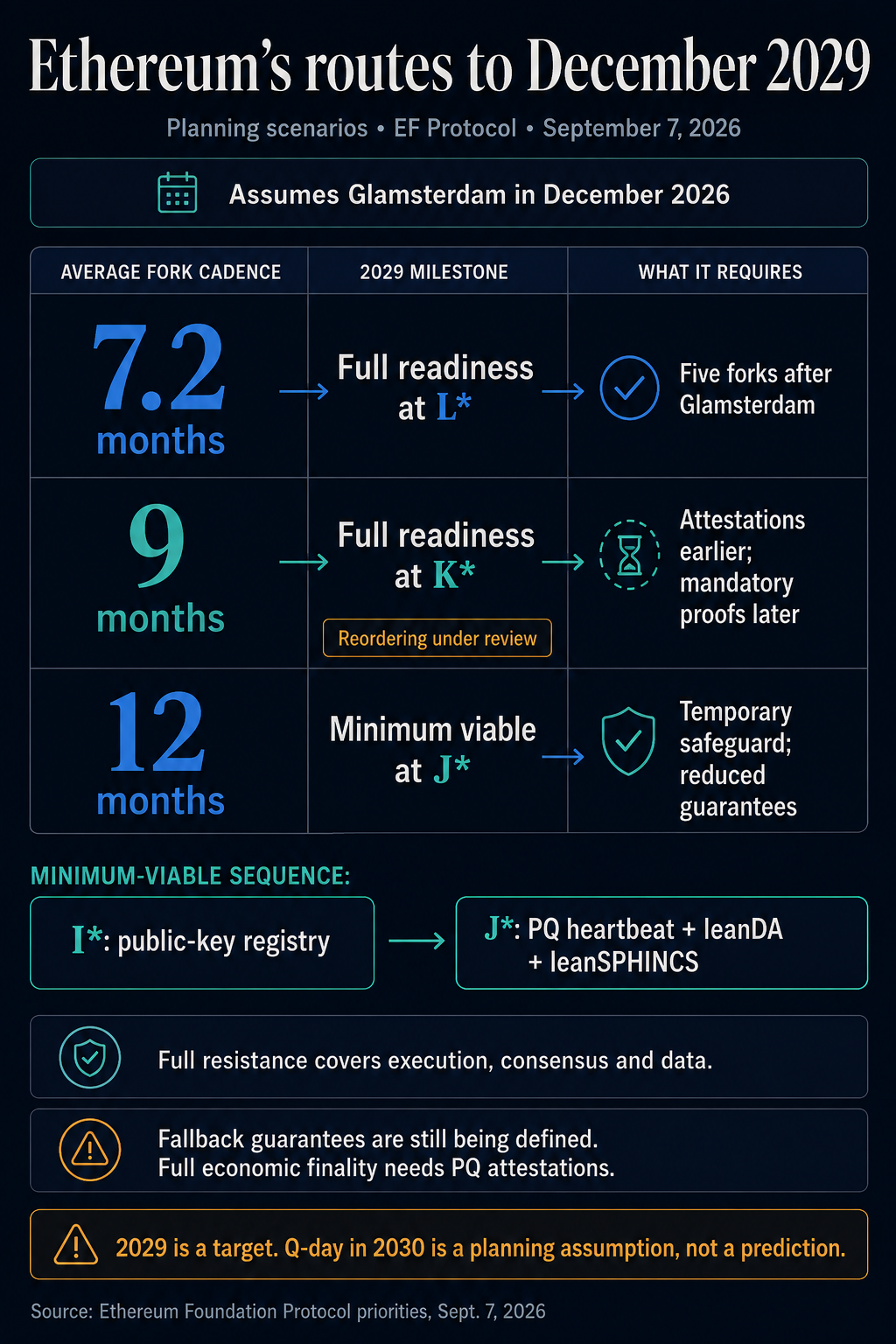
Assuming Glamsterdam reaches mainnet in December 2026, Ethereum’s current planning roadmap places full post-quantum readiness five hard forks later at L*. Reaching that milestone by December 2029 would require upgrades to land every 7.2 months on average, a cadence the Foundation described as aggressive and vulnerable to delays.
“Hegotá is not the PQ fork; it is the fork that decides whether the PQ forks happen on time,” the Protocol cluster said.
Ethereum has built a fallback into the schedule.
A minimum viable post-quantum milestone, or MV-PQ, is planned for J*. That would include a post-quantum consensus heartbeat, leanDA sampling and leanSPHINCS transactions after a public-key registry arrives one fork earlier.
An annual fork cadence could still reach J* by December 2029, but with reduced guarantees. The Foundation describes that milestone as a temporary safeguard intended to let Ethereum keep operating through a potential quantum threat rather than provide full resistance.
Post-quantum attestations needed for full economic finality would still remain outstanding.
Moving those attestations forward to K* could provide a middle path, putting full readiness within reach at roughly nine-month fork intervals while delaying mandatory execution proofs until L*.
That arithmetic is already shaping which features survive Hegotá’s scoping process.
The Protocol cluster evaluated 62 proposals and divided them into tiers. S-tier proposals define the fork and are protected even if the schedule slips. A-tier items are expected to ship but can be cut before the headliners. B-tier proposals must wait until higher-priority features are stable on development networks and then compete individually for whatever capacity remains.
Quick Slots, which would shorten Ethereum’s slot time, sits in B tier despite support from researchers.
Developers are requiring a complete specification, a full prototype, an analysis of downstream effects, and assurance that shorter slots will not complicate the decoupled-consensus design planned for a later fork. Engineering teams warned that changing slot timing affects assumptions throughout the protocol and wider ecosystem.
Independent consensus and execution-layer syncing faces a similar hurdle. The proposal could roughly halve some synchronization bandwidth by avoiding duplicate payload downloads, but developers are still weighing it against a simpler alternative and looking for a clear delivery owner.
Neither feature has been formally delayed. Their inclusion increasingly depends on whether they can clear those requirements without consuming engineering capacity needed for the post-quantum sequence.
Ethereum wants flexibility before choosing the cryptography
The squeeze does not mean every proposal carrying a post-quantum label automatically moves to the front of the queue.
Hash-Chain RANDAO remains B-tier because developers fear hardening one part of consensus before the broader quantum-resistant architecture is settled could create rework.
A proposal to add ML-DSA verification precompiles ranks even lower. The Foundation considers committing Ethereum to a specific post-quantum signature scheme at this stage premature, particularly while cryptographic standards and the network’s longer-term architecture continue to develop.
Frame Transactions avoids some of that problem.
The new transaction model would make account validation programmable, giving Ethereum what developers call cryptographic agility. Accounts could adopt new signature schemes without requiring a separate hard fork every time the network needs to support another form of cryptography.
That makes Frames useful before Ethereum settles on the exact cryptographic tools it will eventually rely on after Q-day.
Consensus is harder. Validator signatures and other consensus machinery cannot be swapped out account by account, requiring coordinated protocol changes across the network. That helps explain why Ethereum’s coming consensus upgrades face tighter scheduling constraints than some execution-layer protections.
Frame Transactions therefore remains one of Hegotá’s protected headliners.
Its related Keyed Nonces and Recent Roots proposals also received A grades. Keyed Nonces would allow users to share a sender while maintaining separate transaction sequences, while Recent Roots would allow private transactions to reference recent onchain state in a form compatible with FOCIL’s inclusion guarantees.
Optional Execution Proofs also remain A-tier, allowing work on stateless execution and zkVM infrastructure to continue even if the point at which those proofs become mandatory ultimately moves back one fork.
Ethereum plans to overlap much of the remaining work. Hegotá implementation would proceed while specifications for I* mature and researchers prepare components needed for later upgrades, increasing demand for cryptographers, client developers, security reviewers and testing capacity across several workstreams at once.
The next consequential decision is whether developers actually move post-quantum attestations from L* to K* and mandatory execution proofs in the opposite direction.
If they do, teams building toward mandatory execution proofs will have another fork to wait while quantum-resistant consensus moves closer to the front of Ethereum’s roadmap. If they do not, developers will need to sustain a faster upgrade cadence or approach December 2029 with minimum viable protections in place while full economic finality remains unfinished.